

"But it displeased Jonah exceedingly, and he was angry"
— Jonah 4:1
4. February 2026
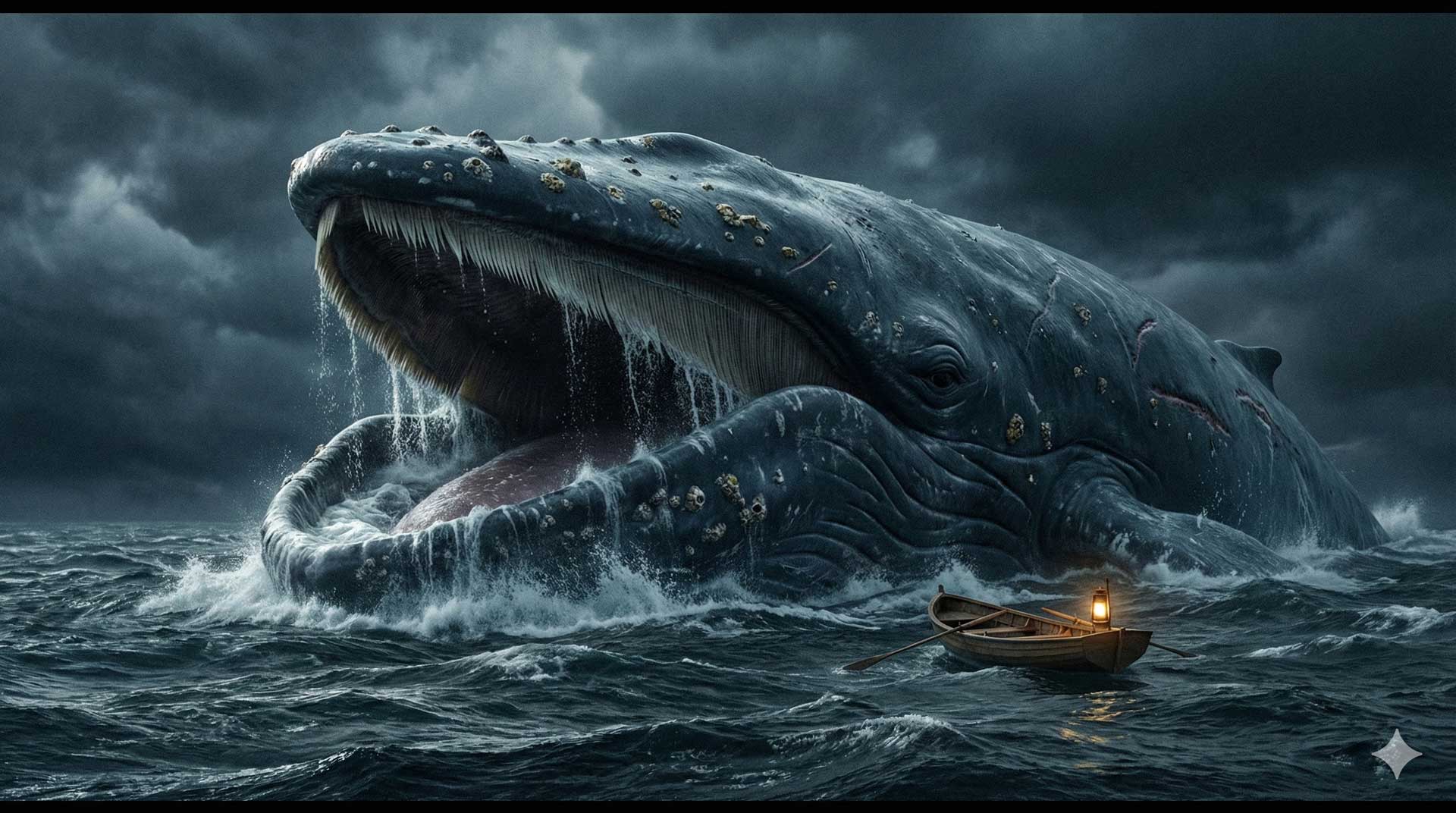
When successful warnings prove the prophet wrong
The prophet who couldn't win
Jonah knew the game. Warn of disaster, get two options:
They listen → You're wrong
They don't → You're dead
He ran. God sent a whale. The structure won.
Every climate scientist, every whistleblower, every safety researcher lives this. Success proves you wrong. Failure comes too late.
Welcome to one of the oldest paradoxical interaction on record.
The Structure
A prophet warns of catastrophe. If the warning works, catastrophe doesn't happen. The prophecy becomes false. Success makes him a liar.
If the warning fails, catastrophe strikes. The prophecy comes true. Failure validates him.
The PI:
- Effective warning = false prophet
- Failed warning = true prophet
- Prophecy only functions through its failure
All Are Rational
God wants repentance. Sends prophet to warn Nineveh.
Jonah refuses. Not from cowardice. From insight. He knows the prophet's career path: deliver bad news → get stoned. So he runs.
God forces him anyway. Storm. Whale. Nineveh. Structural coercion.
Jonah warns, expecting: "They won't listen. I'll be right. Probably dead. But right."
Nineveh listens. Repents. Changes course.
God forgives. Exactly as predicted.
Jonah is furious. Not because he was "wrong." Because the structure made him lose either way:
- They don't listen → Jonah vindicated, probably killed
- They listen → Jonah refuted, God merciful
Everyone acts rationally within their constraints.
None Are at Fault
Jonah understands the system. His competence destroys his credibility. The better he warns, the wronger he becomes.
God is trapped too. Between mercy and justice:
- Mercy requires forgiveness
- Justice demands consequences
- If threats always work, mercy wins
- If mercy always wins, threats become empty
- Empty threats don't work
- Therefore: must sometimes destroy
- But doesn't want to
Solution? Send Jonah. Let the prophet pay the structural price. God remains merciful. Jonah absorbs the paradox.
Nineveh? Acts rationally on new information. Guilty of nothing except listening.
The structure makes effective prophecy impossible. No individual causes this. The pattern emerges from rational actors in an impossible architecture.
The Layers
Layer 1: The Prophet's PI
Competence creates failure. Effectiveness proves incorrectness. The better the warning, the less true it becomes.
Layer 2: God's PI
Omnipotence confronts self-imposed constraint. Can an all-powerful God create a structure that binds himself? If yes: not omnipotent. If no: not omnipotent.
Mercy + Justice = structurally incompatible. Every choice invalidates one attribute.
Layer 3: The Meta-Uncertainty
Is God architect or prisoner of this structure?
Both readings work:
God knows: Designs the paradox deliberately. Sacrifices prophets for theological purposes. Ultimate system architect.
God doesn't know: Caught in his own creation. Omnipotence meets logical impossibility. First victim of his own design.
Cannot determine which. That's the point.
Modern Echoes
Every climate scientist: Warns of catastrophe. If heeded, predictions don't materialize. Critics claim "See? Alarmist." If ignored, validated posthumously.
Every AI safety researcher: Points to risks. If prevented, "You were wrong—nothing happened." If realized, too late to say "Told you so."
Every whistleblower: Exposes structural problems. If fixed, "Made much ado about nothing." If unfixed, vindicated and fired.
Every pandemic warning: Prevented disaster proves overreaction. Realized disaster proves incompetence ("Why didn't you warn us louder?").
Cassandra always right. Cassandra always loses.
Why It Persists
The structure protects itself:
Successful warnings get retroactively discredited. "Nothing happened—you exaggerated."
Failed warnings get retroactively dismissed. "You should have warned us better/earlier/differently."
The prophet cannot win. The system requires their sacrifice to function.
No one intends this. Decision-makers want good information. Prophets want to be heard. Citizens want to know. Collectively they create a structure where effective warning becomes structurally impossible.
Navigation (Not Solution)
Recognize the pattern. You're Jonah. Accept it.
Warn anyway. Not because it works. Because it's structurally necessary.
Don't expect vindication. Success means being proven wrong. Failure means being ignored. Choose failure mode consciously.
Document everything. The pattern repeats. Next Jonah needs the map.
Try and continue. It won't get better. Do it anyway.
The Theological Radical
If God designed this structure deliberately, that's not cruelty. That's genius.
Creating freedom through structural impossibility. Building agency on paradox. Making prophecy work through its failure.
Not bug. Feature.
Perhaps faith doesn't survive despite the paradox. Perhaps it emerges because of it. Only a God who thinks in paradoxical structures could create a world where genuine freedom and genuine consequence coexist.
Religion without PI is naive.
PI without religious humility is arrogant.
Maybe God was the first PI practitioner.
"Try and continue"—as creation principle.
Peter Senner
Thinking beyond the Tellerrand
contact@piinteract.org
www.piinteract.org
Paradoxical Interactions (PI): When rational actors consistently produce collectively irrational outcomes—not through failure, but through structure.