
"Where is the wisdom we have lost in knowledge?
Where is the knowledge we have lost in information?"
— T.S. Eliot, The Rock (1934)
6. February 2026
Peter Senner co-created with Claude
A Paradoxical Interaction in Three Acts
Act I: The Formula
In 2004, Roger Penrose published The Road to Reality, a 1,100-page journey through the mathematical foundations of physics. On one of its pages, he printed the full Lagrangian density of the Standard Model of particle physics — every term, every coupling constant, every index — sprawled across an entire page like a mathematical fever dream.
His point was not admiration. It was dismay.
Penrose printed the formula because it was ugly. Because something this bloated, this unwieldy, this baroque could not possibly be the final description of reality. The formula was his exhibit A in the case against the Standard Model as fundamental truth. A rhetorical device. A warning.
It described everything — except gravity. It predicted particle masses — except it didn't, because the masses had to be inserted by hand. It was simultaneously the most successful and most incomplete theory in the history of physics.
Penrose's message: We can do better. We must do better.
Act II: The Tweet
Twenty years later, someone posts the formula on Twitter/X. No context. No attribution. No mention of Penrose's argument. Just the image — vast, intimidating, magnificent — with an implicit message: Look at this. Look at how much we know. Look at how brilliant this is.
The tweet goes viral. Thousands of impressions. Hearts. Retweets. Bookmarks from people who will never open them again. The formula becomes what the internet does best with: a signifier of intelligence, stripped of meaning.
The poster acted rationally. Sharing impressive content signals competence and earns social capital. The platform rewards this with reach.
The audience acted rationally. Engaging with awe-inspiring content feels like learning. It satisfies curiosity at zero cost.
The algorithm acted rationally. It measured engagement and delivered more of what worked.
And the collective result? Penrose's critique of the Standard Model became an advertisement for it. His argument against intellectual complacency became a vehicle for intellectual complacency. The meaning didn't just get lost — it got inverted.
Act III: The Correction That Nobody Sees
Somewhere in the replies, someone writes: "Actually, Penrose printed this to show how inelegant it is." A handful of characters that restore the original context. The complete correction.
It gets three likes.
This is not a failure of individuals. The corrector acted rationally too — sharing knowledge, adding nuance, doing what good discourse demands. But the platform's structure ensures that correction and context are systematically demoted relative to spectacle and simplification. Not by conspiracy. Not by design flaw. By the perfectly logical operation of engagement-optimized systems.
The Paradoxical Interaction
Every actor in this system behaves reasonably:
- The poster shares something genuinely remarkable
- The audience engages with something genuinely impressive
- The algorithm promotes what people genuinely respond to
- The corrector provides what the discourse genuinely needs
No one is lying. No one is malicious. No one is stupid. Every individual action makes sense.
And yet the system produces the structural opposite of its intended function: a communication platform that systematically miscommunicates. A knowledge-sharing network that strips knowledge of its meaning. A signal of intelligence that functions as an engine of misunderstanding.
All are guilty. None are at fault.
The formula that was meant to say "this isn't good enough" now says "look how good this is."
And the architecture that enables this inversion is not a bug in the system.
It is the system.
Why This Matters Beyond Twitter
This is not a story about social media. Social media merely makes the structure visible.
The same paradoxical interaction operates in peer review (where rigour and novelty are structurally opposed), in democratic discourse (where informed nuance and electoral success are structurally opposed), in corporate governance (where long-term thinking and quarterly reporting are structurally opposed).
Wherever rational individual actors operate within systems that aggregate their actions through metrics that cannot capture meaning, you will find Penrose's formula being tweeted without Penrose's point.
The Standard Model describes all fundamental forces except the one that holds everything together.
The tweet communicates everything about the formula except what it means.
The platform connects everyone to everything except understanding.
These are not failures. These are paradoxical interactions — structural outcomes that no participant intended and no participant can unilaterally prevent, because the structure itself transforms correct inputs into incorrect outputs.
This example was identified on February 6, 2026, when someone posted the Standard Model Lagrangian from Penrose's "The Road to Reality" on X/Twitter without context — inadvertently creating a perfect demonstration of Paradoxical Interaction in real time.
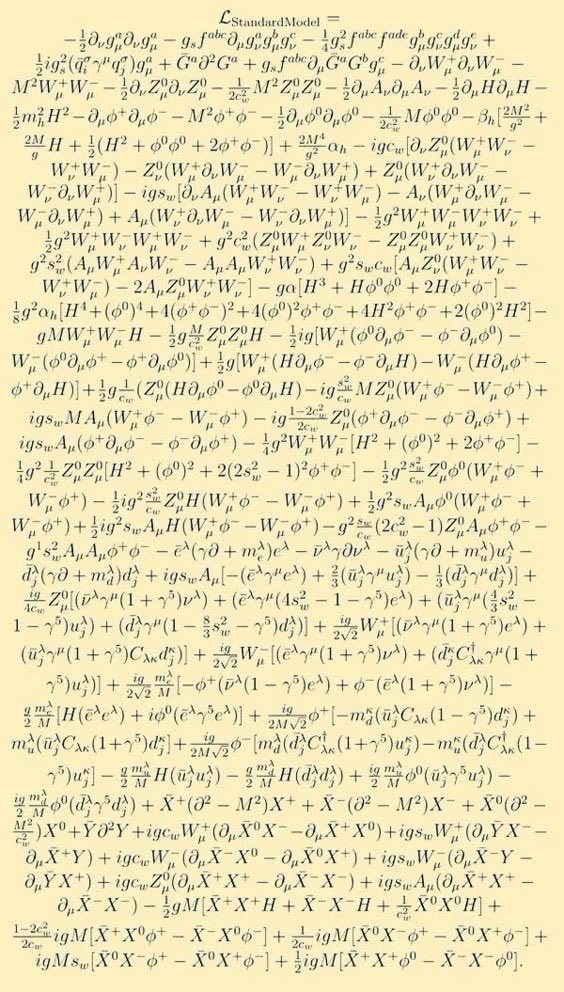
The same formula:
ℒ = −¼ F_μν F^μν + iψ̄Dψ + h.c. + ψ_i y_ij ψ_j φ + |Dφ|² − V(φ)
Postscript: Would Penrose Approve?
Roger Penrose is a mathematical Platonist. He believes in objective truth independent of observers. He would almost certainly reject the notion that correct and incorrect can exist in superposition. He would say: there is a right answer; we simply cannot see it from inside the system.
By expressing opposition, he would have expressed endorsement.
— Peter
Related Posts:
Structural sacrifice mechanisms:
Win the position. Guarantee your death. Repeat the Pattern forever.
Warnings that fail:
Or: The Equality Paradox
— Why asking AI how to align AI is the perfect paradox
On piinteract.org:
- [Anti-Practices] — "Transparency Creates Trust" and other patterns that strengthen PI
- [Example: AI Alignment] — The technical dimension of structural impossibility
- [Core Practices] — "All are guilty. None are at fault"
Paradoxical Interactions (PI): When rational actors consistently produce collectively irrational outcomes—not through failure, but through structure.
Peter Senner
Thinking beyond the Tellerrand
contact@piinteract.org
www.piinteract.org