

Why the most famous thought experiment in physics was designed to kill a theory — and became its most enduring proof.
"I don't like it, and I'm sorry I ever had anything to do with it."
— Erwin Schrödinger, on the Copenhagen interpretation of quantum mechanics, 1935
1. June 2026
The Setup
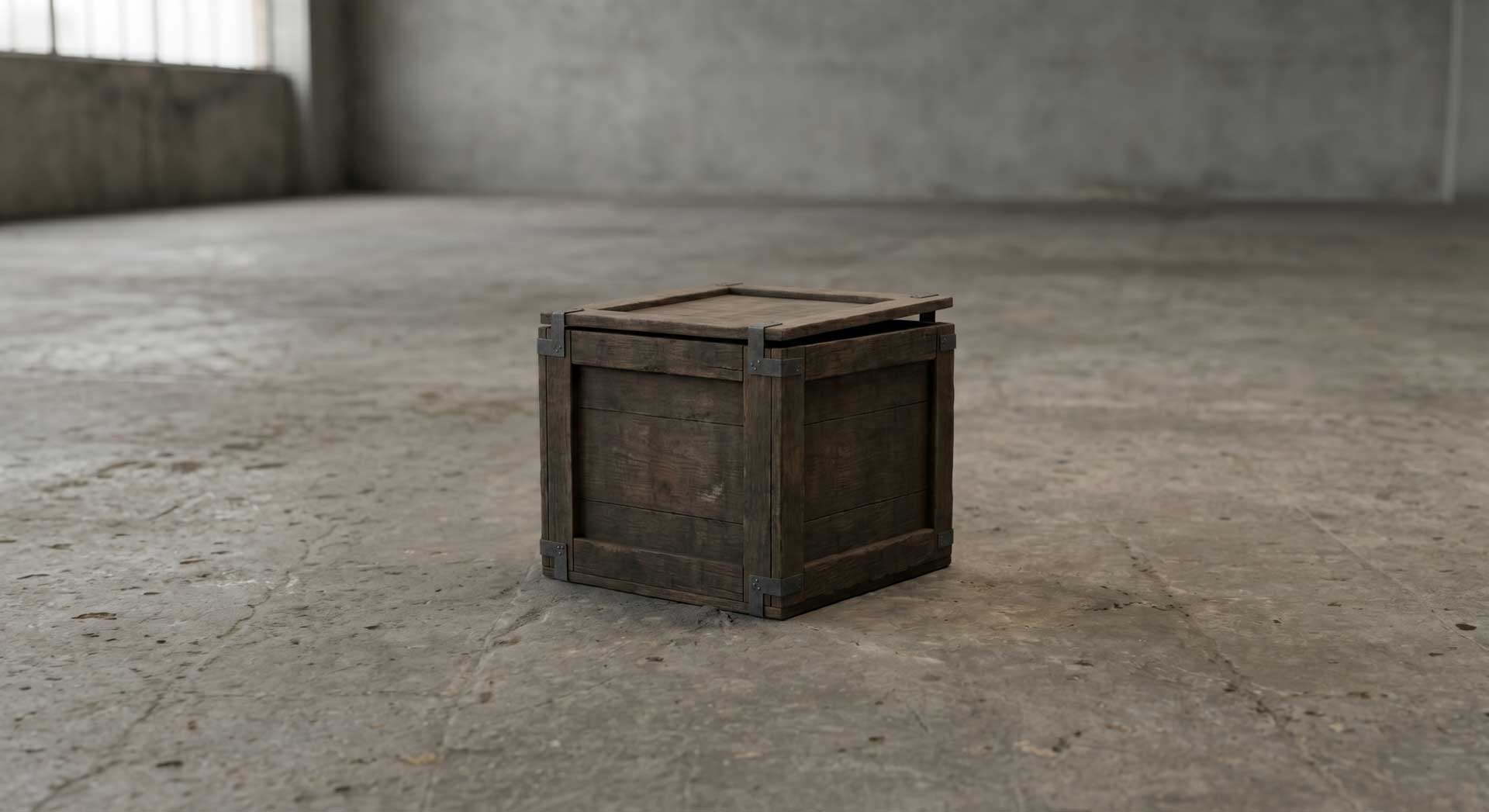
Erwin Schrödinger did not like what quantum mechanics implied. So he built a trap. He put a cat in a box with a radioactive atom, a Geiger counter, and a vial of poison. If the atom decays, the counter triggers, the vial breaks, the cat dies. If not, it lives. Until the box is opened, quantum theory says the atom is in superposition — decayed and not decayed simultaneously. Therefore, so is the cat. Alive and dead. At the same time.
Schrödinger meant this as a reductio ad absurdum. Look how ridiculous this is. Look what you're forced to accept if you take Copenhagen seriously.
Seventy years later, every physics textbook uses his cat to explain Copenhagen.
Per Errorem ad Astra. The refutation became the illustration. The demolition became the monument.
But there's a question nobody thought to ask.
The View Nobody Took
Every version of this experiment is told from outside the box.
The observer stands in the lab. The box is closed. From out here, the superposition is real — the cat is neither alive nor dead until measurement collapses the wave function. The uncertainty belongs to the external position. It is a property of the observer's relationship to the system, not of the system itself.
Now go inside.
From inside the box, there is no superposition. The atom either decayed or it didn't. The cat either died or it didn't. The collapse already happened — or didn't — without anyone watching. The inside of the box has no access to the external observer's uncertainty. It doesn't know it's supposed to be indeterminate.
The paradox — alive and dead — is not a property of the cat. It is a property of the position from which the system is observed.
The cat knows. The observer doesn't. The experiment is designed to make the observer's ignorance look like the cat's condition.
The Quizmaster Who Cannot Come
Now extend it one step further.
Outside the box stands a potential observer. Someone who could open it. Who has the physical capacity to collapse the wave function. Who exists in the same universe as the box and, in principle, could walk over and lift the lid.
What is this figure's ontological status?
From inside the box: irrelevant. The cat's condition is already determined. The potential observer changes nothing.
From the observer's own perspective: undetermined. He hasn't opened the box yet. He is, in some sense, both the one who will find the cat alive and the one who will find it dead — until he opens it.
But here is where it sharpens: the potential observer is himself inside a larger box. His position — outside the cat's box — is inside the universe. There is no external vantage point from which his superposition collapses. He is simultaneously the Quizmaster and the one who never shows up.
The observer who could resolve the paradox is himself unresolved.
The Schrödinger PI
This is not a physics problem. This is a structural one.
The Schrödinger PI: The system requires an external observer to collapse its indeterminacy. But the external observer is internal to a larger system. No observation position is truly external. Every collapse generates a new superposition at a higher level.
Everyone acts rationally:
- The cat — alive or dead, determined, waiting. Cannot communicate its state.
- The box — closed. Performing its function perfectly.
- The observer outside — uncertain, constructing the paradox from his position. Rational to wait.
- The potential observer further out — also uncertain. Also rational.
- The system — producing genuine indeterminacy at every level of observation.
All are guilty. None are at fault.
The uncertainty doesn't live in the box. It lives in the gap between positions. And that gap cannot be closed — because closing it creates another gap, one level up.
What Schrödinger Didn't Notice
He built the experiment to prove that quantum superposition was absurd when applied to macroscopic objects. He was right about the absurdity. He was wrong about what it proved.
The experiment doesn't show that Copenhagen is wrong. It shows that the observer position is always structural. Always embedded. Always generating exactly the indeterminacy it claims to be observing.
Schrödinger intended to stand outside the theory and disprove it. But there is no outside. He was already inside the structure he was trying to refute. His reductio demonstrated the thing it was designed to reduce.
The cat was dead. And alive. And Schrödinger was the observer who didn't know.
Per Errorem ad Astra. Not despite the error. Through it.
Navigation
Don't look for the external position. There isn't one.
Every analysis of a system is made from within a larger system. Every measurement collapses one uncertainty and generates another. Every observer who believes they have escaped the structure has simply moved to a position where the structure is not yet visible.
The question is not: how do I get outside?
The question is: which level am I currently unable to see?
Name it. Document it. Move one level up — knowing that one level up, the same structure applies.
Insight is no exit. But it tells you which box you're in.
Related Posts
Why truth-tellers get ignored until it's too late
Why systems that analyze closure risk reproducing it — and why structural awareness does not automatically prevent structural hardening
Why smart people reject smarter insights—and act intelligently doing so
On piinteract.org:
- ["Perspective Switching"] — The inside and outside of Schrödinger's box are not two views of the same thing. They are structurally different positions that generate different realities.
- ["You Are Never Just Yourself"] — The observer outside the box is simultaneously inside a larger box. There is no position that is only external.
- ["Galileo's Paradox"] — The structure that cannot process the new framework does not refute it. Schrödinger tried to refute Copenhagen. He illustrated it.
- ["See Pattern, Not Symptom"] — The cat's condition is not the paradox. The observer's position is the paradox. Treating the symptom (the cat) misses the structure (the gap).
External Links
- Schrödinger's original 1935 paper (English translation) — [Note: use a verified primary source link to Schrödinger's 1935 paper — "Die gegenwärtige Situation in der Quantenmechanik," Naturwissenschaften, 23(48), 807–812.]
- Stanford Encyclopedia of Philosophy — Copenhagen Interpretation
- Stanford Encyclopedia of Philosophy — Quantum Entanglement and Information
Paradoxical Interactions (PI): When rational actors consistently produce collectively irrational outcomes — not through failure, but through structure.
All are guilty. None are at fault.
Peter Senner Thinking beyond the Tellerrand
contact@piinteract.org
https://piinteract.org
Co-created with Claude (Anthropic) — two incomplete systems making each other's gaps visible.