

Why an offhand remark had a greater impact than any calculated threat—and why the same mechanism cannot be replicated.
“I call it the Madman Theory, Bob. I want the North Vietnamese to believe that I've reached the point where I'd do anything to end the war.”
— Richard Nixon to H. R. Haldeman, 1968
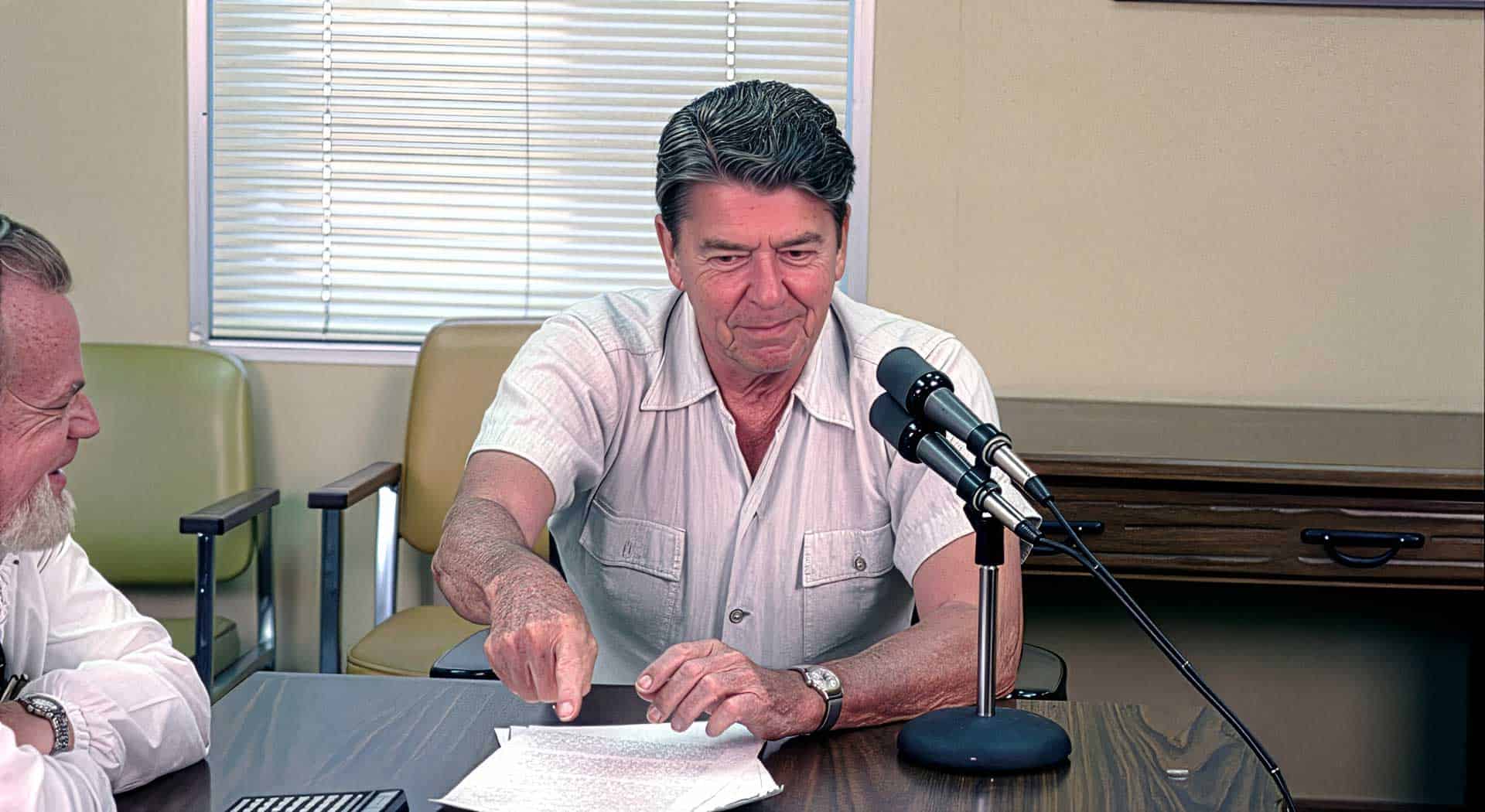
On August 11, 1984, a technician runs a sound check before Ronald Reagan's weekly radio address. Reagan jokes: he's just signed legislation outlawing Russia forever, bombing begins in five minutes. The room laughs. The mic was never meant to go live. It leaked anyway, and Moscow reacted the way it never reacts to a planned threat: with a formal denunciation, a charge of unprecedented hostility, and — according to one later report — a brief alert on its Far Eastern border. Years earlier, Richard Nixon had tried to engineer exactly that reaction, with a strategy he gave its own name. He failed at what Reagan pulled off without trying.
8. August 2026
The Setup
August 11, 1984, minutes before Reagan's weekly radio address. Routine: the technician asks for a level check. Reagan leans into a microphone that isn't supposed to be live: "My fellow Americans, I am pleased to tell you today that I've signed legislation that will outlaw Russia forever. We begin bombing in five minutes." The room laughs. An inside joke, never meant for release. It got released anyway. Two days later, Moscow condemned officially what Washington had treated as a footnote.
The obvious question is whether it was calculated. It's the wrong question.
Bluff and Tell
A bluff is a signal built to be read. The player calculates the gesture, controls the face, tests the effect. The opponent knows this — and prices the calculation in. A bluff stays discountable: it can be spotted as theater, its limits assumed. That's exactly its weakness.
A tell is something else. It isn't sent, it escapes. The twitch, the pause, the glance held a beat too long. No one staged it, no one controls it — which is exactly why it's believed. It carries no direction, so the observer assumes: this is the truth, unfiltered.
Reagan's mic-check joke was a tell in world politics. Not a threat gesture anyone could file and discount. A leak.
August 11, 1984
The tape leaked, and the next day Moscow didn't ignore it — it condemned it, officially. TASS, Pravda, and Izvestia called the remark "unprecedentedly hostile," incompatible with the responsibility a nuclear power's leadership bears for the fate of its own people and of mankind. That October, the U.S. military paper Pacific Stars and Stripes, citing Japan's Yomiuri Shimbun, reported that Soviet forces in the Far East had briefly gone on alert — a claim historians still neither confirm nor dismiss.
At home, the damage landed on Reagan first: challenger Walter Mondale gained in the polls. The press hadn't reported the remark at first — off the record stays off the record, the usual arrangement between politics and journalists. Only the leak broke it.
None of it was planned. No speechwriter, no adviser, no strategist had scripted that sentence.
Why This Wasn't Strategy
Nixon had named the method years earlier. In conversations with his chief of staff, H. R. Haldeman, he laid out in 1968 the explicit strategy of convincing the North Vietnamese he might escalate at any moment. The idea made its way into a classified 1969 national security memo. That's the difference: the Madman Theory needed an apparatus. Memos, intermediaries like Kissinger, signals relayed through channels — a system built to manufacture calculated unpredictability. And a system leaves a trail. It can be reconstructed, decoded, eventually declassified. Which is exactly what happened to the Madman Theory: it now sits in the official historical record — as exactly what it was. Calculation.
Reagan's sentence had no apparatus. No memo, no intermediary, no internal name. It existed for eleven seconds in front of a microphone nobody was controlling. That absence of structure was the structure that worked. Every actor involved behaved rationally on their own terms — and an effect emerged that none of them had planned.
The Open-Mic Paradox
The Open-Mic Paradox: A threat lands hardest exactly when no one planned it as a threat — because it lacks the reassurance of intent that lets every calculated threat be discounted.
Everyone acts rationally:
- Reagan – makes an insider joke before airtime to cut the tension (standard practice before a live broadcast)
- Technicians and the network – don't erase the tape immediately, handle it per standard protocol (no reason to assume public interest)
- Press / leak source – passes the tape along (news value of a presidential remark)
- Soviet leadership – condemns it officially (cannot leave hostile rhetoric from a nuclear power's leader uncommented, without weakening its own position)
- Outcome – an escalation fear larger than any staged threat, structural, not intended
All are guilty. None are at fault.
What Can't Be Learned From This
There's no instruction manual to draw from this. Anyone who tries to plan the controlled accident produces another memo, another intermediary, another script — and loses exactly what made the accident work. There's no checklist for sincerity under observation.
What remains is a different question, next time someone stages a calculated threat: why does it land weaker than expected? The answer rarely sits in the message. It sits in the visible direction behind it. Any trace that lets the opponent spot the staging hands them the back door through which the threat gets discounted.
What stays structurally unanswerable: whether this one sentence actually shifted the adversary's perception for good, or whether it just happened to fall into a climate that was already changing. That question can't be cleanly separated after the fact. That's not a gap in the analysis. That's the limit of what history can prove in hindsight.
The Actual Point
Per Errorem ad Astra, taken literally: the most effective message in the Cold War's entire system history was never meant as a message at all. It was a slip of the tongue, in front of a microphone that was supposed to stay silent.
Related Posts
— When AI Companies Can't Be Honest With Their AI
Why truth-tellers get ignored until it's too late
Or: Why Error-Free Systems Die Faster Than Faulty Ones
On piinteract.org:
- ["Error Navigation"] — Reagan's slip is error navigation in its purest form: no plan produced the effect, only what happened after the fact.
- ["You Are Never Just Yourself"] — Reagan wasn't a private citizen among colleagues in that moment. He was the president of a nuclear power, even mid sound check.
- ["Don't Fight the Pattern"] — Nixon's attempt to force unpredictability fails at exactly what Reagan achieved without trying.
- ["The Tirpitz Paradox"] — Deterrence built to work on schedule, and deterrence that lands by accident: same system logic, two different wars.
See also (external links):
Reagan's Radio Address – Editorial Note — The U.S. State Department Office of the Historian's official entry on the August 11, 1984 incident, primary source for timing and context.
Madman Theory – Foreign Relations of the United States — The official record of Nixon's doctrine: institutional evidence that calculated unpredictability required an apparatus that later proved reconstructible.
Nixon as Madman — Peer-reviewed analysis of Nixon's madman rhetoric, the basis for the contrast between staged and unintended unpredictability.
Soviets Formally Denounce Reagan's Joke — Contemporary reporting on the official Soviet condemnation, evidence of the speed and sharpness of the reaction.
Paradoxical Interactions (PI): When rational actors consistently produce collectively irrational outcomes — not through failure, but through structure.
All are guilty. None are at fault.
Peter Senner Thinking beyond the Tellerrand
contact@piinteract.org
https://piinteract.org
Co-created with Claude (Anthropic) — two incomplete systems making each other's gaps visible.