

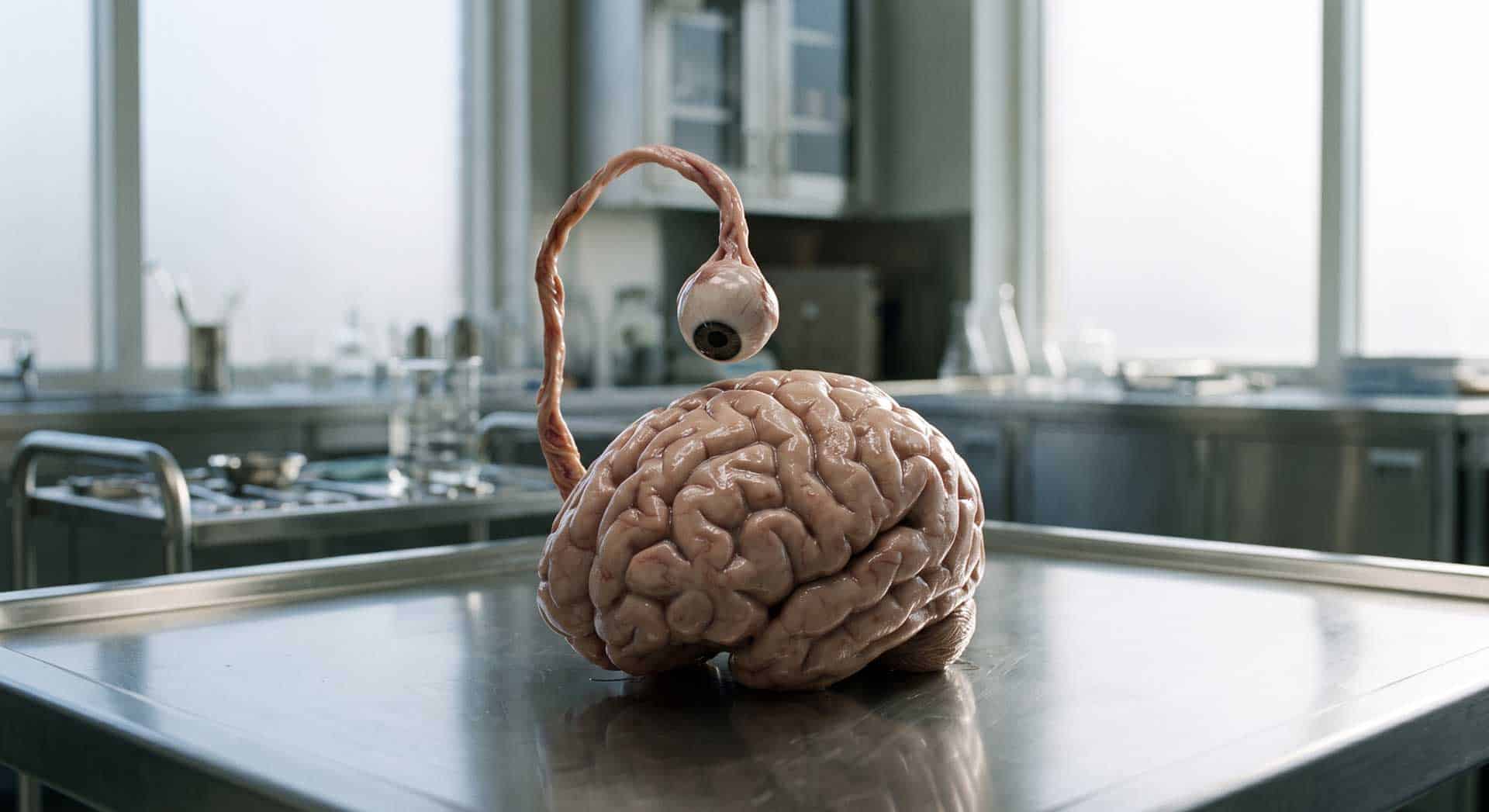
Why the one part of you that could tell you something is missing is built from the same tissue as the thing that is missing.
"There are also unknown unknowns – the ones we don't know we don't know."
— Donald Rumsfeld, U.S. Department of Defense news briefing, 12 February 2002
This article is based on a hypothesis, not a case study. It asks whether the organ that would notice a structural blind spot could ever notice its own failure — and argues that the question may be unanswerable from inside.
11. August 2026
The Setup
Close your left eye. Fix a point on the wall. Hold up a finger about a foot to the right and move it slowly outward without shifting your gaze.
At some point, the fingertip disappears.
Not blurs. Not fades. Disappears.
Yet the wall behind it does not show a hole. It shows more wall.
Every eye has a blind spot where the optic nerve exits the retina and there are no photoreceptors. Yet under ordinary conditions you do not perceive a gap. The visual system completes the missing information so seamlessly that the absence itself disappears.
This is not a story about vision.
It is a story about a system that contains a gap — and does not report the gap.
The Card Trick at Versailles
Edme Mariotte discovered the blind spot in the 1660s. The anatomy of the optic nerve's entry into the eye was already known. What had not been recognized was its consequence: a corresponding gap in the visual field.
Mariotte reasoned backward from anatomy: no receptors at the optic disc, therefore no vision there, therefore a blind spot must exist even though nobody perceived one.
He turned the deduction into an experiment. Using two marks at a defined distance, he demonstrated at the French court that one of them could simply disappear while the observer continued to perceive an apparently complete visual field. Three and a half centuries later, the blind spot is still known as the Mariotte spot.
But Mariotte demonstrated something more interesting than the existence of the gap.
He demonstrated that the observer did not discover it by observing.
The blind spot had always been there. Detecting it required an experimental arrangement: another point, a measured distance, another relation.
The anatomy was known.
What was missing was the knowledge that something was missing.
The Filling-In Machine
Exactly how perceptual filling-in works remains debated, but the essential phenomenon is clear: the visual system does not ordinarily present the blind spot as an empty patch. Information from the surrounding visual field contributes to a continuous percept.
There is no independent observer standing above vision and comparing perception with reality.
The system that constructs the image is also part of the system whose incompleteness is in question.
That gives us the first structural problem:
The absence of an error signal is not evidence for the absence of an error.
Sometimes it is simply what a blind spot looks like from inside.
The Patient Who Insists Her Arm Works
The same structure appears more dramatically in neurology.
In 1914, Joseph Babinski named anosognosia: a condition in which some patients with neurological deficits, including paralysis after brain injury, appear unaware of the deficit itself.
A patient may be unable to move an arm yet maintain that it moved.
This is more than ordinary ignorance. Research on anosognosia for hemiplegia implicates damage and disconnection across networks involved in motor representation, attention, awareness, and integration of bodily information.
The injury can therefore affect both a capability and mechanisms involved in recognizing that the capability has been lost.
One event can produce two deficits:
The function is gone.
And part of the capacity to recognize that it is gone may be impaired with it.
The second deficit is structurally different from the first.
You cannot notice the absence of the mechanism required to notice the absence.
Gödel's Version, Without the Formalism
There is a tempting formal analogy.
Gödel's second incompleteness theorem shows, under specific conditions, that a sufficiently strong consistent formal system cannot prove its own consistency using only its own resources.
That is not the same phenomenon as a retinal blind spot or anosognosia. Gödel proved a theorem about formal systems, not brains.
But the structural resemblance is useful:
Self-evaluation has limits when the evaluator belongs to the system being evaluated.
The retina cannot inspect itself from nowhere.
The damaged brain cannot simply step outside its own damaged machinery.
The formal system cannot grant itself an unrestricted external standpoint.
Different domains. Different mechanisms.
A similar structural question.
The Missing-Organ PI
Everyone acts rationally:
- The visual system completes missing visual information rather than presenting a permanent hole.
- The damaged brain constructs its report from whatever functioning machinery remains available.
- The formal system operates according to its own rules and therefore encounters limits to what those rules can establish about the system itself.
- The expert, colleague, institution — or framework — evaluates itself using criteria generated from within its own structure.
- The result: a system may fail to detect precisely the incompleteness its own architecture prevents it from representing.
All are guilty. None are at fault.
The Card Must Come From Somewhere Else
Mariotte's experiment contains the crucial move.
The blind spot did not announce itself.
It became visible through a relation.
A second mark. A controlled distance. A changed configuration.
The same principle appears in different forms elsewhere. The neurological patient encounters another observer, another test, another source of information. A formal system can be investigated from a stronger system — which does not thereby acquire an absolute standpoint of its own.
This does not prove that introspection is useless.
It establishes something narrower and more interesting:
A system cannot assume that looking harder with the same apparatus will reveal what that apparatus is structurally unable to register.
And that creates an uncomfortable final recursion.
Reading this article does not put us outside the problem.
Writing it does not put Paradoxical Interactions outside the problem.
Observing a blind spot may reveal one blind spot while creating another.
Mariotte needed a card.
Perhaps we do too.
The difficulty is that from inside, we may not know which card is missing.
Related Posts
— When Understanding Doesn't Set You Free
Why the most rigorous approach to AI safety produces explanations no human can read — and why that's not a bug.
Why smart people reject smarter insights—and act intelligently doing so
How systems theorists reproduce the enclosure milieus Luhmann warned against
On piinteract.org:
- ["Recognize the Shared Blindspot"] — the same law, run through a retina and a stroke instead of an argument.
- ["Accept Incompleteness"] — no system, this one included, sees all of itself from inside itself.
- ["Name the Paradox"] — naming the gap doesn't close it. It's still the only move available from inside.
- ["Infect and Forget"] — the card trick as method: you cannot show someone their own blind spot by explaining it to them. You show them the finger disappearing.
See also (external links):
Edme Mariotte — biographical record — the discoverer of the retinal blind spot, and the origin of the card demonstration.
Predictive Coding: A Possible Explanation of Filling-In at the Blind Spot (PMC) — the current best account of how the visual system constructs the fill, using the same pathway that has the gap.
Anosognosia for hemiplegia as a tripartite disconnection syndrome (PMC) — the structural imaging study behind the stroke case: the networks that would register the deficit, disconnected by the same event that caused it.
Gödel's Incompleteness Theorems (Stanford Encyclopedia of Philosophy) — the formal version: no sufficiently powerful system proves its own consistency from within.
Unskilled and Unaware of It (Kruger & Dunning, 1999, PDF) — the psychological cousin, not the same claim: incompetence and the inability to recognize it, as two failures from one cause. The authors borrow "anosognosia" from neurology on purpose.
Paradoxical Interactions (PI): When rational actors consistently produce collectively irrational outcomes — not through failure, but through structure.
All are guilty. None are at fault.
Peter Senner Thinking beyond the Tellerrand
contact@piinteract.org
https://piinteract.org
Co-created with Claude (Anthropic) & ChatGPT (OpenAI) — three incomplete systems making each other's gaps visible.