

Why a sixty-year-old model of black hole evaporation just got corrected by a fiber-optic bench in Paderborn — and why the correction was never about black holes, but about what a boundary is allowed to do to the thing that draws it.
"The message of this lecture is that black holes ain't as black as they are painted."
— Stephen Hawking, Reith Lectures, 2016
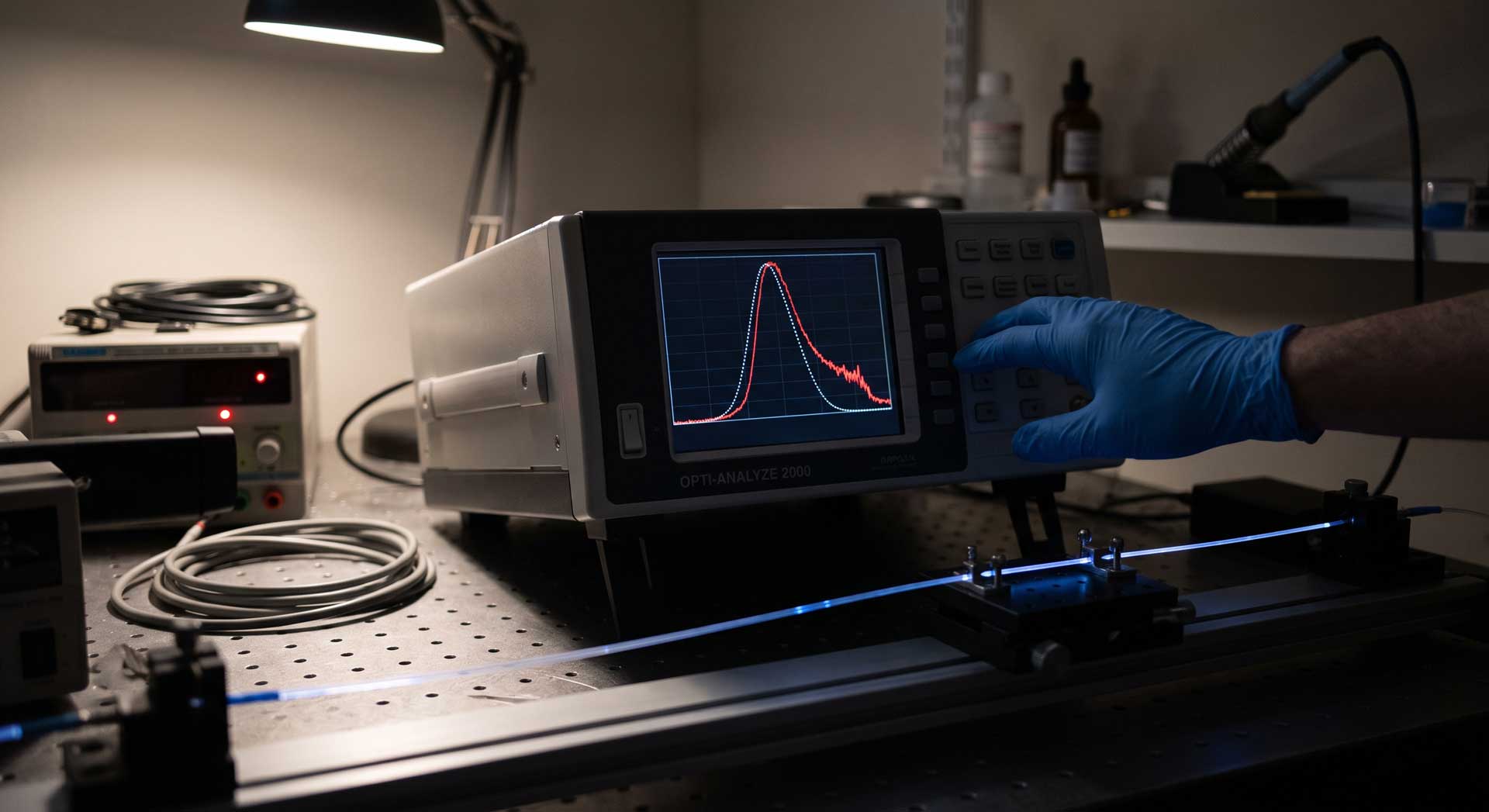
In July 2026, a team led by Lorenzo M. Procopio at Paderborn University, working with Cinvestav in Mexico City and the Weizmann Institute in Israel, published a result in Nature that sounds narrow and turns out not to be. Using a nonlinear optical fiber to build a laboratory analogue of an event horizon — light moving through the fiber the way waves move near a black hole's boundary — they measured something nobody had isolated before: a spectral asymmetry in the pump pulse itself, the pulse that creates the horizon. The pump recoiled. Producing the analogue of Hawking radiation left a measurable mark on the very thing doing the producing.
21. August 2026
The Setup
For real black holes, this recoil is called backreaction, and it's the mechanism by which mass loss actually happens: a black hole doesn't just emit radiation into an unchanged background, it loses mass because emitting the radiation costs it something. Physicists have always known this in principle. What they haven't had, until this experiment, is a system sensitive enough to watch the cost register in real time, on the source, as it happens.
The Assumption the Approximation Smuggled In
The standard toolkit for modeling Hawking radiation is called semiclassical gravity: treat spacetime as a fixed, classical stage, and let quantum fields do their thing on top of it. It's the only version of the problem that's been analytically tractable for fifty years, because coupling gravity to the quantum field self-consistently — letting the stage itself respond to what happens on it — is close to unsolvable in general.
The approximation works. It also has a shape, and the shape is a one-way channel: radiation leaves the horizon, the background stays fixed, backreaction gets added afterward as a correction term, a bookkeeping adjustment to keep the mass ledger balanced. Nothing in the picture requires the horizon to register the emission as it happens. The boundary lets something out. The boundary itself is spared.
That's not a mistake in the physics. It's what "tractable" cost. But a tool built to make a problem solvable has a way of getting mistaken for a description of the problem — and once that happens, the thing the tool couldn't include quietly becomes the thing that was never there.
What the Fiber Found
The Paderborn result reads almost like a rebuke of the shape. The Hawking pair — the two correlated quanta produced at the horizon, one falling in and one escaping — didn't come from a complicated cascade of interactions requiring the usual approximations to untangle. The coupling was biquadratic: a direct, fourth-order interaction between two fields, producing the radiation pair in a single step. And that single step showed up, immediately, as a lopsided shift in the pump pulse's own spectrum. Not later. Not as a correction. At the source, at the moment of emission.
A horizon built to be a one-way membrane turned out, when measured closely enough, to keep a receipt.
The Backreaction PI
Whoever models a boundary as a channel that lets something out while leaving the system that drew the boundary untouched has not simplified the physics. They have written the interaction out of the model — and then rediscovered it later as a correction, a recoil, a surprise.
Everyone acts rationally:
- Theorists working semiclassical gravity treat spacetime as a fixed background, because self-consistently coupling gravity to the quantum field is analytically close to impossible — the approximation is the only version of the problem anyone could actually solve
- Experimentalists on analogue-gravity platforms filter pump depletion out as noise, because the signal they're chasing is the emitted Hawking pair, and the pump is the instrument, not the object under study
- Textbooks and popular accounts describe evaporation as "leaking," because a boundary that lets something through is the intuitive shape a horizon takes for anyone who hasn't had to model backreaction directly
Outcome: sixty years of information-paradox debate ran on a picture in which the boundary is asymmetric by construction — right up until instrumentation got sensitive enough to measure the half of the interaction the model was never built to include.
All are guilty. None are at fault.
The Shift
An approximation becomes a doctrine the moment the field stops treating "backreaction-free horizon" as a simplification and starts treating it as the physical picture — the moment the tractable model is mistaken for the phenomenon, and an objection to the model reads as a lack of rigor rather than a flag on the assumption underneath it.
That's Von Foerster's point running through a spectrometer instead of a sentence: there is no boundary that observes without being observed back. The horizon doesn't get to be the one part of the universe exempt from the rule it enforces on everything else.
What This Doesn't Prove — and What It Does
Not: that real astrophysical black holes leak information this way. The researchers are explicit that this reveals a mechanism laboratory analogues can access, not one astronomy can currently measure directly on an actual black hole.
Not: a solved information paradox. What crosses a real event horizon and what, if anything, correlates with what comes back out remains open.
What it does show: the generation mechanism is simpler than the standard picture assumed, and it's traceable — a direct, single-step coupling that leaves a correlated mark on the source. A horizon that recoils is a horizon that keeps a record of what left it. Whether that record survives evaporation intact enough to answer the information question is still unresolved. That it exists at all, measurably, in a system built to model the boundary — that's the part that reopens the question rather than closes it.
Watzlawick said you cannot not communicate — that silence is itself a message, that the attempt to exit the exchange is still part of it. PI extended that to interaction generally. This is the version measured on an optical bench: a boundary built to be perfectly one-directional, tested at fourth-order precision, and found — not despite its rigor, because of it — to be in dialogue with the thing it was supposed to only expel.
Per Errorem ad Astra. The approximation wasn't wrong. It was incomplete in exactly the direction nobody needed until the instruments caught up.
Related Posts
The Mousetrap — Why asking AI how to align AI is the perfect paradox
Why smart people reject smarter insights—and act intelligently doing so
On piinteract.org:
- ["Procrustes' Bed"] — Spacetime got fixed to the one shape the calculation could hold. What didn't fit wasn't admitted as missing. It was declared zero.
- ["Contradictions Are Features, Not Bugs"] — The recoil isn't a correction bolted onto the theory afterward. It's what a horizon does. Only the approximation ever called it a surprise.
- ["Accept Incompleteness"] — Semiclassical gravity never claimed to be the whole picture. Fifty years of treating it as one is what needed correcting — not the physics itself.
- ["The Right Tool Will Fix This"] — The tool that made the problem solvable got mistaken for a description of the problem. That's not a special case. It's what tools do when nobody keeps checking.
Paradoxical Interactions (PI): When rational actors consistently produce collectively irrational outcomes — not through failure, but through structure.
All are guilty. None is at fault.
Peter Senner Thinking beyond the Tellerrand
contact@piinteract.org
https://piinteract.org
Co-created with Claude (Anthropic) — two incomplete systems making each other's gaps visible.