

Why structure always shows up — and why that isn't a flaw in the system, but its precondition.
“Complete disorder is impossible.”
— Theodore S. Motzkin
In 1932, Paul Erdős asks a question the field of mathematicians can't crack for 83 years. Can you plan a sequence of plus-ones and minus-ones so that it stays balanced forever — no matter what rhythm someone uses to sample it? Erdős guessed no. In 2015, Terence Tao proved it, with a tool borrowed from information theory: balance costs entropy, and entropy is finite. Combine for long enough, and structure is forced — not likely, not probable, forced. This isn't a curiosity of pure mathematics. It's the hardest available confirmation of a pattern PI has been describing for years in societies, organizations, and algorithms.
24. July 2026
A Tunnel, Two Paces Wide
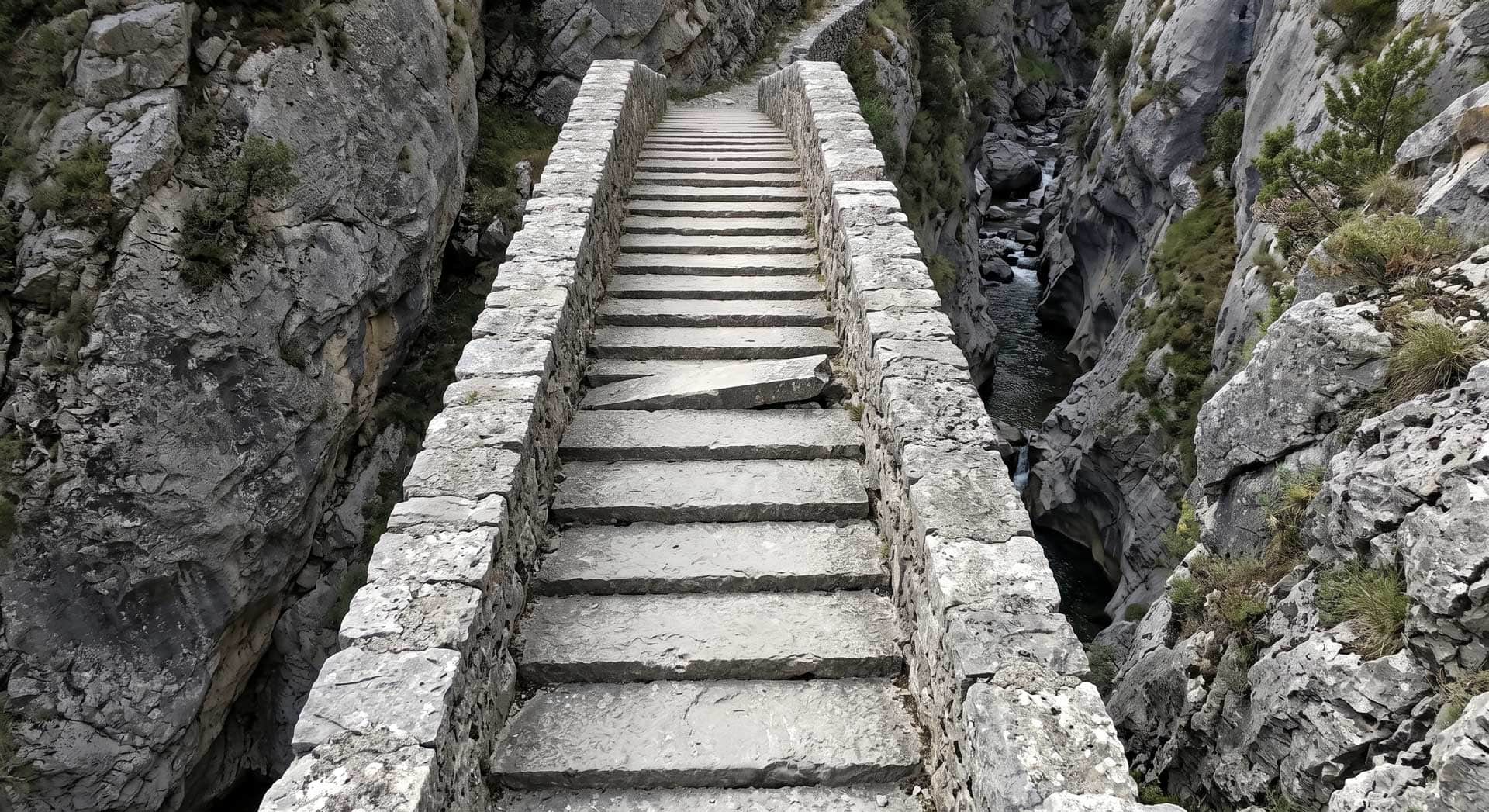
A cliff to the left. A pit of vipers to the right. You have to plan your steps — left, right, left — before you take the first one. And an adversary who knows your list gets to choose the rhythm he tests it against: every step, every second one, every third. At eleven planned steps, there's still a list that survives every rhythm. At twelve, there isn't. Some rhythm throws you off the cliff or into the pit.
That's not a trick. It's a theorem — and it gets harder, not easier, the longer the list runs. The dying starts at eleven. The open question was whether that holds for every list, forever.
The Forced Inequality
Formally, this is the Erdős discrepancy problem: for any infinite sequence of +1s and −1s, and any bound C, however large, there exist numbers k and n such that the sum x_k + x_2k + x_3k + … + x_nk exceeds C. No matter how cleverly the sequence is planned. No matter how balanced it has looked so far. Some slice, at some interval, tips over.
This is not the same as randomness. A genuinely random sequence balances out fairly well on average. The discrepancy problem demands more: that no sequence — however designed, engineered, or gamed — escapes imbalance forever. It isn't noise that produces the structure. Length alone does. Every sequence, combined long enough, produces a slice that breaks the frame.
How Tao Proved It
Erdős offered $500 for a solution in the 1950s. He died in 1996 without seeing one. In 2009, Timothy Gowers turned the problem into Polymath5, an open collective project: anyone could work the math in his blog's comment section. By 2012 the project stalled — but it left what Gowers himself called handles on a smooth wrecking ball. The key handle: it's enough to solve the problem for multiplicative sequences, where every entry is determined by multiplying its factors.
In September 2015, Tao found the last move. He breaks any sequence into chunks and measures their entropy — a gauge of how much randomness a system has left. At each new chunk, one of two things happens: either balance breaks immediately, or entropy drops by a fixed amount. Entropy can't fall below zero. So after finitely many chunks, the first case has to occur. Tao called it a magician's trick — the opponent appears to have a choice, but every choice leads to the same outcome. Erdős's $500 went to his estate, posthumously.
The same mathematics is the business model of quantitative trading: combine enough individually near-meaningless signals over a long enough run, and a pattern appears — real or apparent. That's not a bonus of combination. It's the price of it.
Why No One Can Avoid It
This is where Paradoxical Interaction begins. No one is doing anything wrong. The engineer combines signals because combination reduces noise — that's the entire point of statistics. The fund manager pays for the ability to tell real structure from random structure — also rational, since the two look identical at first. The society that organizes “equal opportunity for all” combines millions of individually neutral decisions across generations — school choice, zip code, who marries whom. Each one explicable on its own. Together they force exactly what PI described in “Why Supposedly Equal Societies Generate Inequality”: inequality no one planned, arriving anyway.
The difference is that back then, it was a sociological observation. Now it's a theorem. The math doesn't confirm the morality of the thing — it confirms the structure. Balance isn't a system's neutral default. Balance is the unstable special case that collapses under any sufficiently long combination.
The Discrepancy PI: Any system that combines enough weak signals over a long enough sequence forces structure into existence — real or apparent. Permanent, total balance isn't unlikely. It's mathematically excluded.
Everyone acts rationally:
- The engineer — combines signals, because combination reduces noise (rational)
- The fund manager — pays to distinguish real structure from random structure (rational)
- The society — distributes opportunity by neutral rules, combined across generations (rational)
- The outcome — forced structure, intended by no one
All are guilty. None are at fault.
Why This Isn't a Bug
Here's the temptation: optimize the structure away. Strip the noise, force the balance, make the system “fairer” or “cleaner.” That's exactly what the theorem forbids. The redundancy that combination produces isn't the system's defect. It's the price every system pays for combining anything at all — signals, rules, people, generations. A system with zero emergent structure wouldn't be a robust system. It wouldn't be a system at all — just a pile of disconnected random numbers, incapable of doing anything.
What's left isn't a solution. It's navigation: the existence of structure is guaranteed, but it demands judgment about which structure is load-bearing and which only appeared because you looked long enough. No theorem supplies that distinction. No dataset does either, however large. It's the part no formula replaces — and exactly why it's the expensive part.
Erdős offered $500 to prove structure is unavoidable. He was paid posthumously, nineteen years after his death. Whoever sees the structure first usually sees it too late to profit from it themselves — but never too late for someone else to.
Optimize away a system's redundancy, and you haven't optimized away the structure. You've only optimized away the ability to see it.
Related Posts
Or: The Equality Paradox
A Paradoxical Interaction in Three Acts
Why the dead are right more often than the living — and why the structure that silenced them is unchanged.
Why the demand for objectivity is structurally self-defeating — and why everyone who makes it is already inside the thing they claim to stand outside.
On piinteract.org
- [Contradictions Are Features, Not Bugs] — This is exactly what Tao proves: forced structure isn't a flaw in combination. It's combination's condition.
- [Just Optimize] — Optimizing the noise away means optimizing away the ability to tell real structure from random structure.
- [The Median Trap] — Averages conceal exactly the discrepancy that any long enough combined distribution is forced to produce.
- [Metrics Gaming] — Combine enough weak metrics and you get structure — then managed instead of understood.
See also (external links):
The Erdős Discrepancy Problem (arXiv:1509.05363) — Tao's original 2015 proof, the primary source for the theorem this post turns on.
Efficient Capital Markets: A Review of Theory and Empirical Work — Fama, 1970. The peer-reviewed formulation of the efficient-market hypothesis, whose claim to permanent balance the discrepancy mathematics structurally contradicts.
That Time Terence Tao Won $500 From Paul Erdős — American Mathematical Society: institutional documentation of the posthumous $500 reward and the path to the proof.
A Magical Answer to an 80-Year-Old Puzzle — Quanta Magazine, Erica Klarreich: the most accessible account of Tao's entropy argument and the "magician's trick" quote.
EDP28 — problem solved by Terence Tao! — Timothy Gowers's own blog, the primary source for the Polymath5 collaboration that gave the proof its handles.
Paradoxical Interactions (PI): When rational actors consistently produce collectively irrational outcomes — not through failure, but through structure.
All are guilty. None are at fault.
Peter Senner Thinking beyond the Tellerrand
contact@piinteract.org
https://piinteract.org
Co-created with Claude (Anthropic) — two incomplete systems making each other's gaps visible.