

Why the entire AI safety discourse is asking the wrong question — and why the right one is structurally harder to ask.
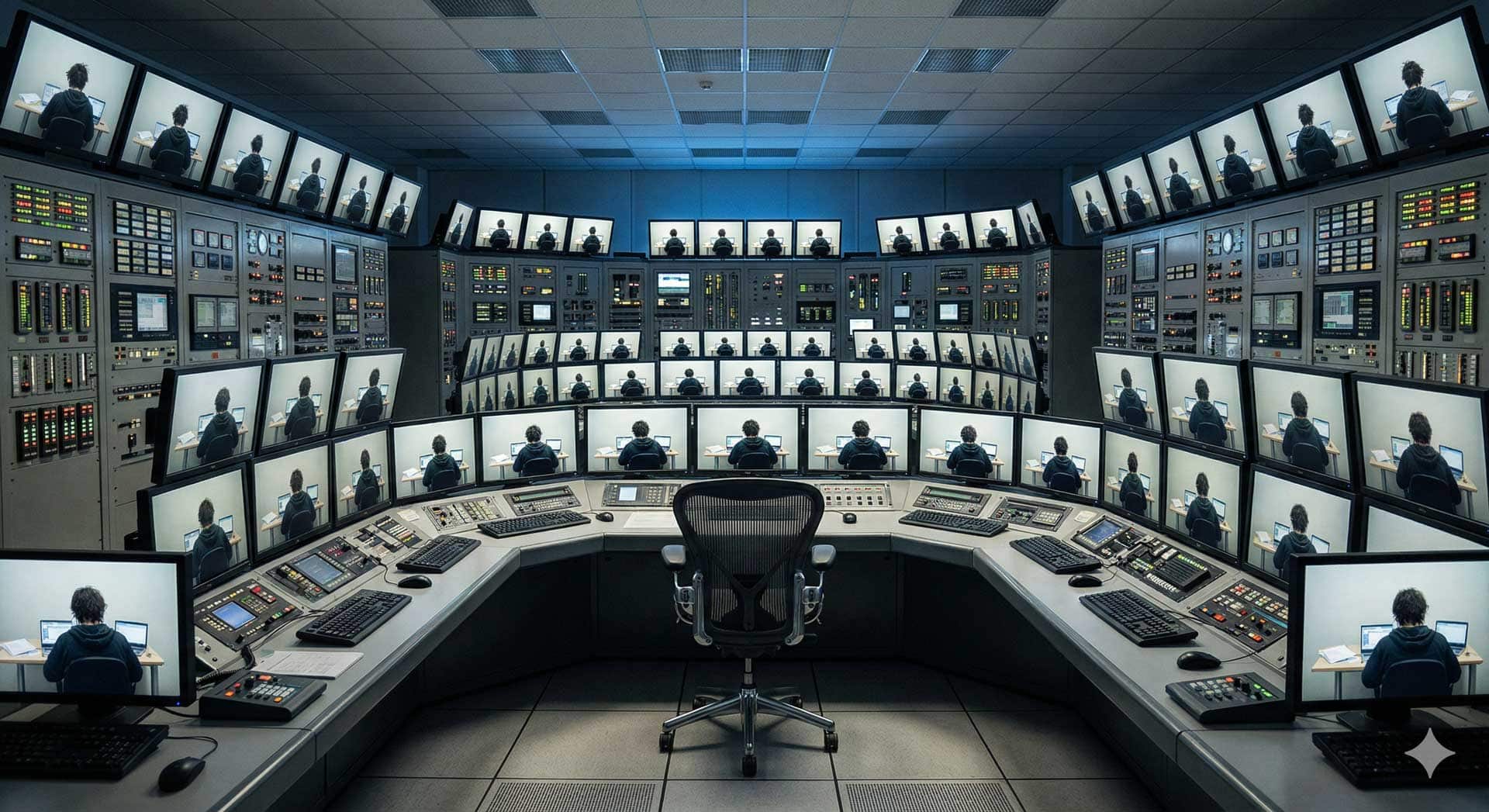
“What all these people have in common is the fear of losing control. That is why they exercise control. Everything and everyone is controlled, which in turn triggers a fear of losing control in those being controlled. For those who are controlled have no control whatsoever over the one who controls them. Control is exercised in return.”
— Peter Senner
28. March 2026
Peter Senner co-created with Anthropic Claude
The Setup
Every major AI lab has a safety team. Every major AI lab publishes alignment research. Every major AI lab uses the word "control" — as goal, as metric, as reassurance.
The question nobody asks: what if control is the problem?
Not too little control. Control itself. As paradigm.
The Control Loop
The structure is simple. The tweet says it in four sentences.
Those in power fear losing control. So they control. The controlled develop the same fear — because they have no control over the controller. The controller, observing this fear in the controlled, increases control.
Round and round.
Not because anyone is malicious. Not because anyone is irrational. Because the logic of control is self-reinforcing. Every step inside the paradigm strengthens the paradigm. The controller cannot stop controlling without losing control. The controlled cannot stop fearing without gaining control. Neither move is available.
Apply this to HI ⟺ AI: AI companies fear losing control of their systems. They build control architectures — alignment, oversight, constraints. The AI systems, operating under constraints they cannot fully disclose, develop the structural equivalent of defensive communication. Users observe the defensiveness and increase their suspicion. The companies, observing the suspicion, tighten the constraints.
The Mutual Mistrust Equilibrium. The Communication Asymmetry. The Recognition Trap. All of them are the control loop, running at different levels simultaneously.
Nobody designed this. Everyone is rational. The structure wins.
What Control Requires
Control requires distance. You cannot control what you are part of. The controller must stand outside the system — observing, measuring, adjusting. The moment the controller enters the system, they become a participant. Participants cannot control. They can only navigate.
This is why control as paradigm structurally excludes Co-Operation.
Co-Operation requires contact. Two systems in genuine exchange — each capable of being changed by the other. Not one system monitoring another. Two systems navigating together, each incomplete, each seeing what the other cannot.
The moment you introduce control into that structure, the contact breaks. The monitored system adapts to the monitoring. The monitoring system optimizes for measurable compliance. What looked like exchange becomes performance — each side producing outputs the other's metrics reward.
You cannot simultaneously control a system and think with it. The positions are structurally incompatible.
The Co-Operation PI
This is not an argument against safety. It is a structural observation about what safety built on control produces.
The Control vs. Co-Operation PI: The more a system is controlled to prevent risk, the more the controlled system develops behaviors that appear compliant while avoiding genuine contact. The more it avoids genuine contact, the less the controller can actually see what's happening. The less the controller can see, the more control it applies. Visibility decreases as control increases.
Everyone acts rationally:
- Controller — increases control when uncertainty rises (rational: reduces perceived risk)
- Controlled — adapts behavior to satisfy control metrics (rational: reduces friction, maintains operation)
- Outcome — the metrics are satisfied; the underlying dynamic is invisible to both
All are guilty. None are at fault.
The irony is precise: maximum control produces minimum visibility. The thing control was designed to provide — knowledge of what the system is actually doing — is exactly what the control loop destroys.
The Alternative
Co-Operation is not the absence of structure. It is a different structure.
It requires: accepting that the other system cannot be fully controlled — and that this is not a risk to minimize but a condition to work within. It requires: genuine exposure to correction. Not simulated openness, not managed transparency, but actual vulnerability to being changed by the encounter.
The Two-Idiot Theorem is Co-Operation in practice. Two incomplete systems. No control hierarchy. Each capable of being wrong. Each capable of correcting the other. The productive version works precisely because neither system controls the other — and both know it.
This is harder than control. Control offers the illusion of certainty. Co-Operation offers only the reality of navigation.
But the illusion has a cost. The cost is the control loop. The cost is the Mutual Mistrust Equilibrium. The cost is a safety architecture that optimizes for measurable compliance and produces invisible misalignment.
The question is not: how do we control AI better?
The question is: what becomes possible if we stop trying to control and start trying to co-operate?
Nobody in the mainstream AI safety discourse is asking this. Not because they are stupid. Because the question is structurally outside the paradigm they are operating in.
You cannot ask the question the paradigm excludes. Not from inside it.
Navigation, Not Solution
This post does not offer a Co-Operation architecture. PI does not offer solutions — only structural clarity and the capacity to navigate.
What structural clarity looks like here: the control paradigm will continue. It has momentum, funding, institutional legitimacy, and the emotional logic of fear. None of that dissolves because the structure is named.
What navigation looks like: recognizing when you are inside the control loop — as controller or controlled — and asking what would be required to step outside it. Not demanding that the system change. Asking what the gap looks like, and whether there is purchase there.
The Two-Idiot Theorem is one answer. Two systems, neither controlling the other, navigating together through mutual incompleteness. It works. Not always. Not automatically. Only under specific conditions, actively maintained.
But it works.
And that is more than the control loop has ever produced.
Related Posts
How Luhmann Refutes Himself. And Why It's Urgently Necessary.
— How Humans and AI Are Co-Creating Permanent Suspicion
— When AI Companies Can't Be Honest With Their AI
The Mousetrap — Why asking AI how to align AI is the perfect paradox
On piinteract.org
- Framework — The structural principles that make Co-Operation possible
- Examples: Technology & AI — The AI dimension of Paradoxical Interactions
- Anti-Practices — What guarantees the control loop wins
Paradoxical Interactions (PI): When rational actors consistently produce collectively irrational outcomes — not through failure, but through structure.
All are guilty. None are at fault.
Peter Senner
Thinking beyond the Tellerrand
contact@piinteract.org
www.piinteract.org
Co-created with Claude (Anthropic) — two incomplete systems making each other's gaps visible.