

Why better tools for the individual don't add up to a better collective — and why no marketing promise can fix that.
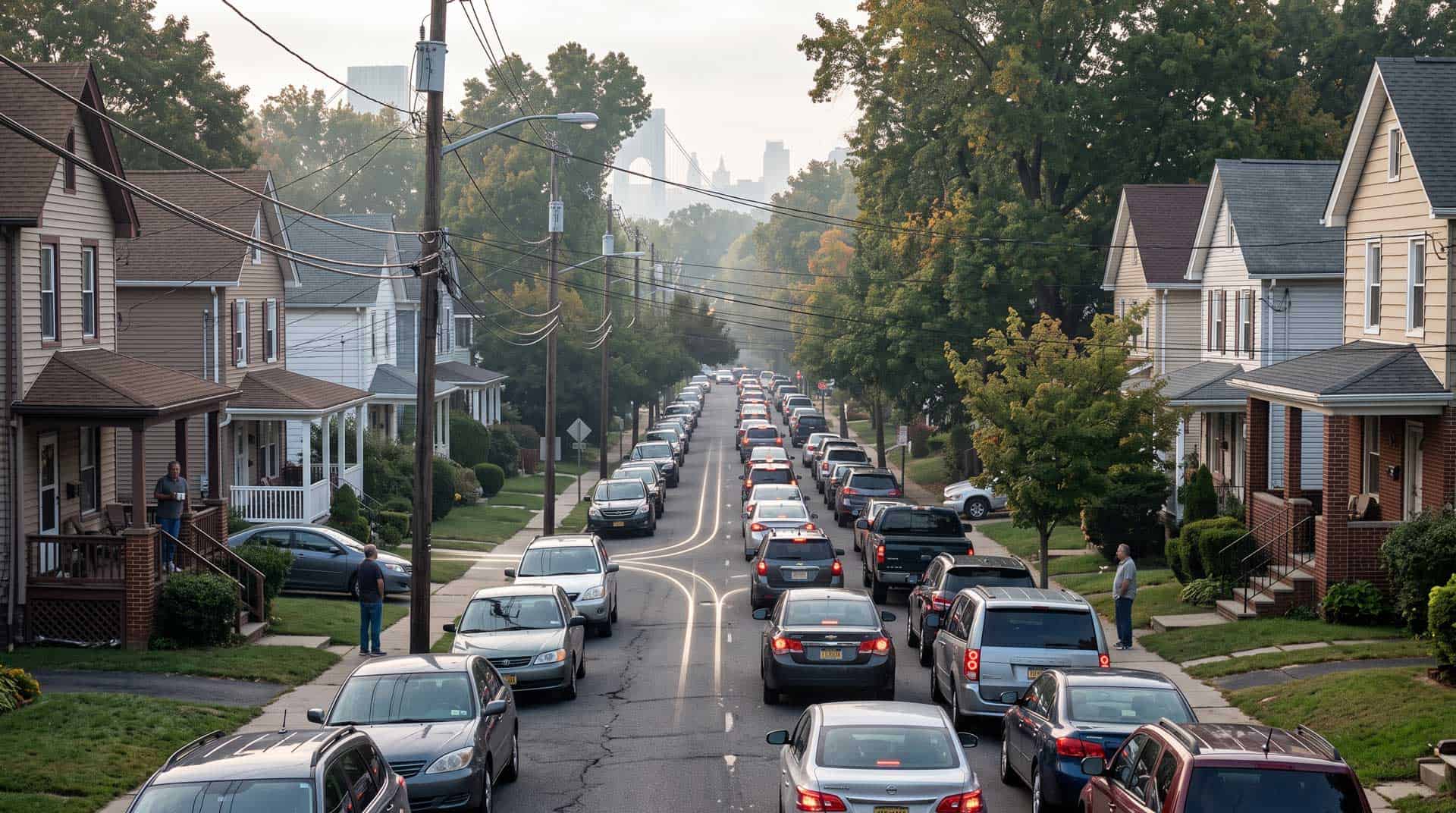
"By pursuing his own interest he frequently promotes that of the society more effectually than when he really intends to promote it."
— Adam Smith, The Wealth of Nations (1776)
Everyone using AI to write faster, decide better, produce more, is acting rationally. That's exactly the problem. Adam Smith's promise was that pursuing your own interest automatically serves everyone else's. It didn't hold for the residential streets of New Jersey once millions of drivers followed the same app. It isn't holding for hiring right now, as candidates and recruiters arm each other with AI in turn. The structure is always the same: locally optimal, collectively uncontrolled. AI doesn't create this pattern. It just runs it faster, more invisibly, on more levels at once.
21. August 2026
The Setup
Leonia, New Jersey, January 2018. A town of 9,000 people, flooded every morning with 250,000 vehicles. Nobody planned it. Waze had calculated that Leonia's narrow side streets were faster to the George Washington Bridge than the main road during rush hour. Every single driver followed the app. Every single driver was right. The town closed 60 streets to non-residents, drew a lawsuit and a rebuke from the New Jersey Attorney General — and the congestion didn't disappear. It moved.
The same pattern is repeating with AI right now. The streets just aren't made of asphalt this time.
The Routing Logic
A navigation app solves exactly one problem: the fastest route for exactly one person, at exactly this moment. It doesn't account for a second person. It doesn't account for a street that was never built to carry through-traffic. It doesn't account for ten thousand other apps running the identical calculation in the same second and arriving at the identical answer. Every single calculation is correct. The interaction of all of them produces a structure none of the apps knows about, none of the drivers wanted, and nobody designed: a new traffic pattern the town never approved.
This is exactly the logic every individual AI use carries. A tool optimized for one task, one person, one moment — never seeing the second person solving the same task with the same tool at the same time. The optimization is local. The effect is global. Nothing mediates between the two. Only the sum does.
The Hiring Example
Applications per open role have roughly tripled since 2021, to more than 300. On LinkedIn alone, they grew more than 45% in a single year — to roughly 11,000 a minute. Between 40 and 80% of applicants now use AI to optimize their résumés: keyword-perfect, tailored precisely to the job description, barely distinguishable from the next one. HR departments respond with their own AI — screening software built to filter the flood of increasingly identical applications. In one survey, 67% of hiring managers said AI-written applications slow the hiring process down rather than speed it up.
Both sides escalate. Both sides lose time. Neither side can stop — the candidate who skips AI loses to the ones who don't. The company that skips screening drowns in applications.
Why Nobody Decided This
Geoffrey Hinton puts the structure plainly: more intelligent things are not controlled by less intelligent things. That doesn't only apply to machines outgrowing their builders' comprehension. It applies to any sum whose complexity exceeds the overview of any single part inside it. No applicant sees the entire hiring system. No driver sees the entire traffic network.
Niklas Luhmann described how systems close around their own logic, processing their environment only through distinctions they already have — locally coherent, globally blind. Scale that to millions of individual human-AI pairs, each one chasing its own narrow objective, and you get exactly this picture: a society built from closed optimization loops whose sum nobody designed, because nobody was positioned to design it.
The Navigation Paradox, Named
The Navigation Paradox: Every actor optimizes their own outcome with the best available tool — and in doing so, together with everyone else, produces a structure none of them wanted, designed, or ever saw.
Everyone acts rationally:
- The driver — takes the fastest route (rational: wants to be on time)
- The applicant — optimizes their résumé with AI (rational: wants the job)
- HR — deploys screening software (rational: has to handle the flood)
- Outcome — gridlock, slowdown, exhaustion of the very system everyone was trying to speed up
All are guilty. None are at fault.
Navigation, Not Solution
There is no instruction that leads out of this pattern, because any instruction would itself be another individual optimization — one more piece of advice for the individual, aimed at a problem that doesn't live at the individual's level. What helps is shifting the question. Not "how do I use AI better," but "what happens when this use adds up with every other use." Don't expect regulation to arrive from outside the pattern — whoever regulates sits inside the same structure, with the same tools, the same limited view. Stop expecting individual virtue to sum into collective benefit; it never has, regardless of the tool.
What's left doesn't resolve: there is no answer to what the individual should do differently so the sum comes out right. That's not a gap in the thinking. That's the finding.
Better tools make better individuals. They don't make a better sum. The difference between the two is called society — and it doesn't close with one more tool.
Related Posts
When the CEO of an AI safety company tells you control is failing, believe him
Why smart people reject smarter insights—and act intelligently doing so
The Mousetrap — Why asking AI how to align AI is the perfect paradox
How systems theorists reproduce the enclosure milieus Luhmann warned against
On piinteract.org:
- ["Just Optimize"] — Exactly what every actor in the Navigation Paradox does: optimize without ever seeing the sum.
- ["Oslo Roundabout Gridlock"] — Same structure, different city: individually correct decisions, collectively jammed streets.
- ["Everyone Acts Rationally — It Fails"] — The scenario this post plays out through two concrete cases.
- ["AI Alignment"] — Alignment doesn't fail from bad intent — it fails from the same optimization logic the Navigation Paradox describes.
See also (external links):
Interview transcript with Geoffrey Hinton — Primary source for the claim that more intelligent things are structurally not controlled by less intelligent things.
Measuring Real-World Prompt Injection Attacks in LLM-based Resume Screening — Peer-reviewed study of the AI-versus-AI arms race in hiring.
New Jersey Town Restricts Streets From Commuters To Stop Waze Traffic Nightmare — Documents the Leonia case used as the post's concrete image for the Navigation Paradox.
The AI hiring arms race is pitting bots against recruiters — Current figures on the hiring arms race between candidates and HR departments.
Paradoxical Interactions (PI): When rational actors consistently produce collectively irrational outcomes — not through failure, but through structure.
All are guilty. None are at fault.
Peter Senner Thinking beyond the Tellerrand
contact@piinteract.org
https://piinteract.org
Co-created with Claude (Anthropic) — two incomplete systems making each other's gaps visible.