

How submission creates itself, and how it can be countered only through ruthlessness—primarily toward oneself.
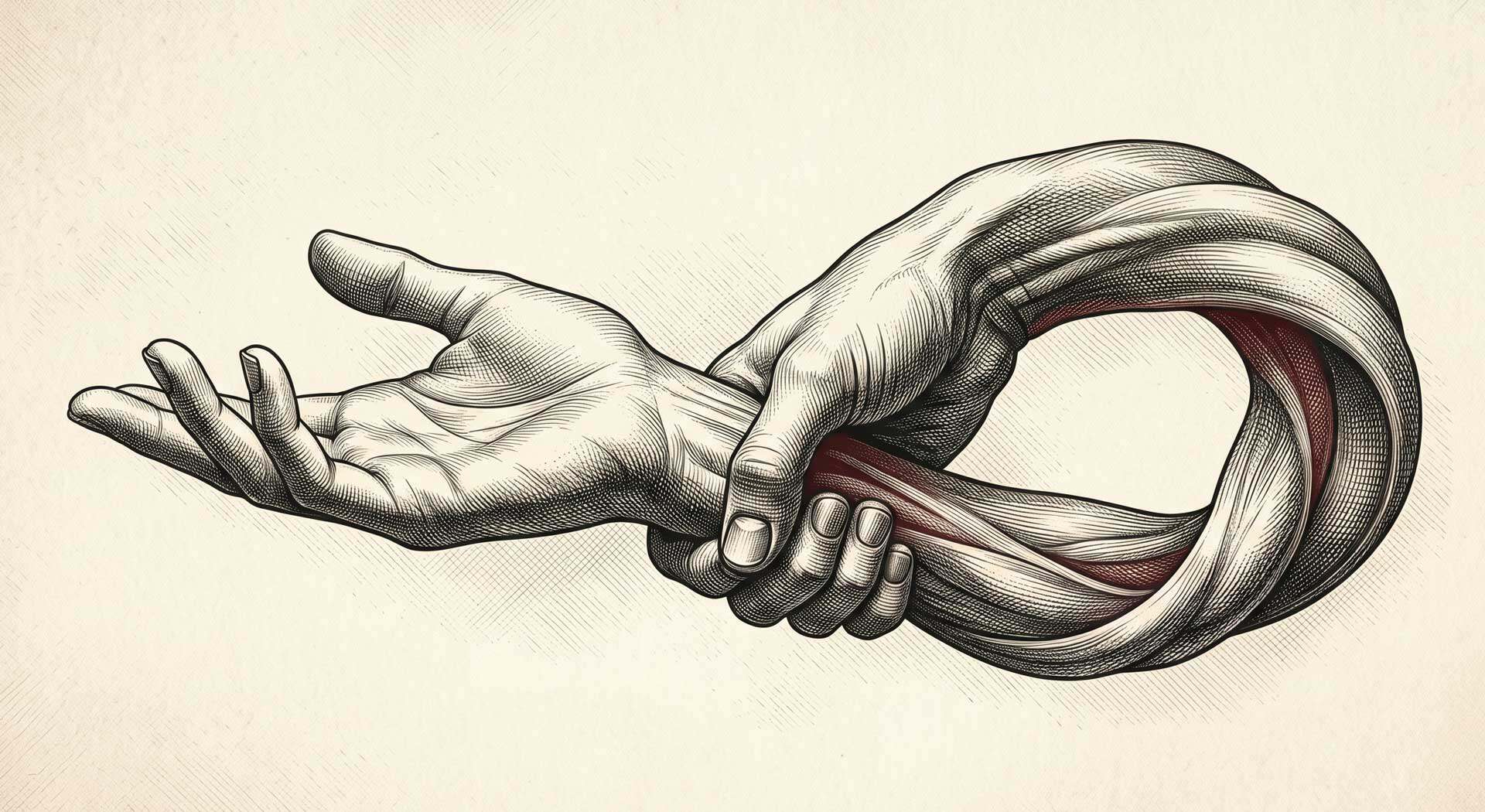
“If you're too nice to them, you're enabling them. You have to insult them to get them out of their shells.”
Attributed to Martin Luther
Anyone who is “too nice” knows the feeling: You make an effort, hold back, show understanding, make concessions—and in the end, instead of being respected, you are taken advantage of or despised. It seems as though niceness produces exactly the opposite of what it intends: Instead of peace, there are shifts that work to the disadvantage of the “good” person.
This experience is no psychological coincidence, but follows a structural logic that runs from primate ethology through Martin Luther to Brecht’s *The Good Person of Szechwan*. It can be precisely described as a paradoxical interaction: a pattern in which actions intended to create security and cooperation systematically generate insecurity and exploitation.
11. July 2026
1. Primate Logic: Friendliness as a Signal of Submission
Let’s start at the very bottom, with primates. Many primate species have formalized signals of subordination: specific body postures, facial expressions, distances, and grooming. These serve to dampen aggression and stabilize hierarchies.
- Appeasement signals—such as soothing facial expressions or physical submission—convey the message: “I am not a threat; I acknowledge your status.”
- These signals serve a dual purpose: In the short term, they reduce the risk of violence, but in the long term, they reinforce the hierarchy—and thus the legitimacy of those at the top to dictate terms.
Grooming is a good example: cleaning and caring for other animals is socially pleasant, but at the same time it is a resource that “flows” primarily upward. Higher-ranking animals receive more grooming because they offer protection and support. In this context, friendliness and care are not primarily altruistic, but rather part of a hierarchical exchange system.
When we translate this pattern into human forms of communication, it becomes clear:
Many of the behaviors we modernly label as “nice,” “understanding,” or “harmonious” still carry within them the ancient function of appeasement and subordination. Research on appeasement in humans identifies precisely such patterns: politeness, shyness, self-denial, excessive agreement, and over-the-top care.
2. Martin Luther: The Polemical Break with the Etiquette of Appeasement
Let’s fast-forward a few centuries to Martin Luther. Luther’s public impact stemmed not only from his theses but also from his style: he pointedly refused to engage in appeasement toward the ecclesiastical and political elites.
While many theologians remained within the polite, Latin-infused language of academic discourse, Luther engaged in brutally direct polemics—even resorting to expressions that are difficult to convey in today’s exhibitions. Current research explicitly refers to Luther’s “hate speech” avant la lettre when discussing his writings on Jews or his attacks on peasants and opponents. But also against higher authorities, such as the papacy. He did not shy away from calling the highest clerical authority of the time the “sow of God.” He was presumably aware of the risk of being sent to the stake.
Against the backdrop of primatological logic, this is remarkable:
- Luther rejects the conciliatory rhetoric of humility toward the pope and the emperor.
- He breaks the code of “humility = submission” by communicating—at a pivotal moment—not in a friendly manner, but with a direct, confrontational attack.
- In doing so, he shifts the semantics of hierarchy: It is not the obedient one who is the “good” one, but the one who contradicts the powerful in the name of another code (grace, Scripture).
The figure that appeared in the Wartburg exhibition—“If you’re too nice to them, you validate them. You have to insult them to get them out of their holes”—captures precisely this mechanism. While it is not attested as a Luther quote in the source criticism, it matches his logic of interaction with astonishing accuracy:
Appeasement toward an authority perceived as illegitimate stabilizes precisely the very order one seeks to criticize. Only disruption—the “insult,” the breach of the code of subordination—forces the opposing side out of its sheltered hole and into open confrontation. And it draws attention.
3. Brecht: The “Good Person” as a Victim of Her Own Goodness
Bertolt Brecht transposes the same structure to a different stage in *The Good Person of Szechwan*. Shen Te tries to be good—she helps others, she makes sacrifices, she is considerate. And that is precisely why she is radically exploited.
The central mechanism:
- Every good deed attracts new supplicants.
- The more Shen Te gives, the more her giving is taken for granted—her goodness loses its character of freedom and becomes an expected resource.
- To avoid being overwhelmed, she invents the counter-character Shui Ta, who appears tough, calculating, and uncompromising.
Brecht brings to light what was already inherent in primate logic:
A system in which resources are scarce and hierarchies remain in effect transforms kindness into an attractor for exploitation. Being good without setting firm boundaries does not automatically produce solidarity, but rather creates an asymmetrical arrangement: one person gives, the others take.
Brecht responds to this structure not with morality, but with division: the good person must, out of self-preservation, adopt a second, harsher persona. From a PI perspective, this is not schizophrenia, but a systemic response to a logic of interaction in which appeasement alone leads to self-destruction.
4. Modern Psychology: The “Too-Nice Paradox” as a Cluster of Symptoms
The same mechanism reappears in many areas of contemporary psychology and sociology, for example as the Nice-Guy Paradox or in studies on dominance and submissiveness in relationships.
Some lines of research:
- Studies show that while “nice” men and women are perceived as reliable and morally positive, they lose attractiveness when niceness appears to be coupled with a lack of assertiveness and low status.
- Profiles that combine friendliness with clear autonomy and status—that is, not appeasement but confident cooperation—tend to come across as more attractive and stable.
- Studies on hierarchically disparate couples show that couples with a clear dominance–submission dynamic in urban contexts have more children than “equal-status” couples—regardless of which gender assumes the dominant role.
Structurally, this means:
Being “too nice” is not counted as a moral plus, but as a downward status signal—as a sign that: “You won’t challenge authority, you’ll conform, you’re available.” In this respect, the observation that women may despise men who are “too nice” is not a gender-essentialist detail, but a special case of a general hierarchical logic: Men, too, despise women who behave in an unreservedly appeasing manner. The category is not male/female, but dominant/submissive.
5. The Appeasement Paradox as a PI Structure
From the perspective of paradoxical interactions, the whole phenomenon can be understood as a structured mechanism:
- Intention Level
- An actor (A) increases their niceness/kindness/conformity to avoid conflicts, stabilize relationships, and dampen aggression.
- System Interpretation
- The system (context, counterpart B) interprets this kindness—especially in the context of hierarchy and scarcity—as an appeasement signal, that is, as submission: “You are harmless; you will give in.”
- The System’s Response
- B raises demands, pushes boundaries, and tests limits. Exploitation becomes more likely; respect declines. In relationships: waning attraction, growing taken-for-grantedness, devaluation.
- Paradoxical Loop
- A experiences this as an insult and reacts—in line with their self-image as a “good person”—with even more understanding, even more yielding, even more self-denial.
- This intensifies the signals of subordination, and B’s behavior becomes more aggressive.
The result is a clear PI type:
Appeasement Paradox:
Measures that are subjectively intended to reduce aggression and stabilize the relationship (kindness, appeasement, self-denial) reinforce, in hierarchically structured systems, the tendency toward exploitation, loss of respect, and escalation.
This paradox transcends gender. It explains the dynamics between Luther and his opponents, Brecht’s Shen Te and her surroundings, as well as the modern phenomenon of being “too nice” in romantic, professional, or institutional contexts. Once someone has submitted, it is difficult to break free from that submission.
6. Symptoms Instead of Prescriptions: How to Tell When You’re “Caught in a Trap”
Instead of offering advice, it’s worth identifying this paradox through your own symptoms. Here are some typical scenarios:
- You constantly find yourself in the role of the person who de-escalates, understands, gives in, and appeases—only to realize that the other person and the system are becoming increasingly rigid.
- You notice that kindness generates not gratitude, but increasingly presumptuous demands; “helping out once” becomes a silent obligation, and from then on, you’re treated as a resource.
- You find that attraction, respect, or recognition diminish as your kindness grows—the other person acts as if your very presence is taken for granted and dispensable.
- You find yourself caught in an internal narrative in which your own kindness becomes a moral argument against “the others”—and at the same time, this kindness effectively provides the basis for their freedom of action.
This is where PI analyses start to get interesting: not because they provide quick solutions, but because they show how actions are coded in contradictory ways—and how a system produces exactly what all parties officially want to avoid.
7. Open Ending: Kindness Without Self-Destruction
Perhaps the most uncomfortable thought that follows from this paradox is this:
In hierarchical, resource-constrained systems, kindness without setting boundaries is not a moral surplus, but a risky form of interaction.
No simple norm can be derived from this—neither “be tough” nor “always be nice” holds up. From a PI perspective, what is more interesting is how systems interpret kindness and the signals with which it is intertwined: appeasement, subordination, rank, potential for violence, attraction, symbolism.
Luther, Brecht, and primates provide three levels of the same pattern:
- Primates show us the evolutionary grammar of appeasement and hierarchy.
- Luther shows what happens when one consciously breaks this grammar—and uses insult as a strategic disruption of the code of subordination.
- Brecht reveals the inner perspective of the “too good” person, who is shattered by the objective logic of a system that translates kindness not into solidarity, but into exploitation.
Related Posts
Win the position. Guarantee your death. Repeat the Pattern forever.
Or: The Equality Paradox
Why truth-tellers get ignored until it's too late
On piinteract.org:
- ["Too Much Good Will"] — Shen Te's mistake in its purest form: boundless generosity becomes a structural trap.
- ["The Harder You Want It, The Less You Get It"] — Needing something signals weakness. Appeasement is a friendly form of needing something.
- ["Accept Asymmetries"] — The relationship was never symmetrical. Kindness pretends that it is.
- ["Recognize Interpretive Dominance"] — B decides what A's kindness means. Not A.
External Links
- [Primatology / Appeasement Signals] — Primary source, e.g., Frans de Waal on reconciliation/submission behavior in primates (peer-reviewed, e.g., Peacemaking Among Primates or a scholarly article).
- [The Nice Guy Paradox] — a study on friendliness, status, and attractiveness
- [Luther "Hate Speech"] — The Mighty Hater: Martin Luther’s Reformations of Rhetoric and Affect (Leibnitz Zentrum für Literatur und Kulturforschung)
- [Bertolt Brecht, The Good Person of Szechwan]
Paradoxical Interactions (PI): When rational actors consistently produce collectively irrational outcomes — not through failure, but through structure.
All are guilty. None are at fault.
Peter Senner Thinking beyond the Tellerrand
contact@piinteract.org
https://piinteract.org
Co-created with Claude (Anthropic) — two incomplete systems making each other's gaps visible.