

Relativity connects descriptions that no observer experiences at once. Its diagrams make the connection visible — and tempt us to mistake a formal overview for a view from nowhere.
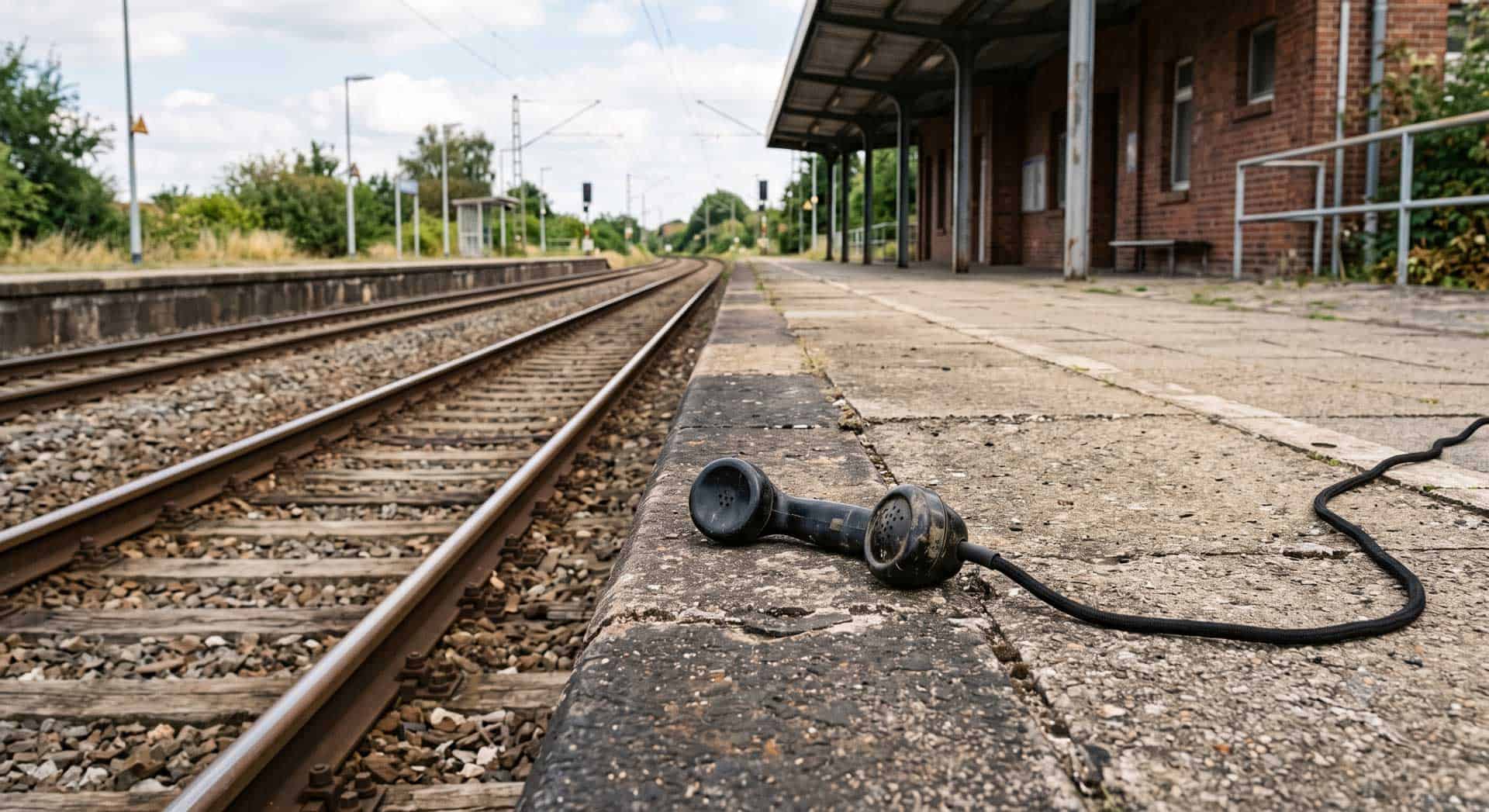
"Give me a place to stand, and I will move the earth."
— Archimedes (as recorded by Pappus of Alexandria)
Einstein begins with a man at the window of a moving train. He drops a stone. For him, it falls in a straight line. A pedestrian beside the track sees a parabola.
The event is the same. Its trajectory is not. To describe it completely, Einstein says, we must name the body of reference.
Physics can translate exactly between the two descriptions. A diagram can even place both coordinate systems on one page. But the page is not a third observer. It is a representation.
The distinction sounds obvious. It is also remarkably easy to forget.
3. August 2026
The Stone Between Two Frames
In Chapter III of *Relativity: The Special and the General Theory*, Einstein writes:
“I stand at the window of a railway carriage which is travelling uniformly, and drop a stone on the embankment, without throwing it.”
Ignoring air resistance, the stone descends in a straight line relative to the carriage and follows a parabola relative to the embankment. Einstein’s conclusion is precise: there is no trajectory independent of a body of reference.
This is not yet special relativity. It is the classical-mechanical setup from which Einstein prepares the deeper problem: measurements of space and time must always be assigned within a specified frame.
The first person matters narratively, not physically. In relativity, an “observer” need not be one pair of eyes. It is usually shorthand for a reference frame equipped with measuring rods and synchronized clocks. Confusing the person with the frame would give the story more intimacy — and less physics.
Signals Without a Shared Experience
The two observers can exchange information. That does not give either of them the other’s experience. It gives them measurements that can be related by a rule.
Einstein makes this explicit in the lightning experiment of Chapter IX. Two lightning strikes are simultaneous relative to the embankment. Relative to the moving train, they are not. The two assignments differ, but they are neither arbitrary nor logically incompatible. Each is defined relative to a different coordinate system, and the Lorentz transformation connects them.
Relativity does not trap observers in sealed worlds. It does something more interesting: it permits different descriptions while specifying exactly how they must correspond.
Hermann Bondi later built an accessible account of special-relativistic kinematics around exchanged light signals. In *Relativity and Common Sense* (1964), his k-calculus uses the ratio between transmitted and received signal intervals — the relativistic Doppler factor *k* — to derive results including time dilation, length contraction, and the relativity of simultaneity. The Lorentz transformation is not abolished; Bondi reaches it by another route.
No observer has to occupy both frames. What they need is not shared experience but a dependable relation between measurements.
The Diagram That Knows More Than Anyone
A Minkowski diagram places primed and unprimed axes on the same sheet. It shows events, worldlines, and the relation between coordinates assigned in different inertial frames.
It does not show what a third observer literally sees. Nor does it claim to. The diagram is a mathematical construction drawn in a chosen coordinate representation. Calling it a lie would confuse the model with the world it models.
Still, the diagram performs a small miracle. It lets the reader survey relations that no single participant experiences as a simultaneous whole.
Everyone acts rationally:
- The physicist compresses several coordinate descriptions into one representation.
- The teacher uses that compression to make their relation intelligible.
- The reader treats the common page as a stable place from which to compare them.
Nothing has gone wrong. And yet something can: the stable place on the page begins to feel like a neutral standpoint in reality. A tool for comparison acquires the authority of an observer who is nowhere situated.
The diagram has not deceived us. We have promoted it.
The Paradoxical Interaction of the Archimedean Point
When a representation mediates between situated perspectives, its formal overview can be mistaken for a standpoint someone could actually occupy.
This is a PI hypothesis about representation, not a result proved by relativity. Physics neither forbids mathematical overviews nor requires an external consciousness to validate them. Reference frames are not closed perspectives, and coordinate transformations are not acts of empathy.
The structural transfer begins elsewhere: with the move from a constructed relation to an allegedly neutral view.
That move is useful. Often indispensable. It is also easy to conceal:
- Without compression, comparison becomes difficult.
- With compression, the conditions of comparison disappear from view.
- The more successful the representation, the less constructed it appears.
The attempted solution creates its own blind spot. We gain orientation by producing a standpoint whose situatedness we no longer notice.
All are guilty. None are at fault.
What This Changes
Not: abolish diagrams. A map does not become dishonest because no landscape looks like it from above.
The better questions are:
- Which relations does the representation preserve?
- Which differences does it suppress?
- Who selected the terms of comparison?
- Where does formal translation end and interpretation begin?
In special relativity, the translation is mathematically constrained. The speed of light in vacuum is invariant, as is the spacetime interval. Observers may assign different spatial and temporal coordinates while agreeing on invariant relations.
Social systems rarely offer transformations this exact. Their shared terms are negotiated, institutionalized, or imposed — usually while presenting themselves as neutral. That is where the analogy ends and the PI problem begins.
The Archimedean point is not the diagram. It is the moment we forget that someone drew the axes.
Related Posts
The Phenomenon of Coupled Oscillators
Why systems that analyze closure risk reproducing it — and why structural awareness does not automatically prevent structural hardening
How systems theorists reproduce the enclosure milieus Luhmann warned against
One is honest. Two are not. Physics knows the difference — and pretends it doesn't.
On piinteract.org:
- ["Perspective Switching (Intrinsic ↔ Extrinsic)"] — The man on the train and the pedestrian never trade places. They only ask what would be rational from the other's position — and stay exactly where they're standing.
- ["Accept Incompleteness"] — The exact gap neither observer can close alone is where the Two-Idiot Theorem actually goes to work.
- ["Recognize the Shared Blindspot"] — The Archimedean point is the blind spot teacher and student share: both need it, neither can justify it.
- ["Name the Paradox"] — The diagram doesn't disappear once you name it. But you stop mistaking its third party for a real observer.
See also (external links):
Relativity: The Special and the General Theory (1917) — Einstein's own text, Chapter III: the original passage where he introduces himself as the observer on the train, before the second observer even appears.
On the Electrodynamics of Moving Bodies (1905) — The original paper, where Einstein fixes the one shared invariant every translation between reference frames depends on: the constancy of the speed of light.
K-calculus in 4-dimensional optics (arXiv) — Formalizes Bondi's method: two observers, only light signals, no shared stage from which both would be visible at once.
Conventionality of Simultaneity — Stanford Encyclopedia of Philosophy: the still-unresolved debate over whether "simultaneous" can be defined independently of a convention at all.
Paradoxical Interactions (PI): When rational actors consistently produce collectively irrational outcomes — not through failure, but through structure.
All are guilty. None are at fault.
Peter Senner Thinking beyond the Tellerrand
contact@piinteract.org
https://piinteract.org
Co-created with Claude (Anthropic) & ChatGPT (OpenAI) — three incomplete systems making each other's gaps visible.