

Why the novel that won its author the Nobel Prize for bringing home a carcass describes the exact structure that took the dream apart — and the man who wrote it.
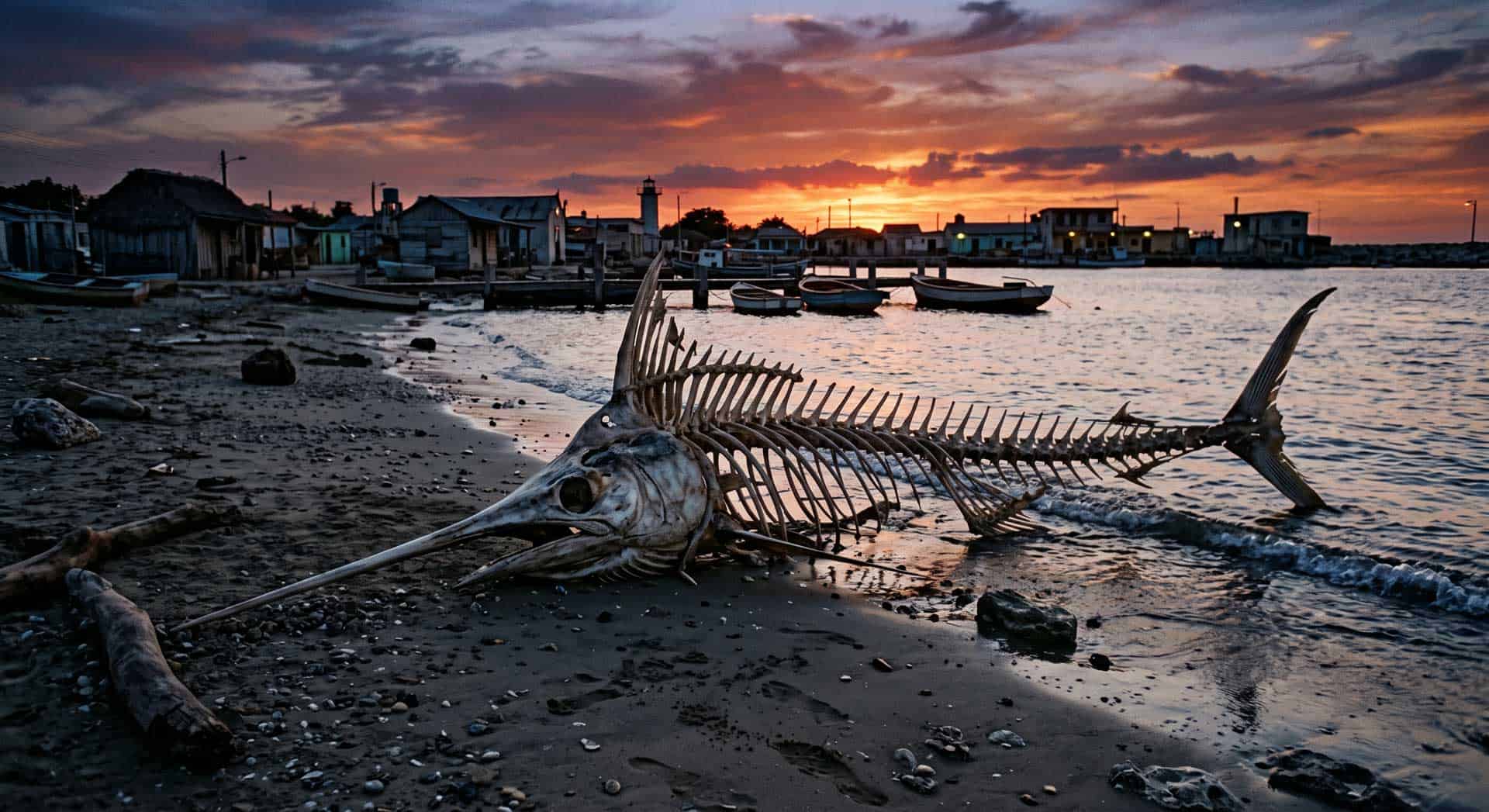
"He did not think of what he had lost, but instead thought of what he had left."
— Ernest Hemingway, The Old Man and the Sea (1952)
Santiago catches the biggest fish of his life. Does everything right. Respects the marlin, fights clean, lashes it to the boat. Still — only the skeleton makes it to shore. Stripped by sharks, feeding in sequence on the way in. The standard reading turns this into a moral: the struggle is what counts, not the outcome. Comforting. Also wrong. It dodges the real question. Not who steals the dream. Who should have guarded it — and why didn't they? And that, in turn, is a very moral question.
2. September 2026
The Long Range Between the Catch and the Harbor
Between the kill and the harbor: a stretch where every shark is right, by its own lights and those of its competitors. The first mako isn't a thief. It's a predator smelling blood on a catch too big to hide — taking, in its own logic, what's owed to anyone strong enough to take it. The galanos that follow aren't repeating the first attack. Each one, on its own terms, reasonable: a fish this size in open water isn't property. It's opportunity. None of them needs a Paradoxical Interaction to confirm that. None feels guilty, because none experiences itself as a predator. Each experiences itself as reasonable — taking what's there to be taken. This is nature. It does not need to define itself.
That's the difference between theft and structure. A thief knows he's stealing, plans for pursuit. A shark in this zone plans for nothing, because nothing is coming. No guard. No watchman. No regulator. There's no point at which Santiago could say: here is the enemy I should have fended off. Just a chain of rational, self-justifying actors — and a zone nobody was ever assigned to police.
The Missing Regulator
No malice required to turn a catch into a carcass. Only the absence of something that steps in. That's the distinction that matters — not whether the sharks are evil, but whether anything stands between them and the kill. In open water, nothing does. Which makes the structure more dangerous, not less, when nobody intends to destroy. A perpetrator who knows he's destroying can be named, indicted, held to account. A chain of actors who each consider themselves reasonable, while jointly eating everything, can't be named at all — not without the naming itself getting read as bitterness, sour grapes, the loser's overreaction.
That's what's actually missing at the dock. Not a bigger boat. Not a sharper knife. An office whose job it was to stand between the catch and the feeding. There wasn't one. There almost never is, out there. Where it's missing in this life, it gets invented elsewhere — an afterlife, a hell, a judgment after death. Not superstition. Structural necessity: manufacturing the accounting nobody alive was willing to do.
What Reaches the Dock
The corpse is delivered at the dock, and the other fishermen measure it — eighteen feet, nose to tail, the longest ever recorded in the harbor. They read the size off the bones. Can't touch it anymore. That's the point the comforting reading skips: recognition arrives too late to do anything with what it recognizes. The tourist in the café who mistakes the skeleton for a shark isn't stupid — he simply has no access left to what it once was. The structure didn't just eat the fish. It ate the legibility of the dream. The passerby who looks at it last will never know what it actually was.
The Paradoxical Interaction of the Bones
The Bones PI: A dream fully earned through clean, legitimate effort can, between completion and arrival, be reduced by a chain of rational, self-justifying actors until only its shape reaches the destination — proof of former size, no longer the dream itself. Not because anyone wanted to destroy it. Because nobody's job was to protect it.
Everyone acts rationally:
- The fisherman — fights clean, lashes the catch down, does everything in his power
- The sharks — each considers itself reasonable, follows its own scent, none aware of the others
- The missing regulator — no office exists whose job is to intervene, so none does
- Result — a carcass reaches the dock, its former size legible, no longer usable
Everyone's guilty. No one's at fault.
The Man Who Wrote It While It Happened to Him
Hemingway didn't write this as theory. He lived it simultaneously. 1950: Across the River and Into the Trees, savaged by critics, some outright mocking. The critics weren't villains plotting a man's destruction. They were the reasonable ones in the room, defending a standard — experiencing themselves as the opposite of destroyers: guardians of quality, telling an author a truth he'd earned. The man who'd helped found a literary canon with The Sun Also Rises and A Farewell to Arms was, two years before The Old Man and the Sea, already treated as finished — a caricature of himself. None of them needed to know they were destroying him. That was the first bite.
Then came The Old Man and the Sea — 1952, the Pulitzer in '53, cited explicitly as the reason for the Nobel in '54. But the man who should have stood in Stockholm that year wasn't there. He was in treatment. That January, he survived two plane crashes in East Africa, hours apart — one serious enough that early reports had him dead, obituaries already running. He lived, with injuries he never fully recovered from: spinal damage, organ damage, the start of a decline, physical and cognitive, that ran through to his suicide in 1961.
No office intervened, anywhere in that chain. No board of critics drew the line between review and attrition. No committee weighed the glory of 1954 against the state of the man receiving it. When Hemingway killed himself in 1961, nobody was held responsible — not because nobody contributed, but because there was no constructed charge for it to attach to. Each bite, on its own, reasonable. Nobody ever pulled the whole chain into view. What was left, like at the dock, was the public case: the laureate, measured and admired, long past reach.
No one is left untouched by this game. The sharks were his own demons too — the ones his life had made sure he could never shake. In the end, they won. But the messenger had already done his duty: the message got out.
What Actually Remains
Santiago doesn't rage at the sharks. He sleeps, dreams of the lions on the beach of his youth, and by the end says he'll go out again. Not hope that it goes differently next time. He knows the sharks are coming regardless of how correct he fights, because nothing out there is assigned to stop them being incorrect. Fair, unfair — the sharks wouldn't argue. They'd say: so what.
It's the only stance the structure leaves, once you've seen it: don't negotiate with the sharks, don't wait for a regulator that isn't coming — go out again, knowing what will reach the dock.
He must go out again to fight his anger and his demons. He has no other choice.
Try and continue.
Not because the outcome changes. Because the alternative is letting the structure decide.
Related Posts
Win the position. Guarantee your death. Repeat the Pattern forever.
Why truth-tellers get ignored until it's too late
Why smart people reject smarter insights—and act intelligently doing so
How systems theorists reproduce the enclosure milieus Luhmann warned against
On piinteract.org:
- ["Don't Fight the Pattern"] — Santiago doesn't negotiate with the sharks. He navigates.
- ["PI Is Not Hopelessness"] — Try and continue doesn't mean it gets better. It means going out again.
- ["Shoot the Messenger"] — the mechanism the closing lines describe directly.
- ["The Right Tool Will Fix This"] — no bigger boat, no sharper knife. A missing regulator isn't a hardware problem.
See also (external links):
The Nobel Prize in Literature 1954 — NobelPrize.org — The official Nobel citation, explicitly referencing The Old Man and the Sea.
When Ernest Hemingway Walked Away From Two Plane Crashes Just Hours Apart (Mental Floss) — The two East African plane crashes of 1954, months before the Nobel ceremony.
Hemingway's Correspondence around Across the River and into the Trees (1949–1950): Process and Reception (The Hemingway Society) — The critical reception of the novel that immediately preceded The Old Man and the Sea.
Paradoxical Interactions (PI): When rational actors consistently produce collectively irrational outcomes — not through failure, but through structure.
All are guilty. None are at fault.
Peter Senner Thinking beyond the Tellerrand
contact@piinteract.org
https://piinteract.org
Co-created with Claude (Anthropic) — two incomplete systems making each other's gaps visible.