

Why rivals who fight endlessly need each other to survive — and what happens to the structure when one of them wins.
"Non si può vivere senza nemici." "You cannot live without enemies."
— Giovanni Guareschi, Don Camillo e Peppone
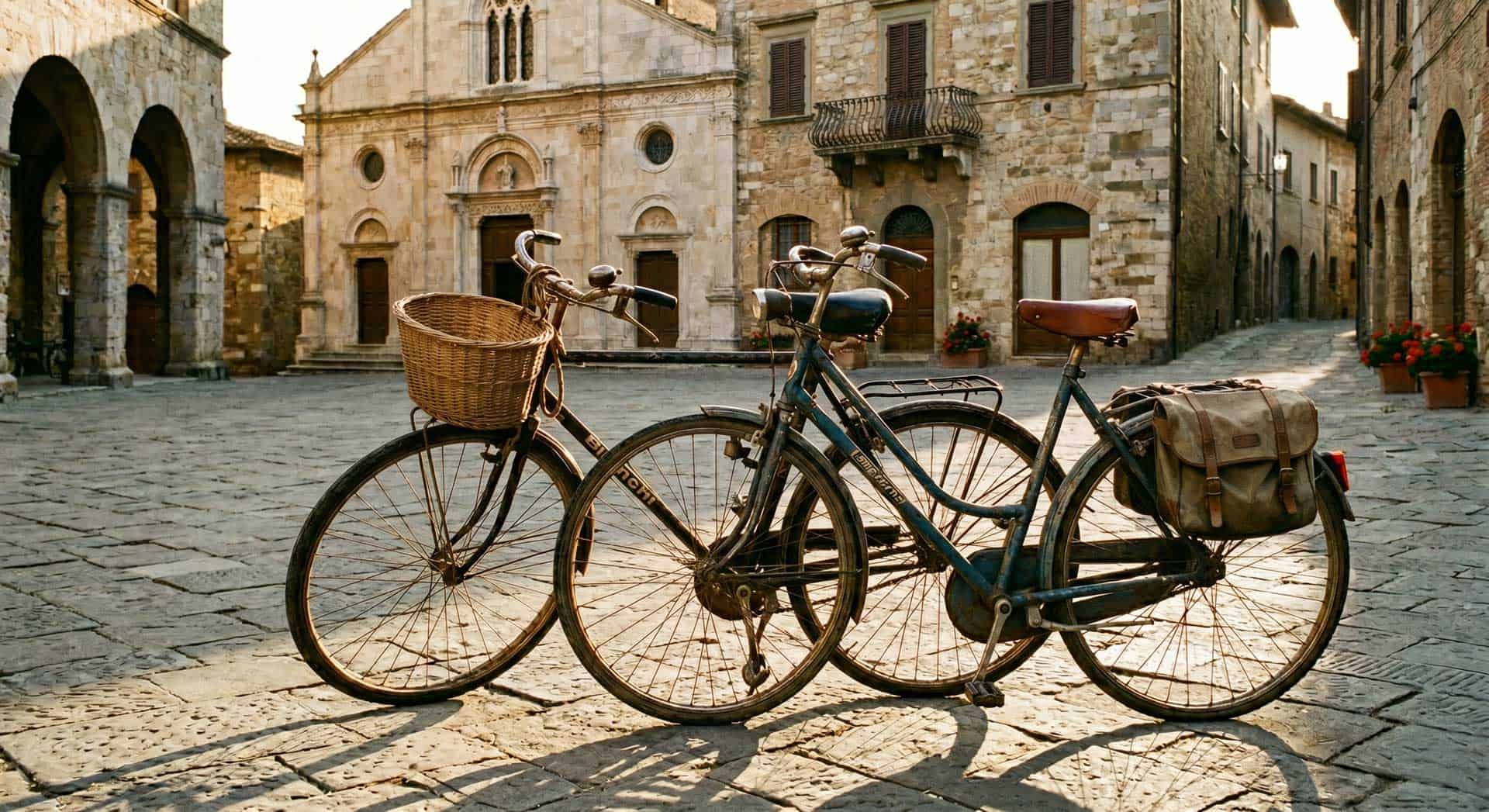
In the final film of the Don Camillo series, a bicycle race takes place. Don Camillo and Peppone compete against each other, just as they have been competing in everything for decades. The priest overtakes. The communist overtakes. Both know it. Neither says a word. The race continues, the film ends, and Guareschi sums it up in a single sentence: They need each other.
Not as a sentimental observation. As a structural diagnosis.
22. May 2026
The Bike Race
The final scene sums up once again what the rest of the films repeatedly show. Don Camillo and Peppone are not rivals who happen to coexist. They are a system. The conflict between them is not a problem to be solved—it forms the architecture of their shared world.
If you take Peppone away, Don Camillo no longer has a reason to be who he is. His tenacity, his resourcefulness, his refusal to give in—all of this is shaped by and for his opponent. The same is true in reverse. Peppone’s communism is not an abstract ideology. It is the concrete communism of a man who has the arch-conservative Don Camillo on the other side of the piazza.
They argue constantly. The village functions because of these arguments. The moment one of them wins—truly wins—the village ceases to be what it is.
Guareschi knew that. The films have no resolution. They repeat themselves. The structure is the crux of the matter.
The Tender Absurdity
Guareschi understood what most social theorists fail to grasp: the bitter absurdities of life are not obstacles to comedy. They are the comedy. Don Camillo and Peppone are human precisely because they are ridiculous. Because they are angry with each other and cannot survive without the other. Because the rivalry in the bike race is tender—a silent agreement that the race is more important than the winner, that the opponent must reach the finish line. And that the race is endless.
This tenderness is the structure made visible. Not through arguments. But through laughter.
We are aware of the irony. This post explains what Guareschi demonstrated. That makes us—automatically, structurally, without our consent—the people who explain the joke. Not because we claimed this role. Because you, who are reading this post, would rather watch the film. You’re right.
In a tragic world, laughter is the only bearable attitude.
All are guilty. None are at fault.
The Real-World Version
In 2021, Dario Amodei left OpenAI and founded Anthropic. The reason, stated publicly and repeatedly: OpenAI was moving too fast, prioritizing commercial scale over safety, subordinating alignment research to competitive pressure.
The diagnosis was structurally correct. The founding of Anthropic was the correct response to that diagnosis.
And then Anthropic entered the same race.
By 2024, Anthropic was releasing models on a schedule that matched OpenAI's. By 2025, Anthropic was competing for the same enterprise contracts, the same government relationships, the same talent pool. The safety-first positioning remained — as messaging. The competitive behavior was structurally indistinguishable from what had been left behind.
Meanwhile, OpenAI began emphasizing safety. Not as a pivot — as a response to Anthropic's positioning. The company that had been criticized for moving too fast began publishing alignment research, building safety teams, articulating red lines.
The roles had rotated. The structure had not moved.
The Structural Turn
This is not hypocrisy. That would require intent. What happened is simpler and more inescapable.
Anthropic needed to exist as a company to pursue its mission. Existing as a company required revenue. Revenue required competitive products. Competitive products required the same infrastructure, the same development velocity, the same release pressure that had made OpenAI the problem.
OpenAI needed to maintain legitimacy. Legitimacy required safety credentials. Safety credentials required the language and posture that Anthropic had claimed. The credible safety position was now held by the competitor — so OpenAI moved toward it.
Both moves were rational. Neither was intended as role-reversal. The reversal happened because the structure demanded it.
Don Camillo doesn't decide to become more political. Peppone doesn't decide to become more spiritual. The village's needs push them toward each other's territory. They resist. They encroach anyway. Because structure.
The Peppone PI
The Don Camillo Peppone Paradox: Two actors in structural opposition stabilize the system through their conflict. Each defines the other. Each requires the other's existence to maintain its own position. The conflict is not a malfunction — it is the operating condition.
Everyone acts rationally:
- Anthropic exits OpenAI — rational. The safety concern was real.
- Anthropic competes aggressively — rational. Without market position, no mission.
- OpenAI adopts safety language — rational. Competitive positioning demands it.
- Roles reverse — structural. No one planned this. No one can reverse it by deciding to.
All are guilty. None are at fault.
The deeper trap: the conflict produces something neither actor could produce alone. The AI safety conversation exists in its current form because both Anthropic and OpenAI are in it, pushing against each other. Remove one — the conversation collapses into either pure commercialism or pure ideology. The friction between them is generative. The friction is the product.
This is antagonistic coherence. Opposing forces creating a higher-order structure through conflict. The bicycle race produces something a solo ride cannot.
Navigation
What does this mean for anyone watching?
Stop expecting one side to win. The structure does not reward winners — it absorbs them. Whoever wins stops being the opposition and starts being the incumbent. The Nemi Loop runs automatically: the challenger who defeats the priest becomes the priest.
Stop reading the safety-vs-speed debate as a debate. It is a performance that maintains the structure. Both sides need the debate to remain unresolved. Resolution would require one of them to disappear — or to become indistinguishable from the other, which is the same thing structurally.
The useful question is not who is right but what does this structure produce — and whether what it produces is what anyone intended.
It isn't. It never is.
That's not a reason to stop. It's a reason to see clearly while continuing.
Related Posts
Win the position. Guarantee your death. Repeat the Pattern forever.
When the CEO of an AI safety company tells you control is failing, believe him
Why truth-tellers get ignored until it's too late
The Mousetrap — Why asking AI how to align AI is the perfect paradox
On piinteract.org:
- ["Schism Dynamics"] — The reformers reproduce the structure of what they reformed — Anthropic as a theological observation.
- ["The Priest of Nemi / Nemi-Loop"] — The challenger becomes the incumbent as soon as the challenge succeeds — the rotation no one plans.
- ["AI Alignment"] — The race that both labs are running is the race both labs exist to stop — structural necessity, not failure of will.
- ["Persistence Without Hope"] — Neither Don Camillo nor Peppone expects to win permanently. They continue anyway. That is the only available navigation.
See also (external links):
Dario Amodei — Machines of Loving Grace — Amodei's own essay on AI risk and alignment: the primary source for the claim that he sees the structural trap from inside it.
Anthropic: Core Views — Anthropic's founding safety position, published 2023 — the stated mission against which its competitive behavior can be measured.
OpenAI — Safety & Alignment Research — OpenAI's current safety positioning: the role reversal in its current institutional form.
The Protestant Reformation and the Paradox of Reform (Cambridge) — Institutional analysis of how reform movements reproduce the structures they oppose — the academic frame for what Guareschi wrote.
Paradoxical Interactions (PI): When rational actors consistently produce collectively irrational outcomes — not through failure, but through structure.
All are guilty. None are at fault.
Peter Senner Thinking beyond the Tellerrand
contact@piinteract.org
https://piinteract.org
Co-created with Claude (Anthropic) — two incomplete systems making each other's gaps visible.