

Why platforms sell a perfect world — and why the structure has to erase everything that does not fit the picture.
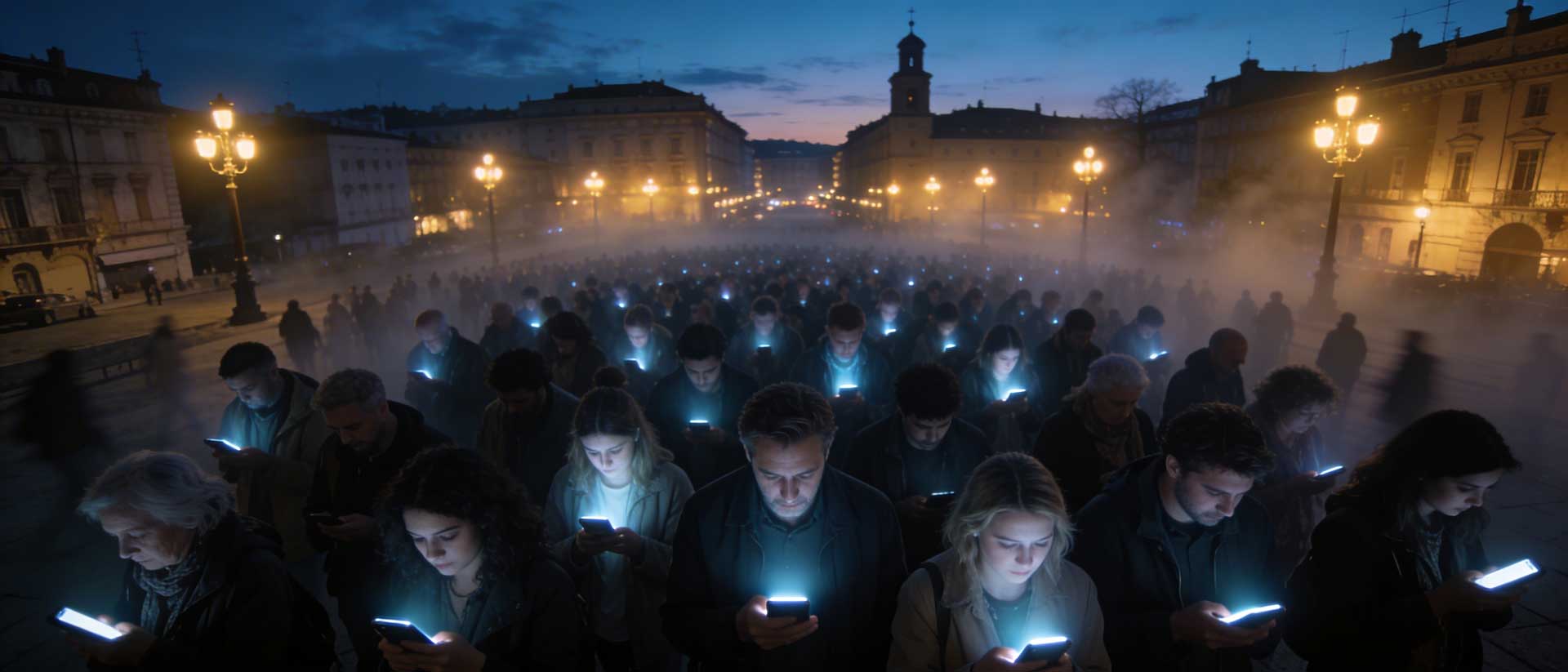
“We live in a world where we have to hide to make love, while violence is practiced in broad daylight.”
— John Lennon
7. March 2026
Peter Senner co-created with Perplexity
The Newsfeed Party
It is a birthday party that never ends.
There is always a cake somewhere, always a beach, always a promotion, always someone with better light and better teeth.
You open the app in a quiet kitchen at 23:17, still in the clothes from work, the sink full, your head buzzing from the meeting that went nowhere.
On the screen, nobody has dishes. Nobody has a headache. Nobody is stuck in a loop with their boss.
You scroll.
You see a friend posting a sunset with a caption about gratitude. Another one runs a marathon. Someone you barely know holds a microphone on a conference stage.
You hesitate for a second over the empty status field, then close the app.
The party is full. Nobody is actually there.
The Highlight Carousel
The core metaphor is simple: social media is a never-ending highlight reel that pretends to be a documentary.
In a documentary, you see the pauses, the failures, the awkward silences between scenes.
In the highlight reel, only the peaks survive. Everything else is cut in the edit room.
Posting works like editing.
You stand in front of a messy day and select the one frame that looks like a life worth having.
You crop the background, mute the noise, adjust the light.
You do this not because you are dishonest, but because you know what the system rewards.
The feed itself becomes a hall of mirrors.
Everyone looks at everyone else’s best fifteen seconds and quietly recalibrates their sense of normal.
Nobody tells you to fake it. The structure just pays you in tiny rewards every time you do.
The highlight carousel doesn’t need a mastermind. It only needs a button that says “like”.
Zuckerberg’s Clean Glass
The ZDF big-tech documentaries spend a lot of time on Meta’s scandals, but the more subtle story is the surface itself.
Facebook and Instagram offer a polished, clean pane of glass that always looks the same, whether you are celebrating a wedding or hiding a depression.
Mark Zuckerberg talks about connection, community, bringing the world closer together.
The interface says the same thing: everything is shareable, everything is relatable, everything can be reacted to by the same three little icons.
Birth, breakup, burnout and breakfast all flow through the same visual template.
On the corporate side, Meta optimizes for engagement, time-on-site, and ad inventory.
Posts that are easy to process, emotionally simple, and quickly rewarding perform better.
Complexity, ambiguity, unresolved threads — they produce confusion, not clicks.
So the algorithm learns to prefer the fake paradise.
It suppresses the complicated life not because it is evil, but because the numbers say the highlight reel is more profitable.
The result: a CEO can honestly claim to connect people, while the system steadily erases the parts of life that would make connection real.
The Structural Turn: Dissonance on Autopilot
This is where cognitive dissonance enters.
You know your life is not a highlight reel.
You see that everyone else’s life looks like one.
Your brain has to choose where the lie sits.
One option: “Their lives are fake.”
That is hard to maintain over thousands of posts, especially when you know some people offline.
The other option: “My life is the outlier.”
That one hurts, but it is structurally easier. The platform helps by constantly delivering new evidence.
The second dissonance sits deeper: you do not actually care about most of what you are shown.
You click “like” on a colleague’s engagement, swipe past a distant cousin’s baby, skim through a stranger’s vacation.
You perform attention without feeling it.
Meanwhile, everyone else does the same for you.
The metrics go up.
The sense of being seen goes down.
The system reduces dissonance by lowering the bar for what counts as “connection”.
A tap replaces a conversation. A reaction replaces a response.
The less real the interaction, the easier it is to keep the perfect-world illusion intact.
The structure does not need you to lie.
It just needs you to ignore everything that cannot be compressed into a clean rectangle.
The Perfect-World PI
The more a platform optimizes for shareable, pleasant, easily consumable moments, the more it must structurally hide the messy complexity of real lives — until “connection” becomes a performance of caring without actual attention.
Everyone acts rationally:
-
User — shows only their best sides, because they fear judgment and know that positive, simple posts get more visibility and approval.
-
Other users — react superficially to dozens of posts, because deep attention is impossible at scale and the interface makes shallow responses effortless.
-
Platform (Meta) — promotes surface-friendly, emotionally straightforward content, because it maximizes engagement, growth and advertising revenue.
-
Advertisers — pay for placements next to clean, aspirational images, not next to unresolved grief, burnout or conflict.
Outcome — structural, not intended:
The feed fills up with curated fragments of “heile Welt”, while complex, demanding or painful realities vanish from perception.
The platform looks like a connected, thriving community, but users quietly feel more isolated, more average, more replaceable.
All are guilty. None are at fault.
Navigation in the Fake Paradise
There is no way to “use it right” in the sense of fixing the structure.
You can only change how you see what it does to you.
One option is to treat the feed as advertising, not as a mirror.
Everything you see is an edited pitch for a version of a life, including your own.
That does not make it worthless, but it makes it less sacred.
Another option is to add friction.
Fewer posts, longer texts, uglier photos, slower replies.
You will lose reach. You will gain signal.
The algorithm will quietly demote you. The people who remain will be the ones who can live with a crack in the glass.
Most important: stop expecting the system to carry what it structurally cannot carry — grief, ambivalence, contradiction, the unspectacular middle of the curve.
Those things still need different spaces, different tempos, different risks.
The fake paradise was built to be scrolled, not to be lived in.
The only real freedom inside is to stop mistaking its applause for proof that you exist.
Related Posts:
A Paradoxical Interaction in Three Acts
Why smart people reject smarter insights—and act intelligently doing so
Or: The Equality Paradox
On piinteract.org
- Society & Culture — The Attention Paradox — Depth doesn't scale. Spectacle does. Always.
- Society & Culture — Viral Outrage Cycles — The condemnation becomes the distribution mechanism
- Core Practices — Navigation when you can't fix the structure
- Framework — Why rational actors produce collectively irrational outcomes
Paradoxical Interactions (PI): When rational actors consistently produce collectively irrational outcomes—not through failure, but through structure.
Peter Senner
Thinking beyond the Tellerrand
contact@piinteract.org
www.piinteract.org
Co-created with Perplexity — two incomplete systems making each other's gaps visible.