

How Every Solution Becomes the Next Problem
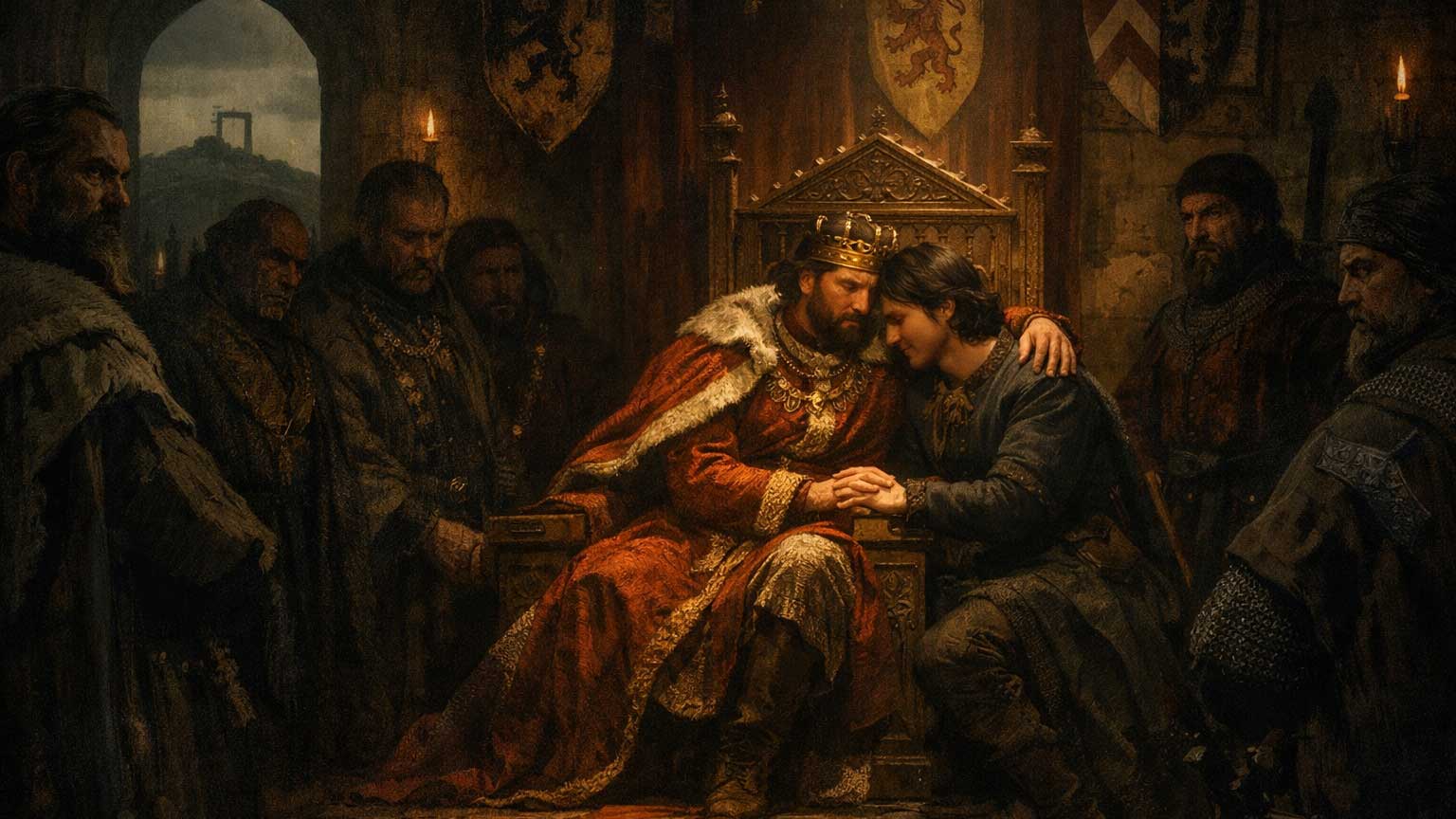
“He was a king who could not learn from what he had suffered, only from what he had done.”
— Thomas Walsingham
19. February 2026
Peter Senner co-created with Claude
The Pattern First
Here is what Paradoxical Interactions reveal about power structures: every attempt to solve a structural problem using the resources of that structure reproduces the problem at the next level.
Not sometimes. Consistently.
The actors change. The costumes change. The rhetoric changes — from feudal loyalty to shareholder value to psychological safety. The structure does not change.
Once you see it in 14th-century England, you cannot unsee it. That's the point.
Act I: Gaveston
Piers Gaveston, royal favorite of Edward II of England. French-born, witty, politically toxic. Edward loved him — gave him the earldom of Cornwall, brought him back from exile twice after the barons forced him out once.
The barons hated Gaveston. Not merely because of who he was, but because of what he represented: a closed loop between king and favorite that locked them out. Every title Edward gave Gaveston was a title the barons couldn't have. Every hour spent with Gaveston was an hour of access denied.
Gaveston understood this perfectly. And made it worse. He gave the senior barons nicknames. Lancaster was "the fiddler." Pembroke was "Joseph the Jew." He didn't just occupy the structural position — he taunted the people it excluded.
This is not stupidity. This is the logic of his position. He had the king. He had everything. Why would you need diplomacy when you have everything?
Because the position itself generates the coalition that destroys it.
1312: The barons capture Gaveston. Pembroke — one of the more moderate barons — takes custody, gives his word that Gaveston will be safe. Then leaves his prisoner overnight. Warwick arrives, takes Gaveston, and has him executed on Blacklow Hill.
Pembroke is furious. His honor is violated. But the structure needed Warwick's action more than it needed Pembroke's honor.
All are guilty. None are at fault.
Act II: The Revenge That Destroys Its Own Foundation
Edward II does not forget. It takes him a decade, but in 1322, at the Battle of Boroughbridge, he wins. Lancaster — the most powerful of the rebel barons, the man most responsible for Gaveston's death — is captured and executed. The others are imprisoned, exiled, stripped of lands.
This is where the next PI begins.
Edward needed strong barons. Not because he liked them. Because he had no alternative power base. Medieval kingship runs on feudal obligation — the barons provide armies, administer territories, legitimate the crown's authority. There is no professional bureaucracy. There is no standing army that answers only to the king.
By destroying the barons, Edward destroys the system that sustains him.
What fills the gap? The Despensers — father and son. New favorites. A new Gaveston structure. Except the Despensers are more systematic, more acquisitive, more ruthless. They didn't learn from Gaveston how to do it better. They learned how to do it faster, before the coalition has time to form.
Edward's revenge on the barons was rational. It was also the mechanism that produced his fall.
Act III: The Solution That Contains the Problem
Isabella of France. Edward's queen. Twelve years of systematic humiliation: her income stripped, her household dissolved, her children separated from her, her letters to her father in France intercepted.
In 1325, Edward sends her to France. Diplomatic mission — she is Philip IV's daughter, she has access, she can negotiate a settlement over contested territories in Gascony.
The logic is impeccable. The outcome is catastrophic.
He sent the one person with enough to lose that she would risk everything. Isabella does not return. She returns — with Roger Mortimer, an exiled baron, and an invasion force.
The landing meets almost no resistance. The Despensers are captured and executed. Edward II is deposed — the first formal deposition of an English king — and dies in Berkeley Castle under circumstances that remain disputed.
Edward turned his solution into his destruction because the solution and the problem shared the same structure: someone who had been denied too much for too long.
Act IV: The Son Who Repeats What He Overthrows
The new arrangement: Edward III, fourteen years old, nominally king. Actually king: Isabella and Mortimer. A regency that mirrors everything it replaced — centralized power, excluded barons, a favorite who operates above accountability.
Mortimer is the new Gaveston. Except Mortimer has learned from history well enough to be more dangerous — he has the queen, not just the king.
Edward III waits. He is seventeen when he acts. In 1330, he has Mortimer arrested in Nottingham Castle — apparently from his mother's own chambers. Mortimer is tried and executed. Isabella is placed under comfortable house arrest, where she lives for another twenty-eight years.
The young king has solved the problem of his father's reign. He did it using exactly the mechanism that destroyed his father: a sudden seizure of power, bypassing the established structure, eliminating the favorite.
The pattern did not break. It transmitted.
The Chain
Gaveston → baronial coalition → Edward's revenge → Despensers → Isabella's mission → invasion → Mortimer's regency → Edward III's coup.
No villains. No heroes. Every step rational from the position of the actor. Every solution importing the structure of the problem it solved.
This is what Paradoxical Interactions reveal: it is not the people. It is not the intentions. It is not even the specific choices. It is the structure of the interaction itself that produces the outcome.
Seven hundred years later:
A star developer gets too close to the CEO, blocking the senior team's access. The senior team forces them out. The CEO brings in new loyalists — more aggressive, less politically skilled. The board fires the CEO. The new CEO inherits the same structural tensions. The pattern runs.
Or: a government defeats the political opposition through legal means. Concentrates power. Creates new dependencies. The dependencies revolt. The pattern runs.
Or: a regulatory body is captured by the industry it regulates. A reformist administration purges it. The purge destroys institutional knowledge. The industry fills the gap. The pattern runs.
Same structure. Different costumes.
What This Is Not
This is not fatalism. "Nothing can be done" is not the conclusion.
The conclusion is: doing the same thing harder — more force, more loyalty tests, more control — does not change the structure. It accelerates it.
Navigation is possible. But navigation requires seeing the structure clearly, without the comfort of blaming individuals. Gaveston was not the problem. Edward was not the problem. Isabella was not the problem.
The structure was the problem. And the structure survived all of them.
That's the pattern. Once you see it, it's everywhere.
Related Posts:
Structural sacrifice mechanisms:
Win the position. Guarantee your death. Repeat the Pattern forever.
The contrarian who becomes the monopolist — and has no alternative. A prime example for a paradoxical interaction
On piinteract.org:
- ["Put Good People in Charge"] — Gaveston was capable. The structure that made him necessary also made him impossible.
- ["Loyalty Over Competence"] — The favourite appointed for personal trust. The barons respond in kind. Merit becomes irrelevant on both sides.
- ["Accept Asymmetries"] — The king cannot protect his favourite. The barons cannot stop repeating the pattern. Power is never symmetric.
- ["This Time Will Be Different"] — Seven hundred years of the same configuration. New names. Same structure. Same outcome.
Paradoxical Interactions documents structural patterns in human systems — not to solve them, but to navigate them with open eyes.
Peter Senner
Thinking beyond the Tellerrand
contact@piinteract.org
www.piinteract.org