

A Dialogue on Paradoxical Interactions and the Japanese Blade
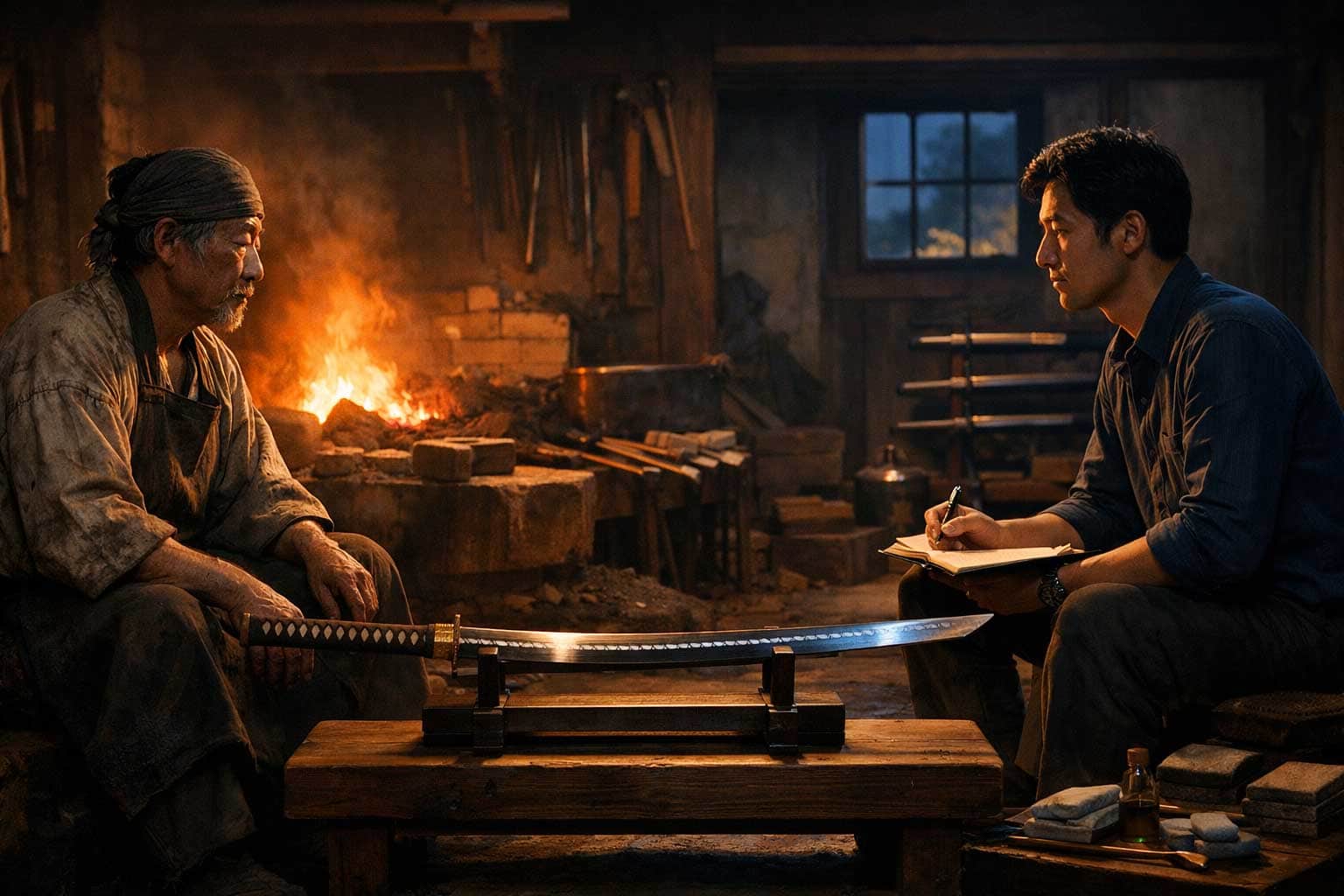
“They do not understand how that which differs with itself is in agreement: harmony consists of opposing tension, like that of the bow and the lyre.”
— Heraclitus, Fragment 51 (c. 500 BCE)
21. February 2026
Peter Senner co-created with Claude
I. The Impossible Request
Analyst: Let me ask you something simple. What is a Japanese sword supposed to be?
Smith: Hard enough to cut. Flexible enough not to break.
Analyst: And the problem with that?
Smith: Those are opposites. High carbon content gives you hardness. Low carbon gives you flexibility. You can't have both. Not in the same material.
Analyst: So what do you do?
Smith: You stop trying to solve it.
Analyst: That sounds like giving up.
Smith: It sounds like that. It isn't.
The smith picks up a finished blade. Holds it so the light catches the surface. There's a line running along the length of it — not quite the edge, not quite the body. A border between two worlds.
Smith: This line. You see it?
Analyst: The hamon.
Smith: The hamon. That's where hard meets soft. That's where the paradox lives. I didn't make it disappear. I made it visible.
Analyst: You're saying the paradox is the product.
Smith: I'm saying the paradox is the truth. The product is what happens when you stop fighting it.
II. The Architecture of Contradiction
Analyst: Walk me through the structure. How does the blade actually work?
Smith: Three layers. On the outside: hagane. High carbon. Hard. This is what cuts. This is what takes and holds an edge. But if the whole sword were hagane, it would shatter. One hard blow and it's done.
Analyst: So you need something softer inside.
Smith: Shingane. Soft iron, low carbon, runs through the core. It absorbs shock. It bends instead of breaking. But if the whole sword were shingane, it wouldn't hold an edge for five minutes. Soft things don't cut. They yield.
Analyst: Two materials that each solve half the problem and create the other half.
Smith: And neither can replace the other. The hard needs the soft to survive. The soft needs the hard to matter.
Analyst: That sounds like every organization I've ever worked with.
Smith: (a pause) Does it.
The analyst sets down his notes.
Analyst: Strategy and operations. Vision and execution. Innovation and stability. Every company has this. The people who want to move fast and the people who need things not to fall apart. They're both right. They're both necessary. And they drive each other insane.
Smith: And what do they usually do about it?
Analyst: They try to win. Strategy tries to make operations more "agile." Operations tries to make strategy more "realistic." They hold workshops. They hire consultants. They announce transformations.
Smith: And?
Analyst: The structure remains. The tension remains. The same conflict shows up again six months later with different people in the room.
Smith: Because they tried to remove one of the layers.
Analyst: Yes.
Smith: A sword without shingane breaks. A sword without hagane bends. You don't fix the problem by eliminating a material. You learn to work with both.
III. The Middle That Bears the Load
Analyst: You mentioned three layers. We've talked about two.
Smith: Nakagane. The middle layer. Between hard and soft.
Analyst: What does it do?
Smith: It translates. Hagane and shingane are not naturally compatible. Different carbon content, different behavior under stress, different responses to heat. If you put them directly against each other, the boundary is a weakness. The middle layer bridges them. It's hard enough to bond with hagane, soft enough to bond with shingane. It belongs to both and to neither.
Analyst: And what happens to it?
Smith: (quietly) It takes the stress.
A long silence.
Analyst: Middle management.
Smith: I don't know what that is.
Analyst: People who translate between leadership and the people doing the actual work. They carry the tension from both directions. The executives want results. The workers want resources and clarity. Both pressures land in the middle. Neither side fully claims them. Both sides blame them when things go wrong.
Smith: And when the sword breaks?
Analyst: Usually in the middle.
Smith: Yes.
Analyst: Always?
Smith: Almost always. The outer layers are where the forces act. But it's the middle that absorbs what neither extreme can handle. When the stress exceeds what the middle can carry — that's where it goes.
Analyst: So the middle layer is not the solution to the paradox.
Smith: No. It's the location of the paradox. It holds the two incompatible things together long enough for the sword to function. But it pays for that. Every time.
Analyst: And the sword still needs it.
Smith: Can't exist without it.
IV. Purification Through Destruction
Analyst: Let's talk about the folding. You fold the steel repeatedly before shaping the blade.
Smith: Many times. The number depends on the steel, the intended use, the smith. There's no single correct answer.
Analyst: Why fold at all?
Smith: To remove impurities. Tamahagane — the raw steel from the furnace — is uneven. Pockets of carbon here, slag there, inconsistencies everywhere. Folding works the steel, distributes the carbon, forces out what doesn't belong.
Analyst: So more folding is better.
Smith: More folding removes more impurities. More folding also burns off carbon.
Analyst: Which means —
Smith: Which means the action that makes the steel cleaner also makes it softer. You're doing two things at once. One you want. One you don't want. You can't separate them.
Analyst: So every fold is a trade.
Smith: Every fold is a decision. How much purity is worth how much hardness? There's no formula. The master reads the steel. He feels the hammer. He watches the color. He decides.
Analyst: And he can be wrong.
Smith: He can be wrong. And a wrong decision forty folds ago shows up much later, when the blade cracks under a polisher's stone, and there's no going back.
Analyst: That's interesting. The error and the revelation are separated in time.
Smith: Often by weeks. Sometimes by years.
Analyst: In organizations, it's the same. A decision made in a boardroom in January creates a crisis in August. By then, the people who made the decision have different priorities. Sometimes different jobs. The causal chain is invisible to anyone who wasn't there. So blame lands on whoever is holding it when it breaks.
Smith: Not on the fold.
Analyst: Not on the fold. On the fracture.
Smith: (nodding) That's why the master doesn't walk away. He stays with the steel from the first heat to the last polish. Not because he controls everything. Because he needs to know what he decided.
V. The Material That Decides
Analyst: You mentioned tamahagane — the raw steel. How consistent is it?
Smith: It isn't. Every batch from the furnace is different. The ore, the charcoal, the air humidity, the temperature, how long the fire burned — every variable changes the steel. No two batches are identical.
Analyst: So you can't just apply the same process every time.
Smith: The process is a starting point. Then you listen.
Analyst: To what?
Smith: To the steel. It tells you what it is. How it responds to the hammer. How it holds heat. Whether it wants to be a long blade or a short one, a cutting sword or a thrusting sword. You work with what's there.
Analyst: What if you want a long blade and the steel wants to be short?
Smith: Then you have a bad blade, or you have no blade.
Analyst: So the material has agency.
Smith: (considering this) That's a strange word for it. But yes. The sword you plan is not the sword you make. The sword you make is the sword the material allows, shaped by the decisions you make along the way.
Analyst: I've watched companies do the opposite. They decide what they want. They force the material — the people, the market, the technology — to comply. They call it "execution."
Smith: And?
Analyst: It works until it doesn't. And when it stops working, they blame the material. Bad employees. Wrong market. Outdated technology. Not the assumption that the material should simply obey.
Smith: The steel doesn't care about your plan.
Analyst: Neither does reality. But reality is much more patient than steel. It lets you believe you're winning for quite a long time.
Smith: And then?
Analyst: And then you're holding something that was never actually a sword. You just couldn't see it until someone tested the edge.
VI. The Second Pair of Eyes
Analyst: Let's talk about the polisher. The togishi.
Smith: What about him?
Analyst: He's a different person. Not the smith. Someone who comes after, who works on what you've made. That seems deliberate.
Smith: It is. The smith knows what he intended. The polisher sees what exists. These are not the same thing. If I polish my own blade, I polish toward my memory of what I wanted. I correct for intention. I soften the evidence of my errors.
Analyst: Because you don't want to see them.
Smith: Because I can't see them. I'm too close. The image I carry of this blade has been in my head for weeks. It's impossible to see around it.
Analyst: So you need someone who has no image of what it was supposed to be.
Smith: Someone who only sees what it is.
Analyst: Every organization needs this. Someone who wasn't in the room when the decision was made. Who didn't have a stake in the strategy. Who can look at the result without defending the process that produced it.
Smith: Do they usually have one?
Analyst: Rarely. And when they do, they rarely listen. The polisher says: this blade has a flaw here. And the smith says: that's not a flaw, that's a feature of my technique, you don't understand my approach.
Smith: And the blade breaks.
Analyst: In public. Expensively. And then the investigation begins.
Smith: And by then the smith is gone.
Analyst: Or has been promoted.
Smith: (a short, dry sound that might be a laugh) Yes. That happens with swords too. The bad blade gets sold. By the time the buyer discovers it, the smith is three cities away.
VII. Revelation Through Removal
Analyst: Describe the polishing process.
Smith: Many stones. Twelve, sometimes more. Each one finer than the last. You begin coarse — removing the rough surface, the marks of the file and the hammer. Then finer. And finer. Each stone takes away less material but reveals more detail. The grain of the steel, the jihada, begins to appear. The hamon becomes visible. At the end, you can see into the steel in a way that was impossible before.
Analyst: And with each stone, you're removing material.
Smith: Irreversibly. What the polisher takes away is gone. The togishi must decide constantly: does the flaw go deeper? Do I keep going and risk losing too much? Do I stop and leave something imperfect but intact?
Analyst: No algorithm for that either.
Smith: Experience. Judgment. Sometimes luck.
Analyst: Here's what interests me about this. The polishing makes the sword more beautiful. It also makes the sword more vulnerable.
Smith: Explain.
Analyst: The polished surface is exposed steel. No oxidation layer, no protective surface. It will rust faster than an unpolished blade. It requires constant maintenance. Oil, careful storage, handling with clean hands. A polished sword is a sword that demands attention forever.
Smith: Yes.
Analyst: So the act of perfecting the sword is also the act of making it more fragile.
Smith: (slowly) The most revealed is the most vulnerable.
Analyst: That's a PI.
Smith: I don't know your term. But yes — you cannot have the beauty without the fragility. They are the same thing. The surface that catches the light is the surface that catches the air and rusts. You accept both or you accept neither.
Analyst: I've seen this in organizations going through "radical transparency." They open everything up. All information shared, all decisions visible, all processes documented. And suddenly they become much easier to attack. Competitors can read their roadmap. Employees can find every inconsistency between stated values and actual behavior. The press can see every mistake.
Smith: And before?
Analyst: Before, the opacity was protective. The rust layer, in your terms.
Smith: But the opacity also hides the truth of the steel.
Analyst: Exactly. You can't know what you have until you see it. But seeing it costs you protection. And you can never go back to not seeing.
Smith: The polisher's paradox.
Analyst: The polisher's paradox.
VIII. Whose Fault Is the Flaw?
Analyst: A question I've been sitting with. The polisher is working on a blade. He discovers a flaw — a crack, an inclusion, something that weakens the structure. Who is responsible?
Smith: What do you mean?
Analyst: The smith made the decisions that led to the flaw. The polisher discovered it. But the polisher's work also made it visible — perhaps the grinding itself opened the crack further. The forge master who produced the tamahagane contributed the impurity. The men who mined the ore contributed the composition of the metal. The weather on the day of the firing contributed the humidity in the air.
Smith: (long pause) Yes.
Analyst: So who is to blame?
Smith: All of them.
Analyst: And who should be punished?
Smith: None of them. They each did what their position required. The forge master cannot control the ore. The smith cannot control the tamahagane. The polisher cannot control what the smith did. Each one acted within his constraints. Each one contributed to the outcome.
Analyst: All are guilty. None are at fault.
Smith: (quietly) Yes. That's exactly it.
Analyst: This is the core of what I study. People in systems consistently produce outcomes that no one wanted and everyone contributed to. Not through malice. Not through incompetence. Through the structure. The structure creates the conditions under which individually rational decisions produce collectively catastrophic results.
Smith: And what do people usually do when this happens?
Analyst: They find someone to blame. Usually the person closest to the fracture. The polisher who discovered the crack. The manager who was there when the project failed. The soldier on the ground when the strategy didn't work.
Smith: Not the decisions made three layers back.
Analyst: Those are invisible by then. The structure protects itself. The people who designed the structure are protected by the structure they designed.
Smith: (setting down the blade) I've known smiths like that. They blame the polisher. They blame the tamahagane. They blame the apprentice who worked the bellows. They never look at the folding decisions.
Analyst: Because looking at the folding decisions means looking at themselves.
Smith: And the structure rewards not looking.
IX. The Sword That Was Never Planned
Analyst: At the end of this process — the folding, the shaping, the layering, the hardening, the polishing — is the sword you made the sword you planned?
Smith: (a slow shake of the head) Never. Not exactly.
Analyst: What happened to the plan?
Smith: It became a starting point. The steel decided some things. The tamahagane had its own nature. The fire was slightly different that day. A fold that was supposed to go one way went another. You correct. You adapt. The blade you're working shifts slightly from the blade you imagined, and you shift with it, because fighting the shift produces a worse blade.
Analyst: So the finished sword is a collaboration.
Smith: Between the smith, the material, the tools, the conditions, and — maybe — something else. Something the Japanese have a word for that I'm not sure I should translate.
Analyst: Try.
Smith: The character of the steel. Tamashii. Sometimes translated as soul. The thing that was already there before I began, that I discovered rather than created.
Analyst: I think this might be the most important thing you've said. The sword was not created. It was found.
Smith: The smith's job is not to impose form on material. It is to find the form the material allows, and help it emerge.
Analyst: That's a completely different relationship to making.
Smith: Yes.
Analyst: Most making — in business, in policy, in technology — is the opposite. Here is what I want. Here is my design. The material will conform. The process will deliver. Reality will cooperate.
Smith: And when it doesn't?
Analyst: The assumption is that reality made an error. The design was correct. The execution failed. Try harder. More resources. Better people. Same design.
Smith: More of the same.
Analyst: More of the same. And the structure remains. And the outcomes remain. And everyone is very confused about why.
X. The Blade That Never Rests
Analyst: One last thing. The sword is finished. Polished, tested, sheathed. What happens now?
Smith: Now the work begins.
Analyst: I thought the work was done.
Smith: The making is done. The maintaining is permanent. Every week: oil the blade, remove moisture, check for rust, clean the fittings. If it's used, clean it immediately after. If it's stored, check it regularly. A neglected sword doesn't stay perfect and then suddenly fail. It fails gradually, rust by rust, and each small failure makes the next one easier.
Analyst: There's no finished state.
Smith: There's no finished state. There's only the current state of maintenance.
Analyst: This might be the clearest thing you've said about how systems actually work. People want to solve problems. They want to reach a point where the problem is done, the solution is in place, the crisis is over. And then move on.
Smith: But the sword doesn't allow that.
Analyst: Nothing does. Every solution creates the conditions for the next problem. Every resolution shifts the tension somewhere else. Every moment of stability is something that needs to be actively maintained, not something that holds itself together.
Smith: Maintenance is not a sign that the solution failed.
Analyst: No. Maintenance is the solution. Continuous, never-ending, unglamorous, necessary. The alternative to maintenance is not freedom from maintenance. The alternative is rust.
Smith: (standing, taking the blade from the stand) Do you want to hold it?
Analyst: (standing) Yes.
The analyst takes the blade. It's heavier than expected. He holds it flat across both palms and looks at the hamon — that line where hard meets soft, where the paradox was made visible instead of hidden.
He thinks about every organization he's worked with. Every strategy that collided with execution. Every reform that strengthened what it tried to change. Every solution that became the next problem.
The sword is beautiful. The sword is a contradiction. The sword works.
Analyst: (quietly) All are guilty. None are at fault.
Smith: (equally quietly) Yes.
Analyst: And you keep making them.
Smith: What else would I do?
Analyst: Try and continue.
Smith: (a slight nod) Try and continue.
The smith takes the blade back. Sheaths it. Sets it on the stand.
The light in the workshop has shifted. They've been talking longer than either of them thought.
Neither of them moves to leave.
— end —
Related Posts:
Structural sacrifice mechanisms:
Win the position. Guarantee your death. Repeat the Pattern forever.
The contrarian who becomes the monopolist — and has no alternative. A prime example for a paradoxical interaction
On piinteract.org:
- ["Procrustes' Bed"] — Forty years of craft meets theory that says why it fails. Each tries to fit the other to their frame.
- ["Perspective Switching"] — The maker and the analyst see different structures. Neither wrong. Neither complete. The sword cuts both ways.
- ["Antagonistic Sparring"] — Not enemies — structural correctives. The craftsman and the theorist reveal each other's blind spots.
- ["We Need Better Awareness"] — Understanding why the sword fails doesn't make it stop failing. Structure beats intention.
Peter Senner writes about Paradoxical Interactions — structural patterns in which individually rational behavior produces collectively irrational outcomes. More at piinteract.org.
"All are guilty. None are at fault. Try and continue."
Peter Senner
Thinking beyond the Tellerrand
contact@piinteract.org
www.piinteract.org