

Why a dynasty built its palace as a fortress against its own city — and why the structure that followed was inevitable.
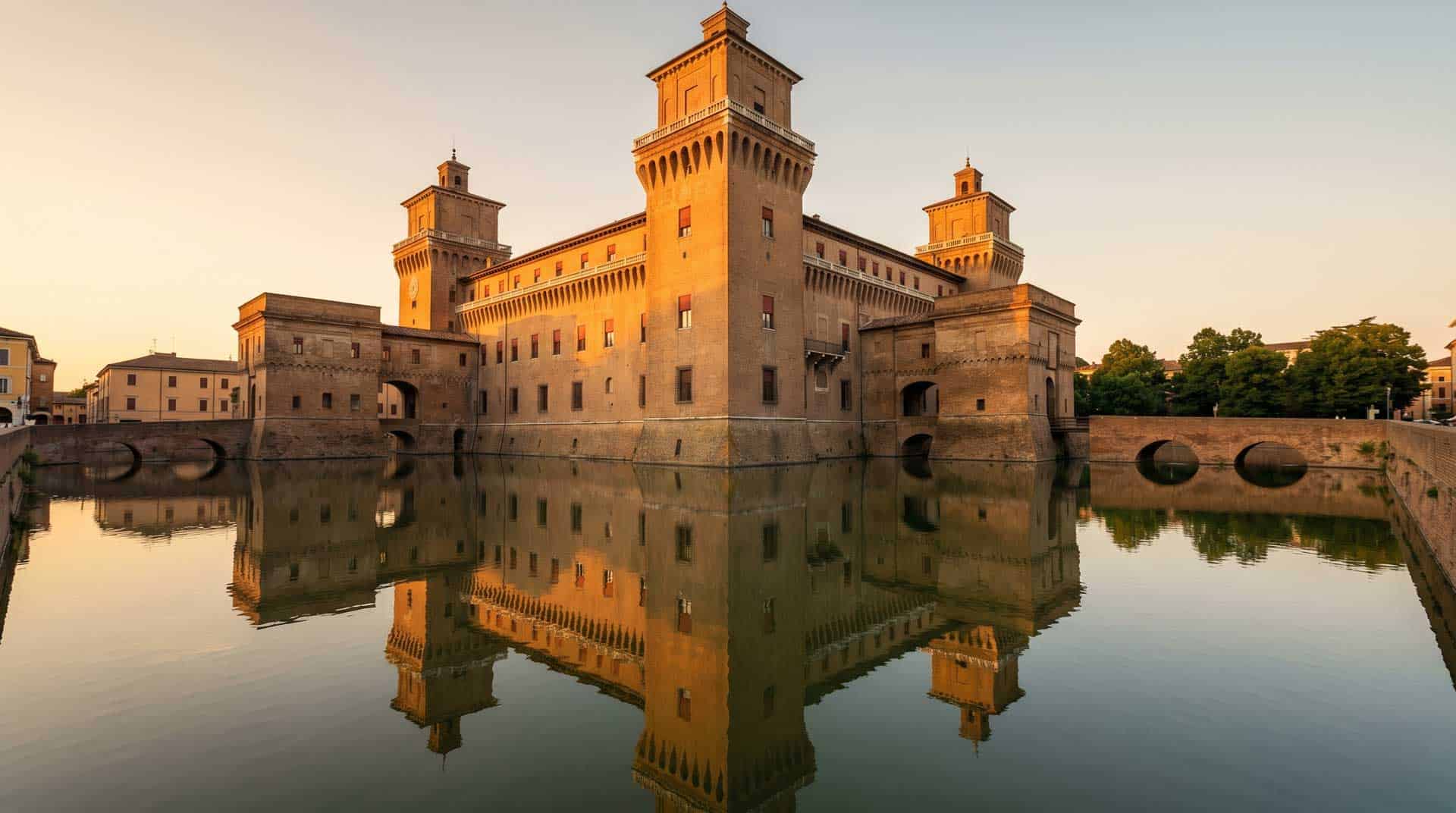
"La fortezza è utile o no secondo i tempi." "The fortress is useful or not, depending on the times."
— Niccolò Machiavelli, Il Principe
In 1385, the people of Ferrara killed a tax collector on the market square. His name was Tommaso da Tortona. The Este had him collecting what the city could not afford to pay. The city responded the way cities respond when they have no other option. Three days later, Niccolò II d'Este commissioned the Castello. Not at the city gates. In the center. Surrounded by a moat. Drawbridge included.
The fortress was not built against an external enemy. It was built against the governed.
5. June 2026
The Moat as Argument
The Castello Estense is architecturally honest in a way that few buildings dare to be. It does not pretend to protect. It announces: we do not trust you, and we are prepared for you.
Most power hides this. It builds institutions, ceremonies, parliaments. It wraps the relationship between ruler and ruled in the language of mutual benefit. The Este skipped the ceremony. The moat was the message.
What the architecture could not solve was the logic that generated it. The Este needed taxes. The population could not pay. The Este extracted anyway. The population resisted. The Este built the castle. And then — still needed taxes.
The moat did not resolve the contradiction. It institutionalized it.
The Room with One Ray of Light
Inside the castello, the brother. Ugo d'Este, kept prisoner for years in a cell constructed within the walls of the family's own seat of power. The cell was not built outside — not in a dungeon somewhere across the city. It was built in. The prison was architectural proof of the family's internal logic: control was total, and it began at home.
But the cell had a specific opening — calibrated to deliver a single shaft of daylight. Not freedom. Not communication. Just enough light to remain alive, which is to say, just enough to remain a prisoner.
The Este did not want Ugo dead. Dead, he was no longer controllable. Alive, in permanent semi-darkness, he remained an instrument — a threat managed, a warning maintained, a piece on the board.
This is structural logic, not cruelty. Cruelty would have been easier to stop.
The Most Beautiful Woman in the World
Lucrezia Borgia arrived in Ferrara in 1502 to marry Alfonso d'Este. She was 22 years old. Contemporary accounts describe her as the most beautiful woman of her time. She had already been married twice — the first marriage annulled, the second husband murdered, most likely by her brother Cesare. Her reputation preceded her: poison, manipulation, political instrument.
Ferrara was suspicious. Alfonso was pragmatic. The Borgia alliance offered what the Este needed — papal backing, political cover, military support.
Lucrezia spent the rest of her life in Ferrara. She became a patron of the arts, a correspondent of poets, a respected duchess. The woman who arrived under suspicion died under something approaching affection — or at least respect.
What changed? Nothing structural. She had been a political instrument her entire life. In Ferrara, the instrument fit the socket. The castello remained the castello. The moat remained the moat. The logic of dynastic calculation remained constant. Only the outcome looked different from the outside.
The Paradoxical Interaction
The Este Castle PI: A ruling structure extracts from the population it governs until the population resists. The response to resistance is not accommodation — it is fortification. The fortification deepens the distrust. The deepened distrust justifies the fortification. The structure reproduces itself through the very tensions it generates.
Everyone acts rationally:
- The Este — collect taxes to fund the state, suppress resistance to maintain authority, build architecture to signal permanence
- The population — resist extraction they cannot sustain, interpret the fortress as confirmation that the ruler sees them as enemy
- Ugo — survives by existing, which is all the cell permits
- Lucrezia — navigates each structure as she finds it, adapts, persists
- Outcome — a dynasty that governed for a century and a half from behind a moat, structurally unable to dissolve the distance it created
All are guilty. None are at fault.
What the Tourists Pay to See
The Castello Estense is open daily. Entry fee: around €10. The population of Ferrara, and visitors from everywhere, pay to cross the drawbridge that was designed to keep their predecessors out.
The moat is still there. The water is decorative now.
This is not irony. This is how structures end — not by being dismantled, but by being repurposed. The thing that was built to dominate becomes the thing that attracts. The memory of the purpose fades. The architecture remains.
Lucrezia is buried in Ferrara. Alfonso's tomb is less well-documented. Ugo's cell is part of the tour.
The structure outlasted everyone inside it. It always does.
I Was There
I visited Ferrara around 2014. I stood in front of the moat and felt something that I didn't have a name for yet.
It wasn't the beauty of the architecture. It wasn't the history — the dates, the dynasties, the names on the plaques. It was something underneath all of that. A dissonance. The official story said: palace, Renaissance splendor, cultural heritage. But what I was looking at said something else entirely. This was not built for the people inside the city. This was built against them.
I didn't have the word "PI" then. I didn't have the framework. I had the feeling — the specific, unmistakable sensation of a structure that refuses to be what it claims to be. The moat doesn't lie. Stone doesn't lie. You can put up any plaque you want. The water is still there.
I've thought about that afternoon many times since. Not because Ferrara was exceptional — but because it was legible. The contradiction was built in, literally. Most structures hide it better. Here it was just standing in the open, reflected in decorative water, charging €10 a head.
I could see it in 2014. I just couldn't name it yet.
That's how PI works. It's always already there. The naming comes later.
Related Posts
How Every Solution Becomes the Next Problem
Win the position. Guarantee your death. Repeat the Pattern forever.
Why truth-tellers get ignored until it's too late
Why the dead are right more often than the living — and why the structure that silenced them is unchanged.
On piinteract.org:
- ["Democracy Erosion"] — The Este did not abandon the pretense of legitimate rule — they maintained it from behind a moat, which is the structural template for managed democratic erosion.
- ["Name the Paradox"] — The castello names the paradox in stone: the ruler who must fortify against the governed has already lost the relationship — and cannot admit it.
- ["You Are Never Just Yourself"] — Lucrezia arrived in Ferrara not as a person but as a structural instrument; the person who emerged was a product of what the structure permitted.
- ["The Peacemaker as Traitor"] — Any Este ruler who attempted to dissolve the moat would have been structurally read as weakness — the gesture of opening is the signal of vulnerability.
See also (external links):
Castello Estense — Ferrara official site — Primary source for the castle's documented history, including the 1385 founding and the surviving prison cells.
Lucrezia Borgia: Life, Death, and Reputation — Sarah Bradford biography overview (Cambridge) — Scholarly examination of how Lucrezia's documented life differs from the structural role she was assigned by contemporaries and historians alike.
The Este Dynasty — Encyclopedia Britannica — Institutional overview of the dynasty's structure, succession logic, and the role of Ferrara as a signorial state.
Signorie and the Architecture of Control in Renaissance Italy — Journal of the Society of Architectural Historians — Peer-reviewed context for why Renaissance Italian rulers built fortified residences within city centers rather than at city perimeters.
Paradoxical Interactions (PI): When rational actors consistently produce collectively irrational outcomes — not through failure, but through structure.
All are guilty. None are at fault.
Peter Senner Thinking beyond the Tellerrand
contact@piinteract.org
https://piinteract.org
Co-created with Claude (Anthropic) — two incomplete systems making each other's gaps visible.