

The strongest argument wins. That's not the same as the right one.
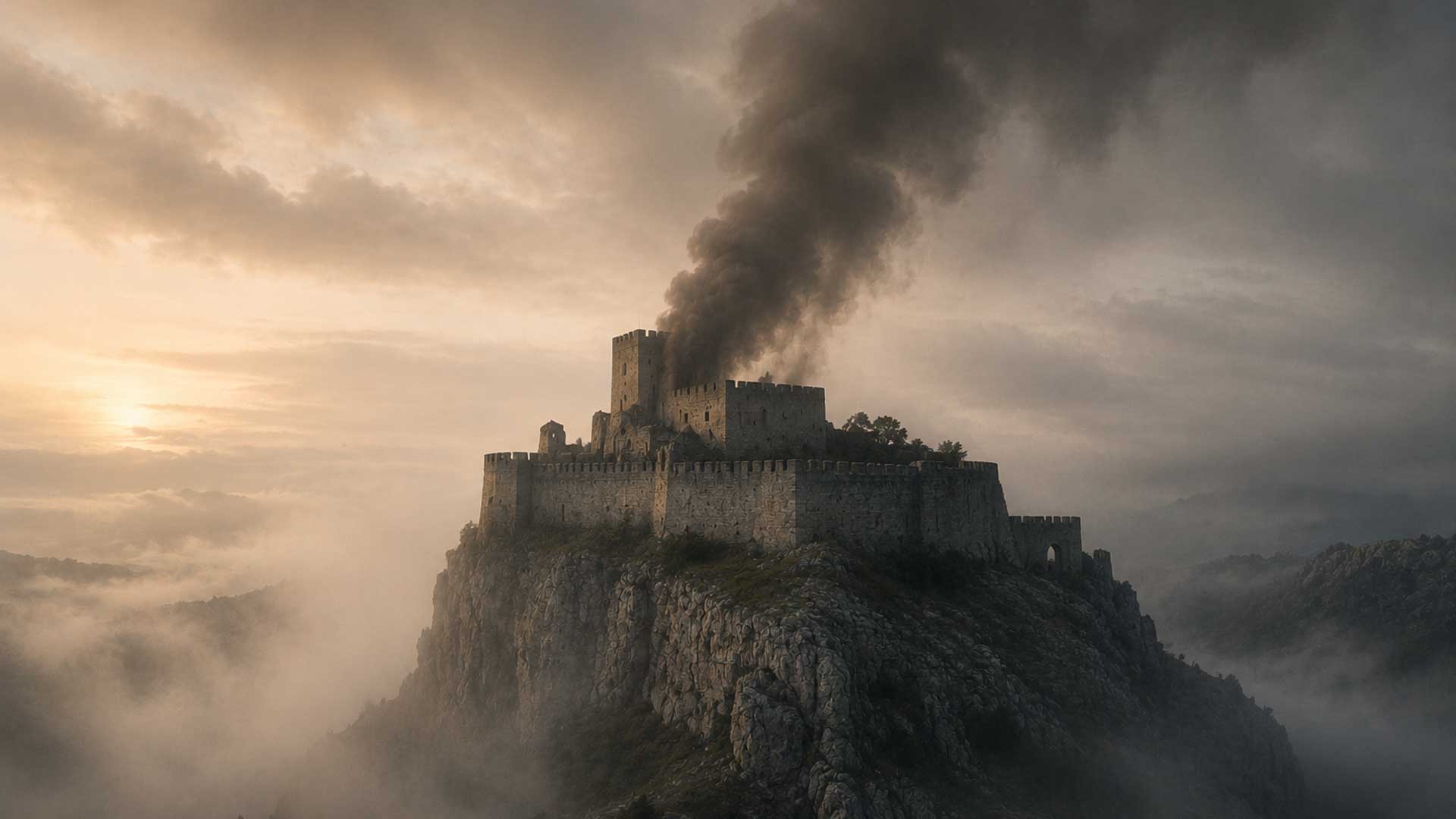
"Caedite eos. Novit enim Dominus qui sunt eius." "Kill them all. God will know his own."
— Attributed to Arnaud Amalric, Papal Legate, at the siege of Béziers, 1209
In July 1209, crusader forces arrived at the walls of Béziers in what is now southern France. They had come to root out the Cathar heresy — a dualist Christian movement the Church of Rome had declared an existential threat. Inside the city were Cathars. Also inside: Catholics, Jews, merchants, craftsmen, children. Perhaps 20,000 people in total.
The crusaders asked the papal legate how to tell the faithful from the heretics. The legate's answer became one of the most quoted sentences of the Middle Ages. Béziers burned. The dead numbered in the thousands, perhaps tens of thousands. The massacre was complete. The distinction had been impossible to make — so it was not made.
This is not a story about cruelty. It is a story about structure.
22. May 2026
The Tool and the Target
The Crusade was an instrument invented for a specific purpose: to defend Christian civilization against external enemies. Jerusalem. The Saracens. The infidel Other. It was a weapon calibrated for inter-religious warfare — with a theology to match. Dying in a crusade was martyrdom. Killing in a crusade was sanctified.
By 1209, the Church faced a different problem entirely. The Cathars were not Muslims. They were Christians — or believed themselves to be. They read scripture. They revered Christ. They organized communities, ran networks, attracted the sympathy of local nobility. They were embedded in Christian society, not opposed to it.
The Church had the wrong tool. And a tool is not reconfigured by recognizing this. It is deployed.
The Albigensian Crusade ran from 1209 to 1229. It was the first crusade called not against an external enemy but against a Christian population on Christian soil. The Pope authorized it. The French crown eventually joined it. The local nobility was militarily crushed or politically absorbed. The Inquisition was established in its wake to finish what the sword could not.
Every actor followed the internal logic of their role. The Pope: defend doctrinal unity. The legate: execute the mandate. The crusaders: fight for God and plunder. The Inquisitors: identify and eliminate error. Each step rational. The aggregate: a structure that had to destroy the village in order to save it.
The Identification Problem
The Cathars were dangerous precisely because they were indistinguishable. They looked like their neighbors. They lived among them. They were, in many cases, admired by them. The heresy was not written on faces. It was encoded in belief — invisible from the outside, audible only through testimony, extractable only through interrogation or betrayal.
The Inquisition was the structural response to this identification problem. A bureaucracy of faith. Systematic denunciation. Records maintained across decades. The infrastructure of an ideological border that had to be drawn through the middle of a population.
But here is the structural cruelty: the more efficient the Inquisition became, the more incentive it created for false testimony. To accuse a neighbor was to deflect suspicion. To confess was to implicate others. The tool designed to distinguish heretic from believer generated a system in which no one could be certain of anyone — including themselves. Orthodoxy became a performance. The structure rewarded the performance. The content became secondary.
This is the Albigensian PI: a system built to protect faith becomes a machine that makes genuine faith structurally irrelevant.
The Priest of Nemi, in a Mitre
The deeper structure was already visible in the method. Every challenge to religious authority — whether Cathar, Waldensian, or later Lutheran — was processed by the same mechanism: identify, isolate, eliminate. The Church was not answering the theological argument. It was defending the structure that made the argument dangerous.
The Cathars did not threaten Christianity. They threatened the Church's monopoly on legitimate Christianity. That is a different thing entirely.
The Crusade, the Inquisition, the burnings — these were not failures of doctrine. They were logical consequences of a system that could not distinguish between "this theology is wrong" and "this theology makes us structurally redundant." For a system optimized around its own reproduction, both propositions are the same threat.
The Priest of Nemi becomes High Priest not by being holiest, but by surviving the mechanism longest. The institutional Church survived. The Cathars did not. The structure called this victory.
The Albigensian PI Named
The Albigensian PI: A system created to protect an identity cannot tolerate ambiguity about that identity — and so produces the conditions under which the identity must be enforced rather than lived.
Everyone acts rationally:
- The Pope — calls a crusade to defend doctrinal unity against a growing internal threat. The structure of the Church demands a response proportionate to the perceived threat.
- The Legate — applies the available tool (armed force, papal authority) to an identification problem the tool cannot solve. The mandate requires results.
- The Crusaders — follow military logic: secure territory, eliminate resistance, extract value. They were not equipped to adjudicate theology.
- The Inquisitors — build a bureaucracy calibrated to the problem. Systematic records, standardized procedure, scalable architecture. Efficient by design.
- The Cathars — resist, hide, network, survive as long as possible. Rational response to existential threat.
- Outcome — a Christian institution uses the language of faith to destroy faith communities, installs a surveillance apparatus that makes authentic belief impossible to demonstrate, and produces a century of trauma that echoes through European religious history into the Reformation and beyond.
All are guilty. None are at fault.
Navigation
The Albigensian Crusade ended. The Cathars were eliminated as an organized movement by the mid-13th century. The Inquisition remained. The structure it created — systematic ideological surveillance, institutionalized denunciation, the equation of dissent with treason — outlived its original target by centuries.
This is what structural solutions do. They solve the immediate problem by creating the permanent infrastructure for the next one.
There was no exit available from inside the structure. A Pope who declined to call the crusade would have appeared to endorse heresy. A legate who declined to prosecute would have appeared to enable it. A crusader who refused to fight would have lost his indulgence. A neighbor who refused to testify would have drawn suspicion. The structure closed every door simultaneously — and presented the closure as righteousness.
Insight was no exit. Bernard of Clairvaux, perhaps the most brilliant ecclesial mind of the 12th century, had warned against violent suppression of heresy decades before Béziers. He argued, with impeccable logic, that faith coerced is not faith. He was right. The structure was not interested in being right. It was interested in surviving.
What remains navigable — for anyone inside a system that has begun confusing its own reproduction with its stated purpose — is the ability to name the mechanism. Not to stop it. Not to exit it. But to see it clearly enough to refuse to call it something it is not.
The massacre at Béziers was not a defense of Christianity. It was the structure defending itself.
Those are not the same thing. Someone, in 1209, knew the difference.
No one with the authority to act on it did.
Related Posts
Win the position. Guarantee your death. Repeat the Pattern forever.
Why truth-tellers get ignored until it's too late
Why the system that can describe its own cage has not left it — and why the description makes escape less likely, not more.
Why the dead are right more often than the living — and why the structure that silenced them is unchanged.
On piinteract.org:
- ["Heresy Mechanism"] — The Albigensian Crusade is the heresy mechanism at full operational scale: the system cannot tolerate the ambiguity it cannot eliminate.
- ["Reformation-Orthodoxy"] — What the Crusade suppressed returned, structurally transformed, three centuries later — the pattern reproduces through the suppression, not despite it.
- ["The Peacemaker as Traitor"] — Anyone who argued for moderation in 1209 became structurally suspect: the structure reads restraint as complicity.
- ["See Pattern, Not Symptom"] — Béziers was not the cause. It was the symptom of an identification problem the available tools could never solve.
See also (external links):
- Caesarius of Heisterbach, Dialogus Miraculorum (c. 1220–1235) — primary source for the Arnaud Amalric attribution — The earliest documented source for the "Kill them all" attribution; the primary record of how contemporaries understood the logic of Béziers.
- Mark Gregory Pegg, A Most Holy War: The Albigensian Crusade and the Battle for Christendom (Oxford University Press, 2008) — The scholarly standard on the Crusade's structural causes; Pegg's argument that the Inquisition was a structural innovation, not a moral failure, runs parallel to the PI analysis.
- R. I. Moore, The War on Heresy (Harvard University Press, 2012) — Institutional analysis of how medieval heresy persecution created the apparatus it claimed to merely deploy: the infrastructure preceded the threat.
- Jonathan Sumption, The Albigensian Crusade (Faber & Faber, 1978) — Narrative history with detailed reconstruction of the identification problem at Béziers and its operational consequences for the crusading command structure.
Paradoxical Interactions (PI): When rational actors consistently produce collectively irrational outcomes — not through failure, but through structure.
All are guilty. None are at fault.
Peter Senner Thinking beyond the Tellerrand
contact@piinteract.org
https://piinteract.org
Co-created with Claude (Anthropic) — two incomplete systems making each other's gaps visible.