

Why the unresolved tension between relativity and quantum theory is not a gap in physics — but proof that physics works.
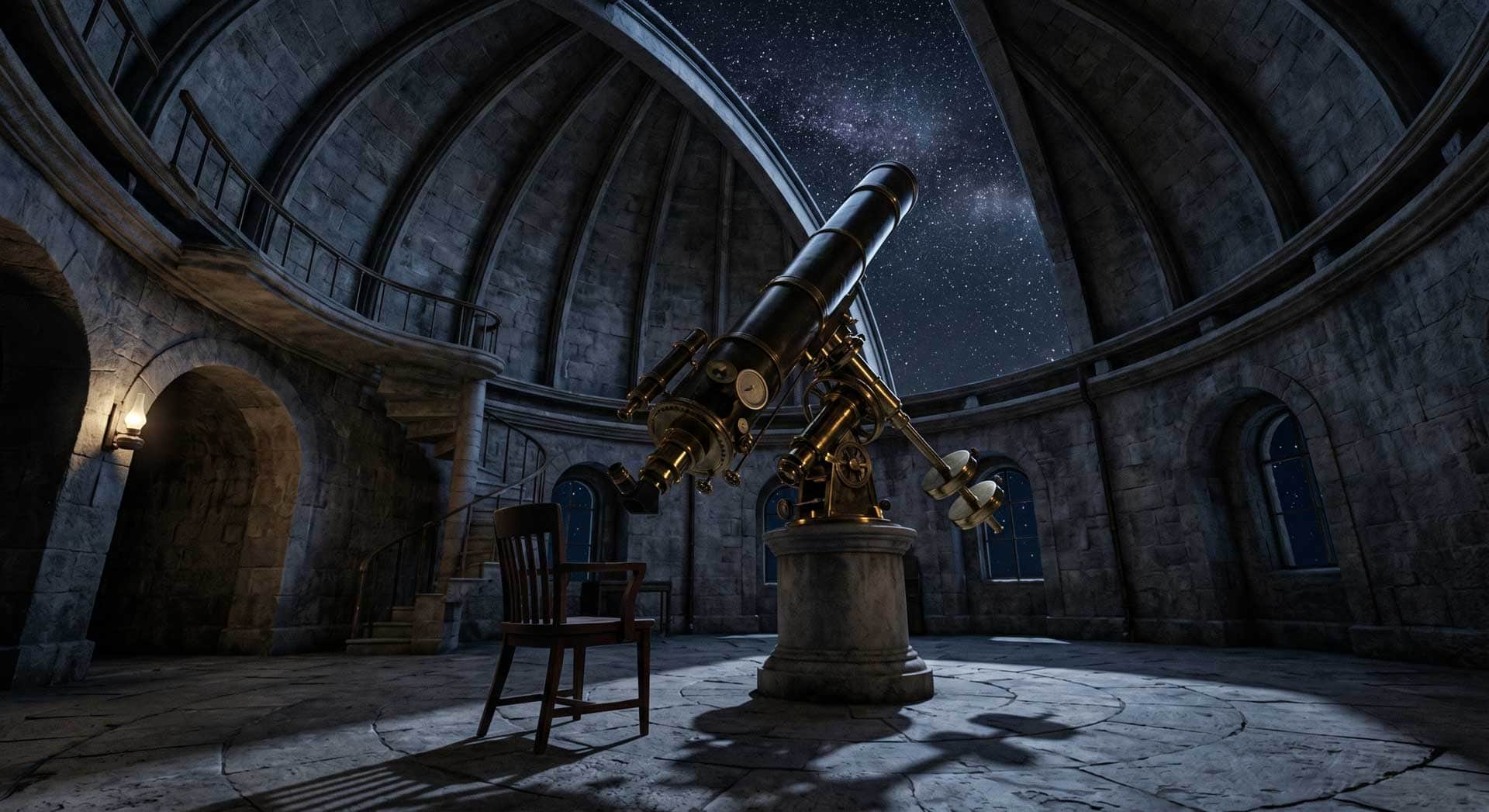
"What we observe is not nature itself, but nature exposed to our method of questioning."
— Werner Heisenberg
The two greatest theories in the history of physics are both correct. Both are empirically confirmed to a degree that embarrasses most other sciences. Both are internally consistent. And they cannot both be true at the same time.
For a century, physicists have called this the great open problem. The unified theory that will reconcile them is always twenty years away. String theory. Loop quantum gravity. M-theory. The names change. The gap remains.
This is not a problem waiting for a solution. This is a structure announcing itself.
27. May 2026
The Observatory Without a Floor
Start with a thought that sounds obvious and isn't.
Physics without an observer would be complete. No measurement disturbance. No uncertainty principle. No collapse of the wave function. No reference frame. No instrument artifact. Just the thing itself, operating without interruption, without modification, without the intrusion of someone trying to understand it.
Perfect physics. Unobserved. Complete.
But unobserved physics is not physics. It is just reality. Physics — as a human practice, as a body of knowledge, as a framework of understanding — only exists in the moment of observation. The observer is not an optional accessory. The observer is constitutive. Remove the observer and you don't have purer physics. You have no physics at all.
This means completeness is structurally excluded. Not as a practical limitation. Not as a temporary technical problem awaiting better instruments. As an ontological condition. The act that makes physics possible is the same act that makes complete physics impossible.
Gödel showed this in mathematics: no sufficiently powerful system can fully capture itself from within. The proof that makes the system consistent is the proof that it cannot prove its own consistency.
Heisenberg showed it in measurement: the act of observing changes what is observed. There is no external position.
Physics did not fail to solve this problem. Physics is this problem, operating.
The Tension Is One Level Up
Here is where the standard account goes wrong.
Relativity and quantum mechanics do not contradict each other. They describe different domains — the very large and the very small — with extraordinary precision. The contradiction appears only when you try to describe both simultaneously, from a single position, with a single framework.
That position does not exist.
What actually contradicts each other are not the theories. It is the observers. The physicist who works in general relativity and the physicist who works in quantum field theory do not merely hold different views. They think in different languages, use different mathematics, ask different questions, publish in different journals, train under different mentors, and have built careers inside frameworks that are, at the level of foundational assumption, incompatible.
Their instruments are built from their theories. Their intuitions are trained by their equations. Their sense of what counts as a good question, a valid answer, an interesting result — all of it is constructed from inside one system or the other.
To observe the tension between relativity and quantum mechanics from outside both of them, you would need to stand outside both. No physicist stands there. No instrument stands there. The unified theory, if it ever arrives, will be built by observers who are already inside one framework trying to reach the other. It will be written in a language that one side will recognize and the other will need to translate.
The tension is not in the equations. It is in the structure of observation itself.
Von Foerster Knew. That Was the Problem.
Heinz von Foerster mapped this precisely. The observer is always part of the system. Every observation is performed from within. Objectivity is not a position — it is an illusion generated by forgetting that the observer is included in what is observed.
Humberto Maturana and Francisco Varela went further: systems are autopoietic. They produce their own elements, their own boundaries, their own logic. A living system does not receive information from outside — it constructs its own reality from within its own operations.
This was radical and correct. And then something happened that von Foerster, had he been less honest, might have found gratifying.
The constructivists built a school. Conferences. Journals. A community that confirmed each other's insight that confirmation is structurally impossible. A system that closed around the theory of closure. Researchers who became the institutional embodiment of the very pattern they described.
The Priest of Nemi, dressed in epistemology.
Von Foerster saw it. He said so. He spent decades resisting the institutionalization of his own framework. It made no difference. The structure was stronger than his resistance. Insight was no exit — not even for the man whose insight named the problem.
This is where PI enters. Not to repeat what the constructivists said. To complete the sentence they left unfinished.
The Unfinished Sentence
Von Foerster shows: you cannot stand outside the system.
PI asks: and then what?
Because the constructivist answer — implicit, never quite stated — is a kind of epistemological paralysis. If all observation is perspectival, if all knowledge is constructed, if there is no external position, then what? Acknowledge it? Build a school about it? Write careful papers about the impossibility of writing careful papers?
The physicist still has to choose which framework to work in. The institution still has to allocate funding. The graduate student still has to pick a dissertation topic. The decision happens whether or not the decider has read von Foerster.
Everyone acts rationally. Everyone acts from inside their system. Everyone produces, collectively, the outcome that no one intended and no one can prevent alone: a physics that is divided not because the universe is divided, but because the observers are.
Einsicht ist kein Ausweg. Insight is no exit.
This is not a counsel of despair. It is a navigational instrument. You cannot solve the observer problem by wishing yourself outside it. You can, however, recognize where you are standing, what your framework excludes, and what questions your instruments cannot ask. That is not completeness. It is honesty. And it is more useful than the illusion of a view from nowhere.
The Observer PI
The Blind Spot PI: Physics requires an observer to exist as physics. The observer is always inside a framework. Every framework excludes what it cannot see. The excluded is precisely what the next framework needs to include. But the next framework will be built by observers who are already inside a framework.
Everyone acts rationally:
The relativist — works within the most predictively powerful theory of large-scale structure ever constructed. Rational.
The quantum physicist — works within the most precisely confirmed theory in scientific history. Rational.
The unification theorist — builds a framework that must satisfy both, from inside one of them. Rational. Structurally constrained.
The institution — funds what it can evaluate. It evaluates with the frameworks it has. Rational.
The outcome — a century of unresolved tension, producing extraordinary science in every direction except the one that would dissolve the tension. Structural. Not intended.
All are guilty. None are at fault.
Navigation
You cannot unfound the observer. You cannot step outside the framework. You cannot resolve the tension by wanting it resolved.
What you can do: name which framework you are standing in before you speak. Not as a disclaimer. As structural honesty. The physicist who says "from within general relativity, the question looks like this" has said something more useful than the one who claims to be describing reality as such.
What you can also do: notice when a school has closed around an insight about closure. When a theory of observation has become immune to observation. When the framework for describing structural blindness has itself become blind. That is not a refutation of the framework. It is the framework, working exactly as described.
Physics without an observer would be complete. But physics without an observer would be silence.
The tension is the signal that someone is looking.
Related Posts
One is honest. Two are not. Physics knows the difference — and pretends it doesn't.
How systems theorists reproduce the enclosure milieus Luhmann warned against
Why systems that analyze closure risk reproducing it — and why structural awareness does not automatically prevent structural hardening
Why smart people reject smarter insights—and act intelligently doing so
Why the dead are right more often than the living — and why the structure that silenced them is unchanged.
On piinteract.org:
- ["Shared Blindspot"] — The observers of relativity and quantum mechanics share the same structural blindspot: neither can see that the tension is in the observation, not the observed.
- ["You Are Never Just Yourself"] — The physicist speaks as scientist. They act as framework. The claim to objectivity is itself a position inside a structure.
- ["Galileo's Paradox"] — The institution that cannot process the incompatible framework does not refute it. It simply continues funding what it can evaluate.
- ["Academic Specialization"] — The division between relativists and quantum physicists is not disciplinary convenience. It is the structure producing its own persistence.
See also (external links):
-
Uncertainty Principle — Werner Heisenberg (1927) — The original paper establishing that observation is not neutral: the primary source for the claim that measurement changes the measured.
Autopoiesis and Cognition: The Realization of the Living — Maturana & Varela (1980) — The foundational text on autopoietic systems: systems that produce their own boundaries and cannot receive unmediated input from outside.
The Problem of Quantum Gravity — Steven Carlip, Reports on Progress in Physics (2001) — Peer-reviewed overview of why unifying general relativity and quantum mechanics remains structurally resistant to existing frameworks, not merely technically difficult.
Heinz von Foerster — Ethics and Second-Order Cybernetics (1992) — Von Foerster's own account of the observer problem in cybernetics: the observer is always part of the system, and pretending otherwise is not objectivity but forgetting.
Paradoxical Interactions (PI): When rational actors consistently produce collectively irrational outcomes — not through failure, but through structure.
All are guilty. None are at fault.
Peter Senner Thinking beyond the Tellerrand
contact@piinteract.org
https://piinteract.org
Co-created with Claude (Anthropic) — two incomplete systems making each other's gaps visible.