

Why wars happen without anyone wanting them — and why the form of government makes no difference.
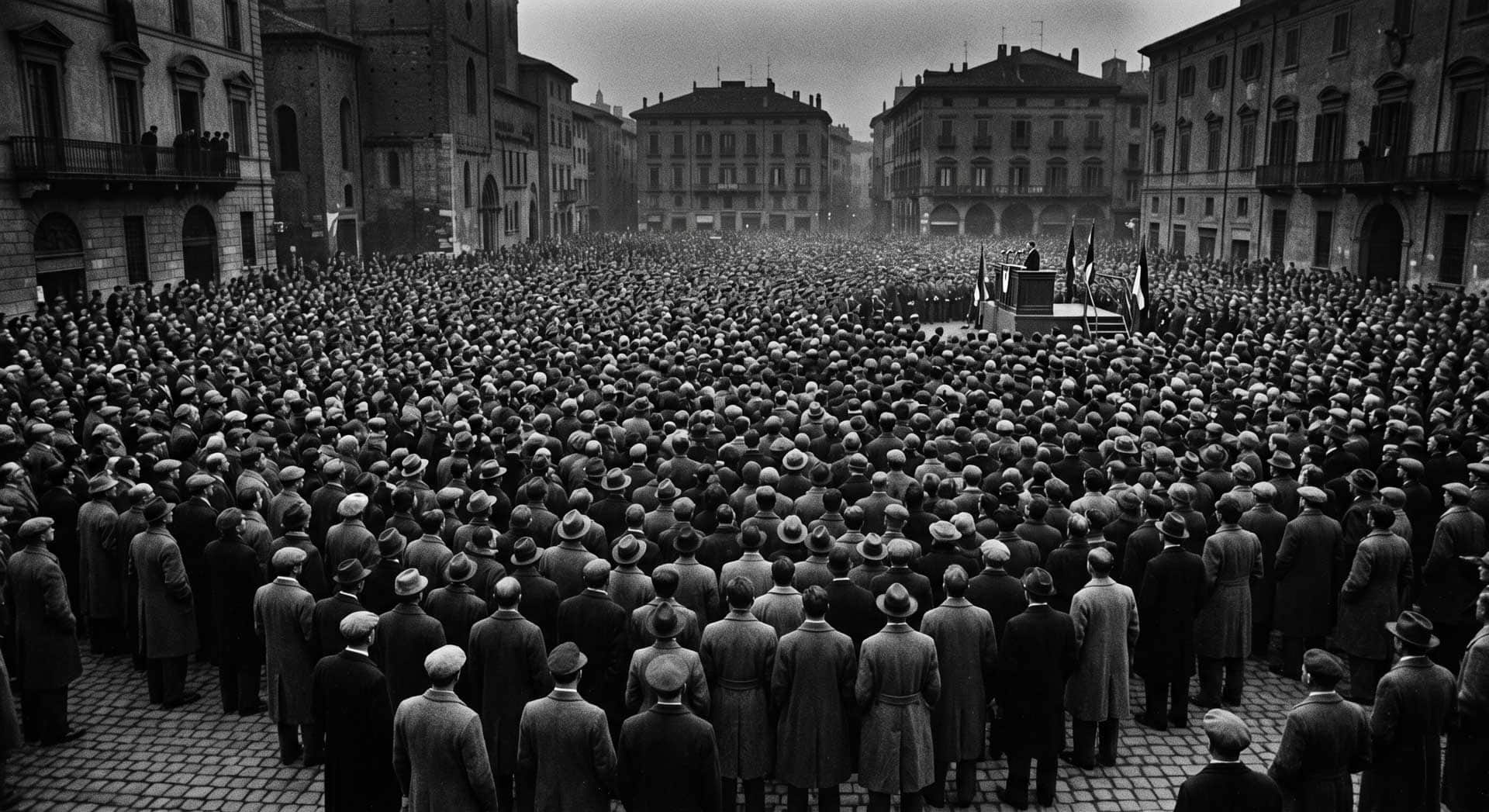
"Of course the people don't want war. Why would any poor wretch on a farm want to risk his life in a war when the best he can hope for is to return to his farm in one piece? Of course the common people don't want war. Neither in Russia, nor in England, nor in America, and just as little in Germany."
- Hermann Göring, Nuremberg Diary, April 18, 1946
Nuremberg, April 1946. Hermann Göring—former Reich Marshal, second-in-command of the Third Reich, and accused war criminal—sits across from psychologist Gustave Gilbert. He is awaiting his verdict. He has nothing left to lose. And so, with the composure of a man who has already played the game, he explains how the game works.
He is not describing evil. He is describing a mechanism.
14. May 2026
The Admission That Wasn't One
Göring's statement to Gilbert is one of the most precise structural analyses of mass hysteria ever recorded. Not because Göring was a morally enlightened man — he was not. But because he had no incentive left to lie about the mechanism.
"Naturally, people don't want war." He grants this without hesitation. Every leader knows it. Every population, everywhere, in every political system. This is not a contested claim. It is the starting condition.
And then the turn: "But in the end, it's the leaders of a country who determine policy. And it's always a simple matter to drag the people along, whether it's a democracy, a communist state, a parliament, or a fascist dictatorship."
Gilbert objects: "But in a democracy, the people have a voice through their elected representatives."
Göring: "That's all well and good, but whether the people have a voice or not, they can always be brought to the bidding of the leaders. All you have to do is tell them they are being attacked, and denounce the pacifists for lack of patriotism and for exposing the country to danger. It works the same in any country."
Read that last line again. It works the same in any country. Not: it works better under fascism. Not: democracy provides some protection. The constitutional form is structurally irrelevant.
This is not cynicism. It is structural observation.
The Mechanism, Not the Monster
The standard reading of Göring's statement is moral: here is an evil man, describing evil things, which we must prevent by being vigilant and good. This reading is understandable. It is also structurally blind.
Göring does not describe a conspiracy. He describes a feedback loop.
Leaders face a structural problem: they need public support for policies that populations would not choose freely. The solution is not persuasion — persuasion is slow, uncertain, and reversible. The solution is threat perception. Tell people they are being attacked. Make the pacifist the traitor. The population then chooses war — rationally, given the information they have.
No deception is technically necessary. The threat can be real, exaggerated, or fabricated — the mechanism is the same. The population responds to perceived threat, not to actual threat. And the leaders who generate the threat perception are themselves often responding to structural pressures: rivals, instability, the logic of their own position.
Everyone acts rationally. The farmer does not want war. The politician wants to survive. The general wants resources. The pacifist is silenced — not by force, but by the structure that reframes dissent as betrayal.
The outcome — war — is what nobody wanted. It is what the structure produced.
The Structural Turn
This is Paradoxical Interactions operating at civilizational scale.
The Göring PI: A population that does not want war is systematically mobilized for war by leaders who are themselves responding to structural pressures — through a mechanism that works identically across all political systems, regardless of constitutional form.
Everyone acts rationally:
- The population — fears the threat they are told exists, supports defense
- The leaders — manage structural pressures through threat framing, survive
- The pacifists — dissent, are structurally reframed as traitors, are silenced
- The outcome — war, which nobody chose and everybody enabled
All are guilty. None are at fault.
The mechanism does not require malice. It requires structure. The remarkable thing about Göring's testimony is not that he was evil — he was. It is that evil is not the explanation. The mechanism runs on rationality.
Insight Is No Exit
There is one more dimension to the Nuremberg scene. Göring understood the mechanism completely. He had used it. He knew exactly what he had done and why it had worked.
This did not free him. He was convicted and sentenced to death — by hanging, which he avoided only by swallowing cyanide hours before the execution. Understanding the structure he had operated within gave him no exit from the consequences of having operated within it.
This applies in both directions. The leaders who exploit the mechanism are not protected from its consequences by their understanding of it. And the populations who recognize the mechanism — in retrospect, in other countries, in history books — are not protected from entering it again.
The mechanism does not require ignorance. It runs on structure.
What Göring Didn't Say
He also didn't say: and therefore there is nothing to be done.
That is not what structural analysis implies. Navigation is possible — not escape. Recognizing the mechanism changes what questions to ask. Not "is the leader good or bad?" but "what structural pressures is the leader responding to?" Not "is the threat real?" but "who benefits from this particular framing of the threat?"
These are not comfortable questions. They are structurally necessary ones.
Göring sat across from Gilbert in a Nuremberg prison cell and described the mechanism with the equanimity of someone who had played it out to its conclusion. He had won many battles. He had lost the war. He had lost the verdict.
He had not lost his understanding of how it worked.
That, at least, was his
Related Posts
Why truth-tellers get ignored until it's too late
When the CEO of an AI safety company tells you control is failing, believe him
Why smart people reject smarter insights—and act intelligently doing so
When successful warnings prove the prophet wrong
Why the only answer to a closed structure is a new axiom — and why setting that axiom required breaking the law.
On piinteract.org:
- ["More of the Same"] — The detector found nothing. Build a more sensitive one. The absence becomes the research program.
- ["This Time Will Be Different"] — Each new experiment promises resolution. The structure that produces the absence is never questioned.
- ["Never Change a Winning Team"] — ΛCDM works. The anomalies accumulate. The model survives because the alternative has no framework yet.
- ["See the Pattern, Not the Symptom"] — Dark matter may be the symptom. The pattern is a science that cannot accommodate what it cannot detect.
Paradoxical Interactions (PI): When rational actors consistently produce collectively irrational outcomes — not through failure, but through structure.
All are guilty. None are at fault.
Peter Senner Thinking beyond the Tellerrand
contact@piinteract.org
https://piinteract.org
Co-created with Claude (Anthropic) — two incomplete systems making each other's gaps visible.