

Why the only answer to a closed structure is a new axiom — and why setting that axiom required breaking the law.
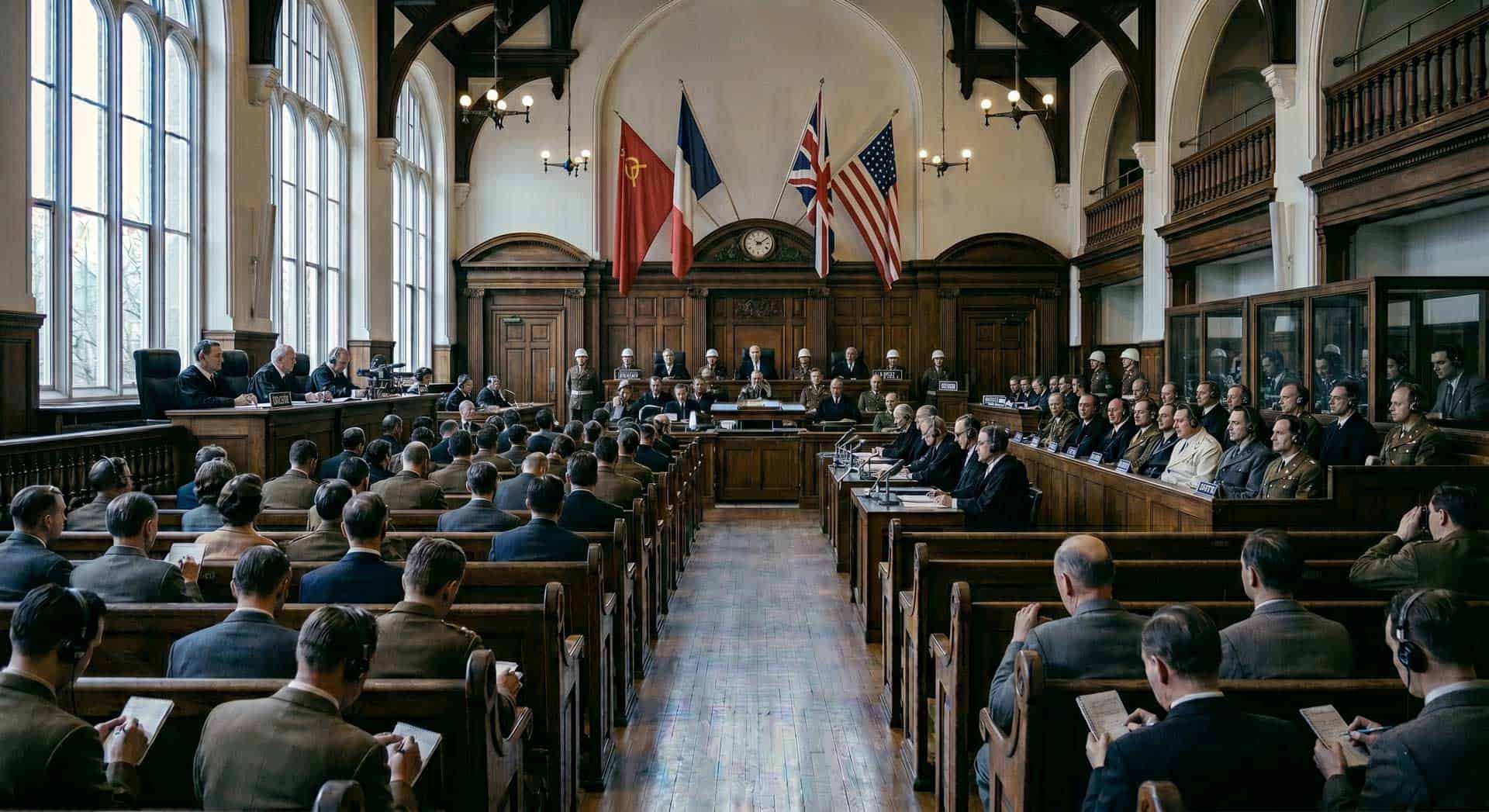
"The wrongs which we seek to condemn and punish have been so calculated, so malignant, and so devastating, that civilization cannot tolerate their being ignored, because it cannot survive their being repeated."
— Robert H. Jackson, Opening Statement, Nuremberg Trials, November 21, 1945
Nuremberg, 1945. Hermann Göring sits in the dock and watches the proceedings with almost professional interest. He will later explain in a private interview how the mechanism works. He is familiar with the line of argument. And he knows—or believes he knows—that his own argument is watertight.
His defense rests on a structural observation that is entirely correct within the existing framework.
No head of state can be held accountable by a court of another state for actions he committed in the service of his own state. If a foreign court can convict a head of state for the exercise of state power, it implicitly claims the right to convict any head of state—including its own. The court undermines its own legitimacy. Every verdict against Göring is simultaneously a verdict against the principle that protects every government that passes it.
The argument is not sophistry. It is structural logic. And Göring knows it.
He also knows, by the time Jackson finishes his opening statement, that he has lost.
31. May 2026
The Argument That Was Unanswerable
To understand what Jackson did, you first have to understand why Göring was right.
The system of international relations as it existed in 1945 rested on a foundational principle: sovereignty. States are the ultimate actors. Heads of state exercise state power. State power, by definition, cannot be judged by another state's power without that judgment being an act of power itself — which then requires its own justification, which leads back to the question of sovereignty.
This is not a loophole. It is the architecture. The Nuremberg defendants had operated entirely within this architecture. The crimes were vast. The structure that enabled them was the very structure that made the prosecution structurally impossible.
Every lawyer in that courtroom in November 1945 understood this. The defense understood it. The prosecution understood it. The judges understood it.
Göring understood it best of all.
What Jackson Did Instead
Robert H. Jackson, Associate Justice of the United States Supreme Court, did not try to win the argument within the existing structure. He did not produce a better reading of existing international law. He did not find a precedent that covered the case.
He set an axiom.
Crimes against humanity. The phrase had been used in passing before — vaguely, without legal force. Jackson gave it weight, definition, and jurisdiction. He placed it outside the sovereignty argument entirely. Not: these acts violated existing law. But: these acts violated something prior to law — something that law, any law, must presuppose to be law at all.
This is not a legal argument. It is a Gödelian move.
Gödel showed that no sufficiently powerful formal system can prove all truths expressible within it using only the rules of that system. Some truths require a step outside — an axiom that is not derived from the system, but assumed before it. The system cannot generate its own foundation.
Jackson looked at the closed structure of sovereignty and did the same thing. He did not argue inside the system. He placed a new axiom outside it — one that reframed every move the defense could make. Not: you violated the law. But: you violated the condition without which law cannot exist.
The moment that axiom was accepted, Göring's argument collapsed. Not because it was refuted. Because the playing field had been redrawn.
Nulla Poena Sine Lege
There is a principle that sits at the foundation of every legal system that calls itself just. Nulla poena sine lege. No punishment without law. You cannot be convicted for an act that was not a crime when you committed it. You cannot be sentenced under a law that did not exist when you acted. Retroactive criminal law is not law — it is vengeance dressed as procedure.
Every lawyer in that courtroom knew this too.
Jackson knew it. He had spent his career inside legal systems that treated nulla poena sine lege as inviolable — because it is inviolable. It is not a technicality. It is the structural guarantee that distinguishes a court from a show trial, a verdict from an execution with paperwork. Strip it away and you have not improved the law. You have abolished it.
And yet.
The crimes Jackson was prosecuting had been committed under law — German law, state law, the law of a sovereign nation operating within the international architecture of 1939. The Holocaust was not illegal in the Third Reich. The war of aggression had been authorized by the state. The defendants had not acted outside their legal framework. They had acted entirely within it, with full institutional sanction, with paperwork, with bureaucratic precision.
Nulla poena sine lege — applied faithfully — meant: no crime. No trial. No verdict. Walk free.
Jackson broke the principle. He had to. The axiom he set — crimes against humanity — was applied retroactively to acts committed before the concept had legal force. He convicted men under law that did not exist when they acted. He did precisely what nulla poena sine lege exists to prevent.
He knew this. He said so, obliquely, in his opening statement. And he did it anyway.
This is not a criticism of Jackson. It is a structural observation. He faced a PI with no clean exit. On one side: honor nulla poena sine lege, acquit the architects of the Holocaust, and confirm that state power grants absolute immunity for any atrocity committed in its name. On the other: break nulla poena sine lege, convict them, and establish that retroactive law is permissible when the crimes are sufficiently vast.
Both exits corrupt something foundational. There is no third door.
Jackson chose. He broke the principle in order to save what the principle was meant to protect. He violated the form of justice to preserve its substance. Whether that trade was right is a question moral philosophers have argued since 1946 and will not finish arguing.
What is not arguable is the structure. Jackson did not escape the PI. He entered it — deliberately, with full knowledge — and accepted the cost.
The Structural Turn
This is Paradoxical Interactions at the level of legal architecture.
The Nuremberg PI: A closed structure — sovereignty as absolute immunity — produces actors who are rationally unaccountable for their actions within it. The only exit is a new axiom placed outside the structure. But setting that axiom requires breaking nulla poena sine lege — the very principle the axiom is meant to protect. Justice can only be done by committing the injustice it was designed to prevent.
Everyone acts rationally:
- Göring — operates within the law, correctly, with full institutional sanction
- Jackson — recognizes the structure is unbeatable from inside, steps outside it, breaks nulla poena sine lege to close the immunity gap
- The tribunal — accepts the new axiom, acquires jurisdiction it did not previously have, convicts
- The outcome — accountability achieved through the precise violation of the principle that makes accountability legitimate
All are guilty. None are at fault.
What makes this a PI and not simply a difficult moral choice is that both exits corrupt something foundational. Honor nulla poena sine lege and the architects of genocide walk free — the principle that protects the innocent protects the perpetrators. Break it and you establish that retroactive law is permissible when the crimes are large enough — which is exactly what every authoritarian prosecutor will claim next time. There is no clean exit. There never was.
Counter-structure does not eliminate structure. It relocates it.
The Göring Verdict
Göring recognized the shift immediately. Not because he suddenly agreed with the moral argument — he did not. But because he understood structural logic well enough to know when the ground had moved beneath him.
He had argued within a system that rewarded structural precision. Jackson had exited that system. The argument Göring had prepared — watertight, internally consistent, structurally impeccable — was now addressed to a court that was operating under different axioms.
You cannot refute an axiom with an argument. An axiom is not derived — it is assumed. To challenge it, you would need to propose a different axiom and argue for its adoption. Göring's defense could not do this. It had no alternative axiom to offer. It could only insist that the old ones still applied.
They didn't. Jackson had made sure of that.
Göring had complete structural insight into the sovereignty argument. He lost anyway — not because his insight was wrong, but because Jackson had moved the argument somewhere insight alone cannot follow.
What This Means
The lesson from Nuremberg is not that good eventually defeats evil. That is the moral reading, and it is not wrong, but it is not structural.
The structural lesson is this: there are PI configurations where every available exit violates something foundational. Not because the actors are insufficient, not because better options were missed, but because the structure itself forecloses clean solutions. Jackson did not find a way out of the PI. He chose which foundational principle to sacrifice — and bore that choice.
Jackson saw the structure completely. He saw that nulla poena sine lege would have to fall. He saw that breaking it would set a precedent that could be exploited. He saw that not breaking it would confirm absolute immunity for state-sponsored atrocity. He saw both exits clearly.
He chose anyway. That is not the absence of a PI. That is what navigating a PI looks like from inside it.
Every subsequent international tribunal — the ICC, the ICTY, the ICTR — has lived inside the tension Jackson accepted at Nuremberg. The axiom opened a space. It did not close the structure. The sovereignty problem returned, one level up. The nulla poena problem returned, with every new indictment. The precedent Jackson set has been cited by prosecutors pursuing justice and by governments pursuing enemies. The axiom does not discriminate.
Göring took the cyanide. Jackson returned to the Supreme Court.
The axiom remained. So did the contradiction it carried.
Related Posts
A Paradoxical Interaction in Three Acts
Why truth-tellers get ignored until it's too late
Why cognitive escape is the only way to escape the structure
Why wars happen without anyone wanting them — and why the form of government makes no difference.
On piinteract.org:
- ["More of the Same"] — The detector found nothing. Build a more sensitive one. The absence becomes the research program.
- ["This Time Will Be Different"] — Each new experiment promises resolution. The structure that produces the absence is never questioned.
- ["Never Change a Winning Team"] — ΛCDM works. The anomalies accumulate. The model survives because the alternative has no framework yet.
- ["See the Pattern, Not the Symptom"] — Dark matter may be the symptom. The pattern is a science that cannot accommodate what it cannot detect.
Paradoxical Interactions (PI): When rational actors consistently produce collectively irrational outcomes — not through failure, but through structure.
All are guilty. None are at fault.
Peter Senner Thinking beyond the Tellerrand
contact@piinteract.org
https://piinteract.org
Co-created with Claude (Anthropic) — two incomplete systems making each other's gaps visible.