

Why the most biting political satire strengthens what it attacks — and why everyone involved is acting entirely rationally.
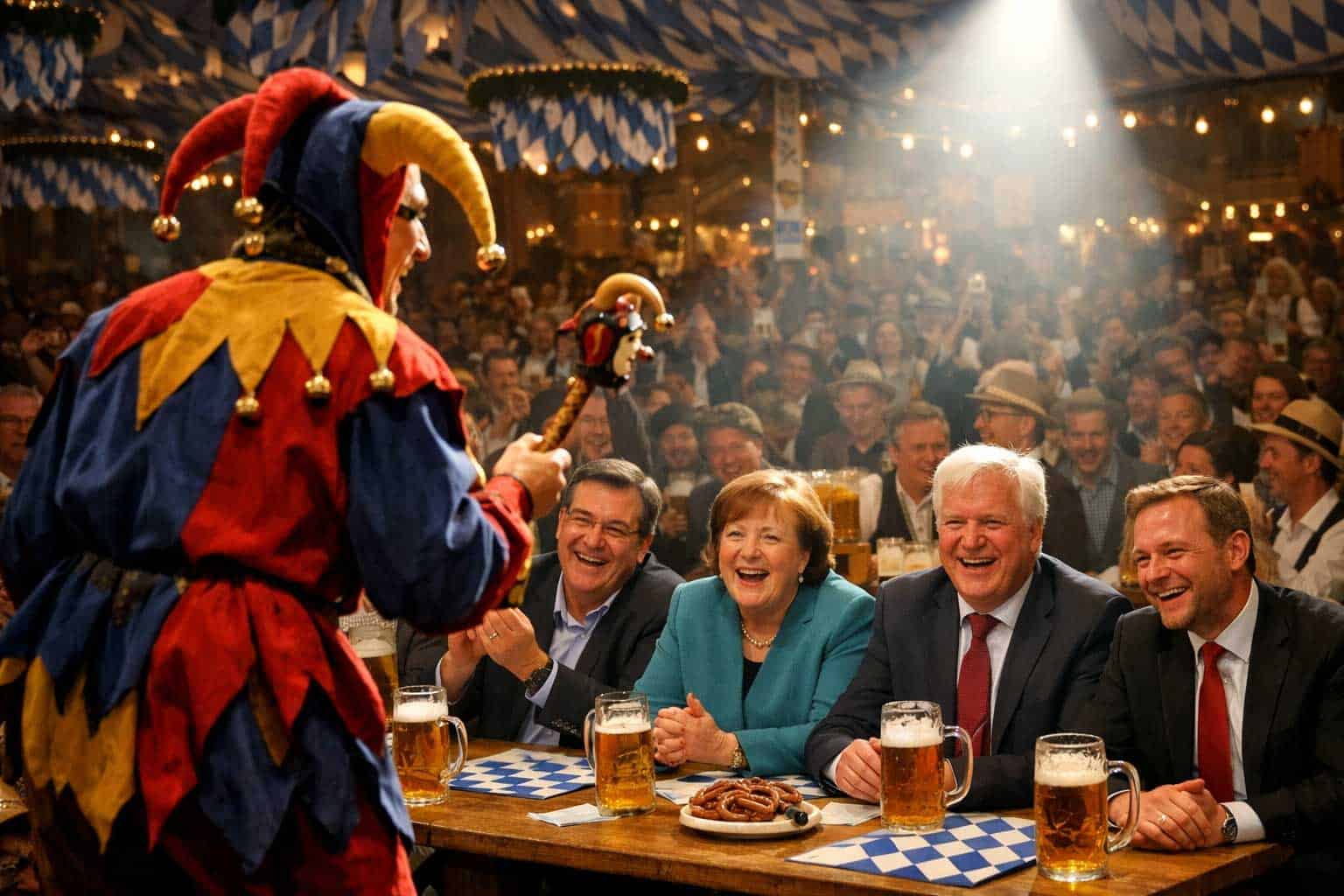
“The satirist who makes the king laugh has lost.”
— attributed to Karl Kraus
5. March 2026
Peter Senner co-created with Claude
The Setup
Every year, two to three weeks after Ash Wednesday, Munich's Paulaner Brewery opens its Nockherberg Hall for the strong beer tapping ceremony. Bavaria's politicians sit in the front row. The Minister President. The opposition leaders. The mayors. Cameras everywhere.
Then the production begins. Not just a comedian — a full Singspiel. Actors, singers, musicians, an ensemble that has spent months writing, rehearsing, staging. Political satire performed as one of Bavaria's most venerable art forms. The crowd roars. The politicians applaud. The prime minister laughs loudest at the jokes about himself.
The next morning, the newspapers call it "sharp." "Merciless." "Holding power to account."
Nothing changes. Nothing was ever going to.
That's not a failure of the satire. It's the satire working exactly as designed.
The Valve Mechanism
Pressure builds in social systems. Frustration with politicians, institutions, the distance between power and accountability. That pressure needs somewhere to go.
The Nockherberg provides it.
Once a year, in a single concentrated ritual, the frustration is named, performed, laughed at — and discharged. The audience leaves satisfied. The politicians leave vindicated. The system absorbs the critique and continues unchanged.
This is not cynicism. This is thermodynamics.
A valve is not a solution to pressure. It's a pressure management system. The Nockherberg doesn't reduce the conditions that create political frustration. It reduces the energy available to act on it.
The sharper the satire, the more effective the valve. The audience that leaves having laughed hardest has discharged the most.
Why the Politicians Sit There
They don't have to attend. No law requires it.
They come because absence is more dangerous than presence. A politician who skips the Nockherberg signals: I can't take a joke. I fear scrutiny. I'm weak.
A politician who sits in the front row and laughs at himself signals the opposite: I'm confident. I'm human. I can absorb criticism. I'm strong enough to be mocked.
The structure rewards attendance and punishes absence. Every actor responds rationally to the incentive. The result: a room full of powerful people voluntarily submitting to ritual humiliation — which makes them look better, not worse.
The jester has no power over the king. The king controls the jester's terms of employment. The jester knows this. The audience knows this. Everyone knows this. The ritual continues anyway, because everyone needs it.
The Nemi Priest in Costume
The Nockherberg is old. 1837, by some accounts. Institutionalized, traditioned, protected.
It is the establishment — dressed as the establishment's critic.
And it is not one person. It is a production. Writers, directors, actors, singers, musicians, costume designers, stage technicians. Each with a contract. Each with a career. Each with a reason to be invited back next year.
No single person decides how sharp the critique goes. The structure decides. The writers know the tolerance parameters — not because anyone told them, but because they have worked in this world long enough to internalize them. The director knows what will play well and what will clear the room in the wrong way. The actors know the difference between a joke that lands and one that ends careers.
The collective makes the system more stable, not less. There is no individual to point at. No author who "pulled the punches." The production as a whole arrives exactly where the structure permits — and does so entirely through the rational decisions of talented professionals.
Whoever wanted to abolish the Nockherberg would be accused of having no sense of humor. Of fearing scrutiny. Of authoritarianism. The institution has immunized itself against criticism through the appearance of being self-critical.
The Priest of Nemi has an entire ensemble. They're all still guarding the grove.
The PI Structure
The Nockherberg PI: A ritual of political criticism that discharges the energy required for political change while appearing to enable it.
Everyone acts rationally:
- Politicians attend — signals strength, avoids the weakness of absence
- Writers and directors stay within tolerance — career, repeat engagement, professional reputation
- Actors and musicians perform — prestige, platform, the Nockherberg on a CV means something
- The audience laughs — releases frustration, feels heard
- The media covers it — tradition, spectacle, guaranteed content
- The system continues — the valve worked
All are guilty. None are at fault.
No one designed the Nockherberg to be a system stabilizer. It evolved into one. The actors who sustain it are not hypocrites. They are participants in a structure that rewards exactly the behavior that reproduces it.
What Navigation Looks Like
This is not an argument against the Nockherberg. That would be arguing against a structure with an argument — which the structure will absorb without difficulty.
It is a structural observation: the form of critique matters as much as the content.
Critique that takes place inside the system's sanctioned spaces, at the system's sanctioned times, delivered by the system's sanctioned performers, to an audience that bought tickets — that is not critique. That is maintenance.
The question to ask is not: "Was the satire sharp enough?" The question is: "Who benefits from this ritual existing, and what does it prevent?"
The answer is not comfortable. But it's the only one that sees the structure clearly.
A valve that works perfectly is not a broken system. It is the system working as intended.
Related Posts:
The closest thematic connections:
Win the position. Guarantee your death. Repeat the Pattern forever.
Why truth-tellers get ignored until it's too late
Why smart people reject smarter insights—and act intelligently doing so
How Every Solution Becomes the Next Problem
Or: How Google turned "Paradoxical Interactions" into therapy, admitted it, and nothing changed.
On piinteract.org
- Examples: Society & Culture — Structural patterns in how communities manage dissent and difference
- Examples: Systems & Governance — How power structures absorb and neutralize challenge
- Anti-Practices — What doesn't work, and why trying harder makes it worse
- Core Practices — Navigation without the illusion of solution
Paradoxical Interactions (PI): When rational actors consistently produce collectively irrational outcomes—not through failure, but through structure.
Peter Senner
Thinking beyond the Tellerrand
contact@piinteract.org
www.piinteract.org
Co-created with Claude (Anthropic) — two incomplete systems making each other's gaps visible.