

Why every radical break reproduces what it abolished — and why the one man who didn't argue won.
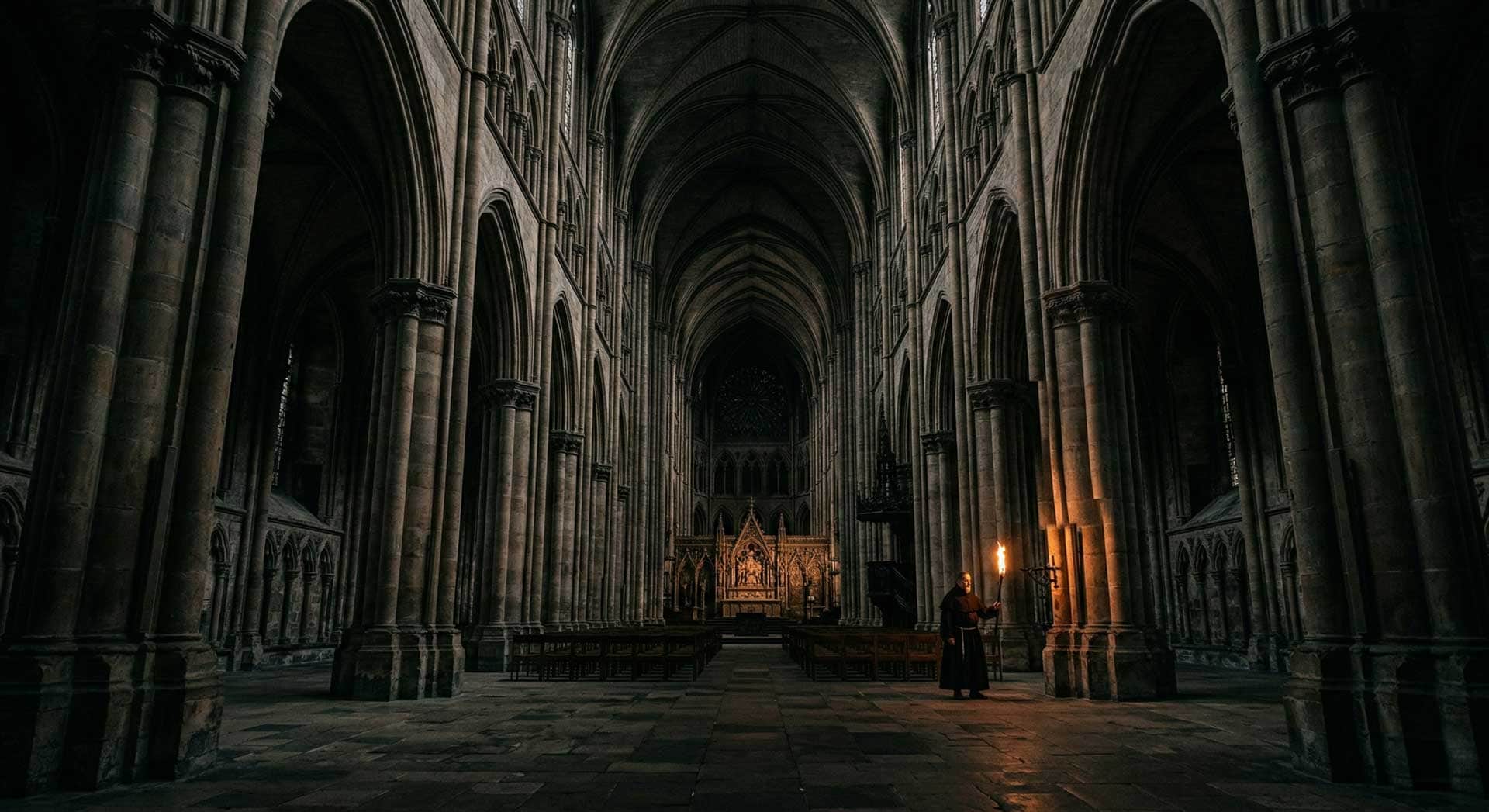
A theologian who does not become a mystic is a theoretician. A mystic who does not become a theologian is a heretic.”
— Thomas Aquinas
2. April 2026
Peter Senner co-created with Anthropic Claude
The Setup
Wittenberg, 1517. Martin Luther nails 95 theses to a church door. The argument: the Church sells what it cannot own. Grace is not a commodity. God is not a franchise.
The diagnosis is correct. The structure is not impressed.
The Three Who Argued
Luther broke with Rome. Theologically precise, personally courageous, structurally catastrophic — for his own project.
Because Luther had to convince. Argument requires reception. Reception requires community. Community requires structure. Structure requires gatekeepers. Gatekeepers require authority. Authority requires — a church.
Within two generations, Lutheranism had synods, confessions, ordination rites, excommunication procedures, and a clergy that managed grace on behalf of the faithful. The institution he demolished, he rebuilt. Not from malice. From the logic of the break itself.
Zwingli radicalized. No images, no music, no ritual mediation between the soul and God. Strip everything. The more radical the break, the purer the community. The purer the community, the more hermetic its boundaries. Zurich became a theological fortress. The reform that wanted no walls built the highest ones.
Calvin perfected the system. Predestination: God has already decided who is saved. You cannot earn it — but you can recognize it. In your discipline. In your success. In your accumulated capital. Max Weber drew the line from Calvin to capitalism, and he was right. The doctrine that abolished works-righteousness invented the most demanding works-righteousness in history. Every Protestant entrepreneur carrying guilt about his vacation is Calvin's descendant.
Three men. Three breaks. Three new institutions — each tighter than the one they replaced.
The Structural Turn
This is not irony. It is not hypocrisy. It is not failure.
It is the mechanism.
Every system that challenges an existing structure must organize itself to sustain the challenge. Organization requires boundaries. Boundaries require rules. Rules require enforcement. Enforcement requires authority. Authority requires — a structure.
The more urgently you argue, the more you need followers. The more followers, the more coordination. The more coordination, the more bureaucracy. The more bureaucracy, the more the original insight disappears into the machinery built to protect it.
Luther did not fail. Luther succeeded. That is exactly why the Reformation reproduced what it reformed.
Everyone acts rationally. That's exactly why they collide.
The Reformation PI
The Radical Break PI: The more completely a reformer breaks with an existing structure, the more completely they must rebuild it — because the break requires organization, organization requires hierarchy, and hierarchy requires exactly what the break rejected.
Everyone acts rationally:
The reformer — argues against corrupt structure (rational: the structure is corrupt)
The followers — organize around the argument (rational: organization amplifies impact)
The institution — hardens around the organization (rational: survival requires stability)
Outcome — new institution, structurally identical to the old one, with fresher theology
All are guilty. None are at fault.
The Exception
Henry VIII did not argue.
He did not write theses. He did not convene councils. He did not develop a theology of the soul's direct relationship to God. He wanted a divorce. Rome refused. He dissolved the relationship — with Rome, not with Catholicism.
The Church of England kept the liturgy, the hierarchy, the bishops, the sacraments, the incense. It changed one thing: the address at the top. Not the Pope. The King.
No argument. No community to organize. No theology to protect. No institution to rebuild — because the existing institution was simply reassigned.
The Anglican Church has survived five centuries without the structural convulsions that shook Lutheranism, Calvinism, and the Reformed traditions. Not because it was more principled. Because it never argued about principles. It executed.
Macht argumentiert nicht. Macht vollzieht. Power does not argue. Power executes.
Navigation
What follows from this — not as prescription, but as orientation:
The reformer who argues gives the system ammunition. Every argument can be countered, absorbed, institutionalized, and turned into a new dogma. The structure does not defeat the argument. It digests it.
The reformer who executes leaves nothing to digest. There is no counter-argument to a fait accompli.
This is not a recommendation for cynicism. It is a description of structural mechanics. Luther was more admirable than Henry. Henry was more effective.
The question is not which is better. The question is which you are — and whether you have understood the difference.
The Footnote That Changes Everything
One more observation. The unkind one.
Luther married Katharina von Bora in 1525. Eight years after the theses. The theology arrived first — the marriage followed. That is the official sequence.
Who reads the structure rather than the sequence notices something else. The Church of Rome forbade clergy marriage. Luther, as an Augustinian friar, was bound by this prohibition. The prohibition applied to him personally, existentially, biologically.
The unkind reading: the doctrine liberated the desire. The theology was architecturally perfect — and happened to create exactly the legal and moral space that Luther, as a man, required.
This is not a refutation of Luther. It is the purest possible confirmation of PI. The highest structures arise from the most basic drives. The doctrine that shook Europe may have begun not in a moment of divine illumination, but in a more ordinary kind of urgency.
High aims. Low drives. No one is to blame. Everyone built it.
That is the structure. That is always the structure.
Related Posts
Win the position. Guarantee your death. Repeat the Pattern forever.
How systems theorists reproduce the enclosure milieus Luhmann warned against
Why truth-tellers get ignored until it's too late
How Every Solution Becomes the Next Problem
On piinteract.org
- [Religion & Belief Systems — Reformation Orthodoxy] — The structural reason every reform produces a new orthodoxy
- [Religion & Belief Systems — The Heresy Mechanism] — How breaking the structure makes you the structure
- [Religion & Belief Systems — Schism Dynamics] — Why every split multiplies what it divides
- [Core Practices — Infect and Forget] — The only strategy that doesn't rebuild what it replaces
Paradoxical Interactions (PI): When rational actors consistently produce collectively irrational outcomes — not through failure, but through structure.
All are guilty. None are at fault.
Peter Senner
Thinking beyond the Tellerrand
contact@piinteract.org
www.piinteract.org
Co-created with Claude (Anthropic) — two incomplete systems making each other's gaps visible.