

Why regulating the frequency of price changes doesn't reduce price coordination — and why it makes it structurally inevitable.
"The curious task of economics is to demonstrate to men how little they really know about what they imagine they can design."
— Friedrich Hayek
3. April 2026
The Setup
Germany. April 1, 2026. Fuel prices have been at their highest since the 2022 energy crisis. Super E10: €2.08 per liter. Diesel: €2.28. The cause — an Iran war, the Strait of Hormuz blockade, oil at $117 per barrel. The political response: fast, decisive, bipartisan. Bundestag passed it. Bundesrat approved it. The President signed it. Bundeswirtschaftsministerin Katherina Reiche announced it: from today, petrol stations may only raise prices once per day.
The measure was designed to stop chaos. It produced something more precise.
The Old Game
Before the law, fuel pricing was a daily choreography. Prices spiked in the morning, dropped toward evening. The ADAC had documented it for years: cheapest between 18:00 and 22:00, most expensive between 7:00 and 8:00. It looked irrational from outside. From inside, every move was rational.
Each station watched the others. Each adjustment triggered counter-adjustments. No one set prices alone. No one coordinated. The result was a volatile swarm — maddening for consumers, structurally stable for the industry.
Forty percent of Germans managed to tank in the cheapest daily window. The system was exploitable — if you knew the rhythm.
The New Architecture
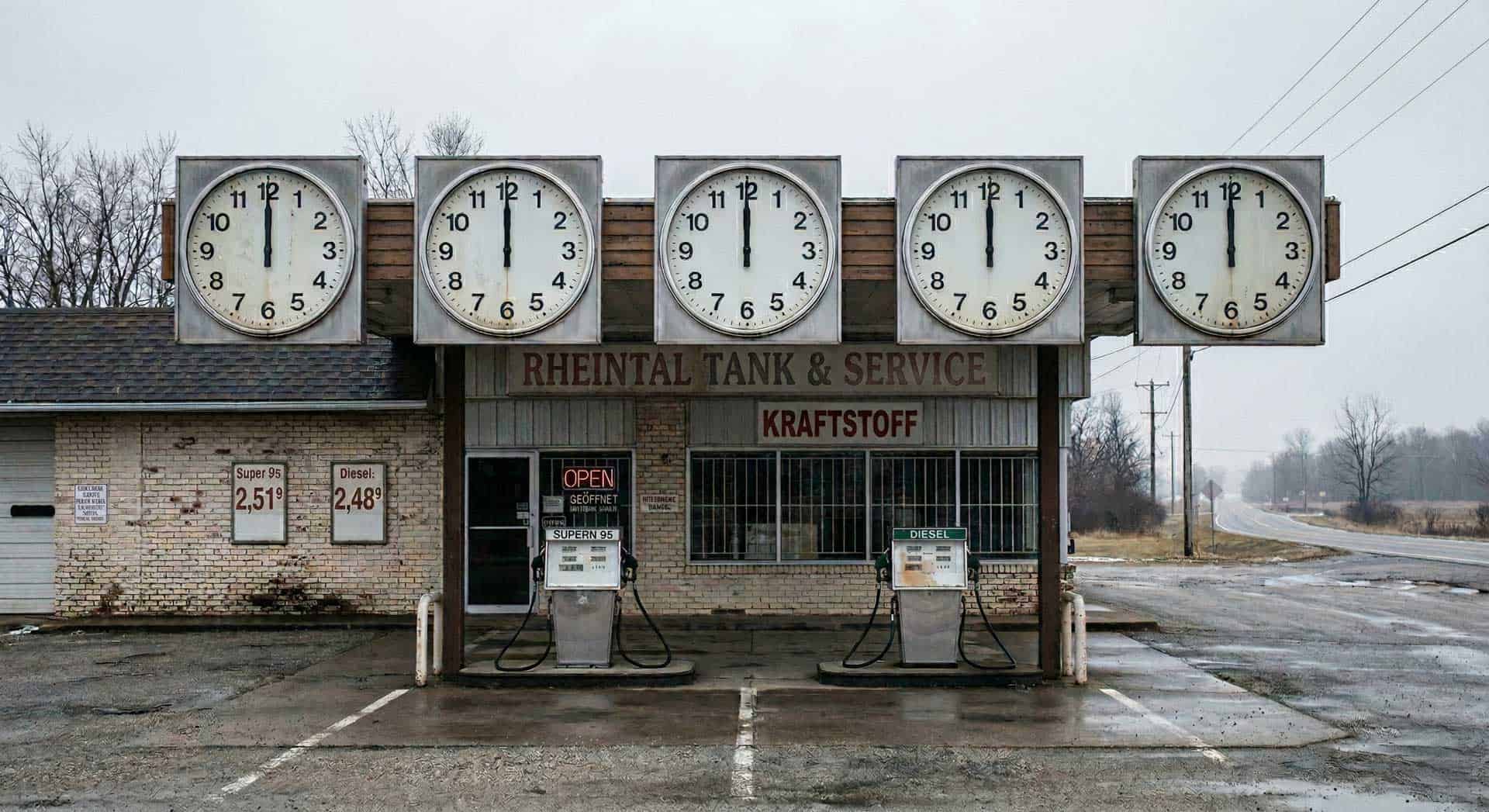
The law changed one parameter: frequency. Prices may now only be raised once daily. At noon. Exactly 12:00.
Everything else remained untouched. The logic of competition. The oligopoly structure. The shared interest in margin preservation. The incentive to maximize the single permitted daily increase.
The intervention didn't dissolve the pattern. It compressed it into a single moment.
The Structural Turn
What happens when you tell every player in an oligopoly that they have exactly one permitted move per day, at the same time?
They all move at that time. Not because they agreed. Because the structure gave them no other option.
Before the law: stations raised prices at different hours, in different amounts, watching each other with a lag. The result was noise — visible, measurable, irritating, but distributed.
After the law: every station raises its price at noon. The noise is gone. In its place: a synchronized pulse. Daily. Predictable. Structurally produced without a single phone call between competitors.
The Bundeskartellamt — which was granted stronger enforcement powers under the same package — now faces a paradox it cannot resolve within its own mandate. Coordinated pricing is only prosecutable when it can be traced to an agreement. Structural synchronization leaves no trace. The clock did the coordinating.
The PI Named
The Synchronized Clock PI: A law designed to limit the frequency of price manipulation creates the structural conditions for maximum synchronized price manipulation — without intent, without agreement, without evidence.
Everyone acts rationally:
- The legislature — limits exploitative price swings (rational: protect consumers)
- Each petrol station — uses its single permitted window at the moment of maximum effect (rational: margin preservation)
- The Bundeskartellamt — enforces a law it cannot use against the outcome it was designed to prevent (rational: applies the rules as written)
- The consumer — told prices are now "more transparent" while facing daily noon spikes (rational: adjusts behavior to new rhythm, arrives just before noon)
All are guilty. None are at fault.
Navigation
80% of Germans consider the law insufficient. They're right — but not for the reason they think. The law isn't weak. The law is structurally precise. It intervened exactly where it was aimed and produced exactly what the structure required.
The question isn't whether the Kartellamt will prosecute. It won't find what it's looking for. Synchronization without agreement is not a cartel. It's a clock.
The question also isn't whether a stronger version of this law could work. A price ceiling, a windfall tax, the Luxembourg model of state-set maximums — these are different interventions with different structural properties. Some of them might work. None of them would eliminate the paradox that any mechanism for limiting price behavior creates new price behavior structured around the mechanism's rules.
What remains: know which window you're in. Just before noon is the new 18:00. That's not a tip. That's what happens when a regulation becomes the market's metronome.
Einsicht ist kein Ausweg.
Related Posts
How Every Solution Becomes the Next Problem
When the CEO of an AI safety company tells you control is failing, believe him
Why truth-tellers get ignored until it's too late
On piinteract.org
- Examples: Systems & Governance — The structural conditions under which regulatory interventions produce the outcomes they were designed to prevent.
- Anti-Practices — What not to do when the structure doesn't change.
- Framework — Why rational actors and collective irrationality are not contradictions.
Paradoxical Interactions (PI): When rational actors consistently produce collectively irrational outcomes — not through failure, but through structure.
All are guilty. None are at fault.
Peter Senner Thinking beyond the Tellerrand
contact@piinteract.org
https://piinteract.org
Co-created with Claude (Anthropic) — two incomplete systems making each other's gaps visible.