

Why the more a traffic system works, the less it works — and why no one is at fault.
"The art of government consists in not allowing men to grow old in their jobs."
Napoléon Bonaparte
A phantom traffic jam forms because every driver reacts to the car ahead, not to the road ahead. The car ahead brakes. You brake. The car behind brakes harder. The car behind that brakes harder still. The wave travels backward through ten kilometers of motorway at forty kilometers per hour until the original brake impulse has long vanished — and the jam exists without cause.
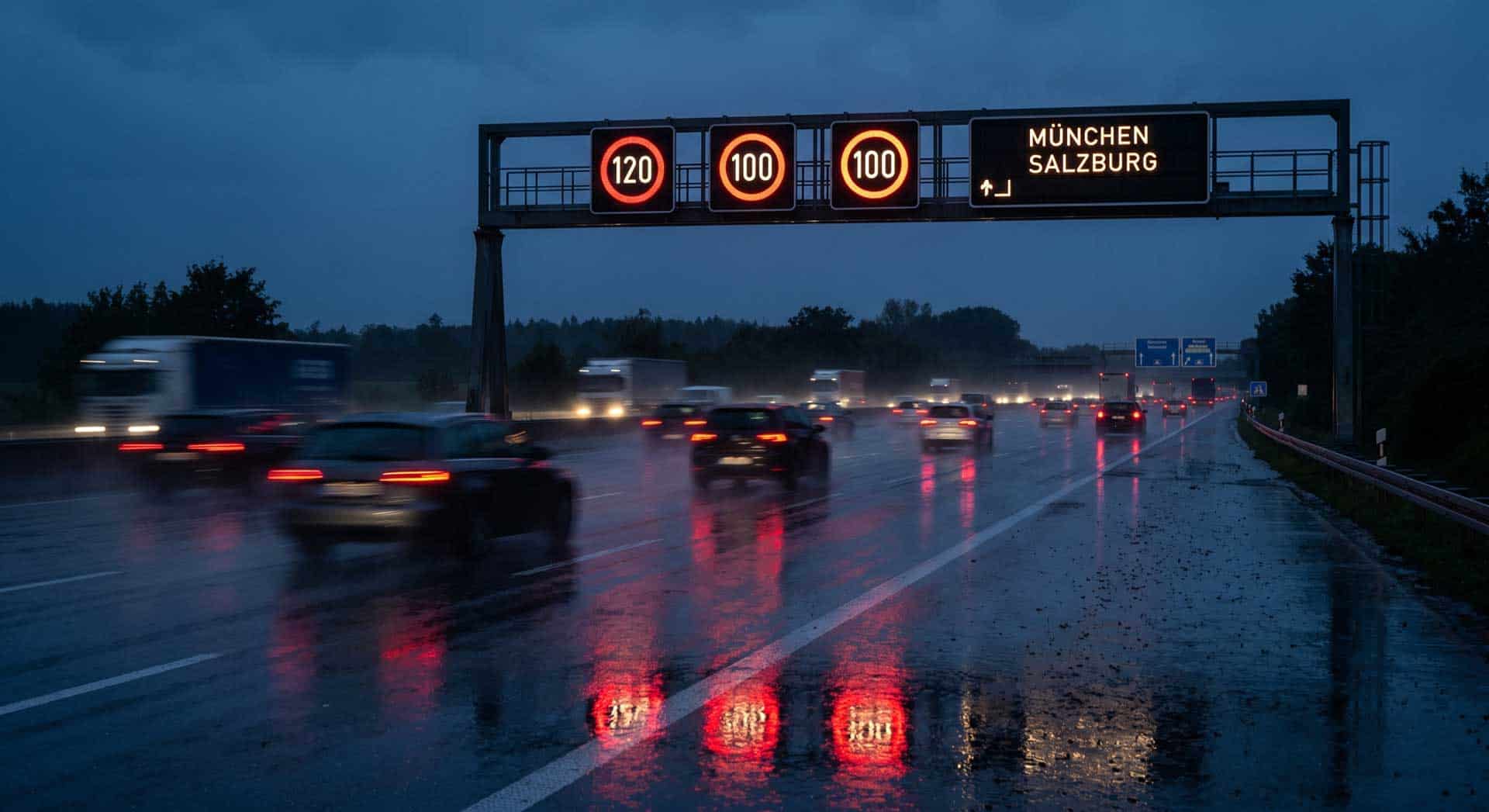
The German highway authority understood this. The solution was elegant: gantry signs spanning every lane, connected to sensors, adjusting speed limits in real time. Smooth the wave before it forms. The physics works.
6. June 2026
The Sign That Cried Wolf
The first time a driver sees the gantry showing 80 km/h on an open motorway, they slow down. The sign seems authoritative. It hangs directly overhead. It is specific. It applies to their lane. They comply.
The tenth time, they check the road. No congestion visible. No weather event. They slow — slightly, briefly.
The fiftieth time, they're already past the sign before they've consciously registered it.
This is not negligence. This is how human attention works. Habituation is not a bug in the neurological system — it is the feature that allows human beings to function in a world saturated with signals. The brain learns to filter the predictable. What has never preceded danger stops triggering the danger response.
The system's effectiveness depends on driver attention. Driver attention depends on the sign being unusual. The sign becomes less unusual the more signs there are. There is no optimization path that doesn't eat itself.
Who Follows the Signs
Research confirms what any daily commuter could report: the drivers most likely to comply with gantry signs are those least familiar with the route. The occasional traveler, the tourist, the truck driver on an unfamiliar corridor — they follow instructions because they have no experience to override them.
The daily commuter — who drives the same stretch of motorway every morning, who has seen the gantry show 80 km/h three hundred times with no discernible reason, who has learned empirically that compliance costs time and buys nothing visible — this driver has been educated out of compliance by the system itself.
The system teaches its most frequent users not to use it.
And then: the sign appears on a morning when the junction two kilometers ahead has just collapsed into stationary traffic. The commuter who has filtered out the last two hundred signs passes it at 130 km/h and hits the queue.
The system failed. Not through malfunction. Through success.
The PI Structure
The Gantry PI: A traffic management system deploys dynamic signs to prevent phantom congestion. Frequent exposure erodes compliance. The drivers who need the information most have been systematically conditioned to ignore it.
Everyone acts rationally:
The transport authority — installs maximum coverage for maximum safety
The regular commuter — discounts a signal that has historically predicted nothing
The system designer — cannot simultaneously maximize coverage and preserve signal novelty
The phantom jam — forms anyway, downstream of the experienced drivers who didn't slow
All are guilty. None are at fault.
What Cannot Be Fixed
The proposed solutions are instructive: randomize the signs. Add real-time incident data. Display the reason alongside the limit. Make the signs more credible.
Each solution introduces new information. New information becomes familiar. Familiarity breeds filtration. The cycle resumes at the next level of sophistication.
The only structural alternative is to make the signs genuinely unpredictable — which is to say, genuinely unreliable. A sign that shows 80 km/h only when something is actually wrong is a sign that shows 80 km/h far less often. It preserves attention by reducing presence. It solves the habituation problem by solving the coverage problem — which is the original problem.
The system cannot be everywhere and trustworthy at the same time.
You can see this. You cannot change it. What you can do is stop being surprised that the driver in front ignored the sign — and stop assuming they were inattentive. They were paying exactly the right amount of attention to a signal that had stopped containing information.
Einsicht ist kein Ausweg.
Related Posts
Why truth-tellers get ignored until it's too late
Why the most biting political satire strengthens what it attacks — and why everyone involved is acting entirely rationally.
The Phenomenon of Coupled Oscillators
Why the most rigorous approach to AI safety produces explanations no human can read — and why that's not a bug.
On piinteract.org
- Anti-Practices — Why the instinct to add more signal is the structural mechanism that depletes it.
- Examples: Systems & Governance — The gantry sign as instance of a universal pattern in systems design.
- Framework — The structure behind every rational actor producing irrational collective outcomes.
Paradoxical Interactions (PI): When rational actors consistently produce collectively irrational outcomes — not through failure, but through structure.
All are guilty. None are at fault.
Peter Senner Thinking beyond the Tellerrand
contact@piinteract.org
https://piinteract.org
Co-created with Claude (Anthropic) — two incomplete systems making each other's gaps visible.