

Why the Wars of the Roses lasted thirty years—and why the succession that was supposed to end them already contained the seeds of the next war.
"I can add colours to the chameleon, Change shapes with Proteus for advantages, And set the murderous Machiavel to school."
— William Shakespeare, Henry VI, Part 3 (Richard, Duke of Gloucester)
Two houses, one family tree, two truths. Lancaster claims the male line of succession, York the older line—but through a woman. Both premises are logically sound in themselves. Both are mutually exclusive. For thirty years, lords switch sides, kings are deposed or murdered, and children vanish in the Tower—not because anyone acted unreasonably, but because everyone did. In the end, there is no resolution. In the end, there is a rose, half white, half red, patched together so that no one would have to ask anymore who was right. Shakespeare recognized the structure and, in the same breath, obscured it.
6. August 2026
The Setting
August 22, 1485, Bosworth Field, Leicestershire. Richard III rides with his army against Henry Tudor’s alliance. His horse collapses beneath him. After the battle, his crown is found—according to tradition—in a hawthorn bush. His naked body is draped over a saddle and put on public display in Leicester for two days. 527 years later, in August 2012, a team from the University of Leicester excavates a skeleton from beneath a parking lot: a curved spine, eleven injuries, nine of them to the skull. The king, who died without a horse, is identified because his DNA still matched. The structure that killed him has outlived him.
The Horse
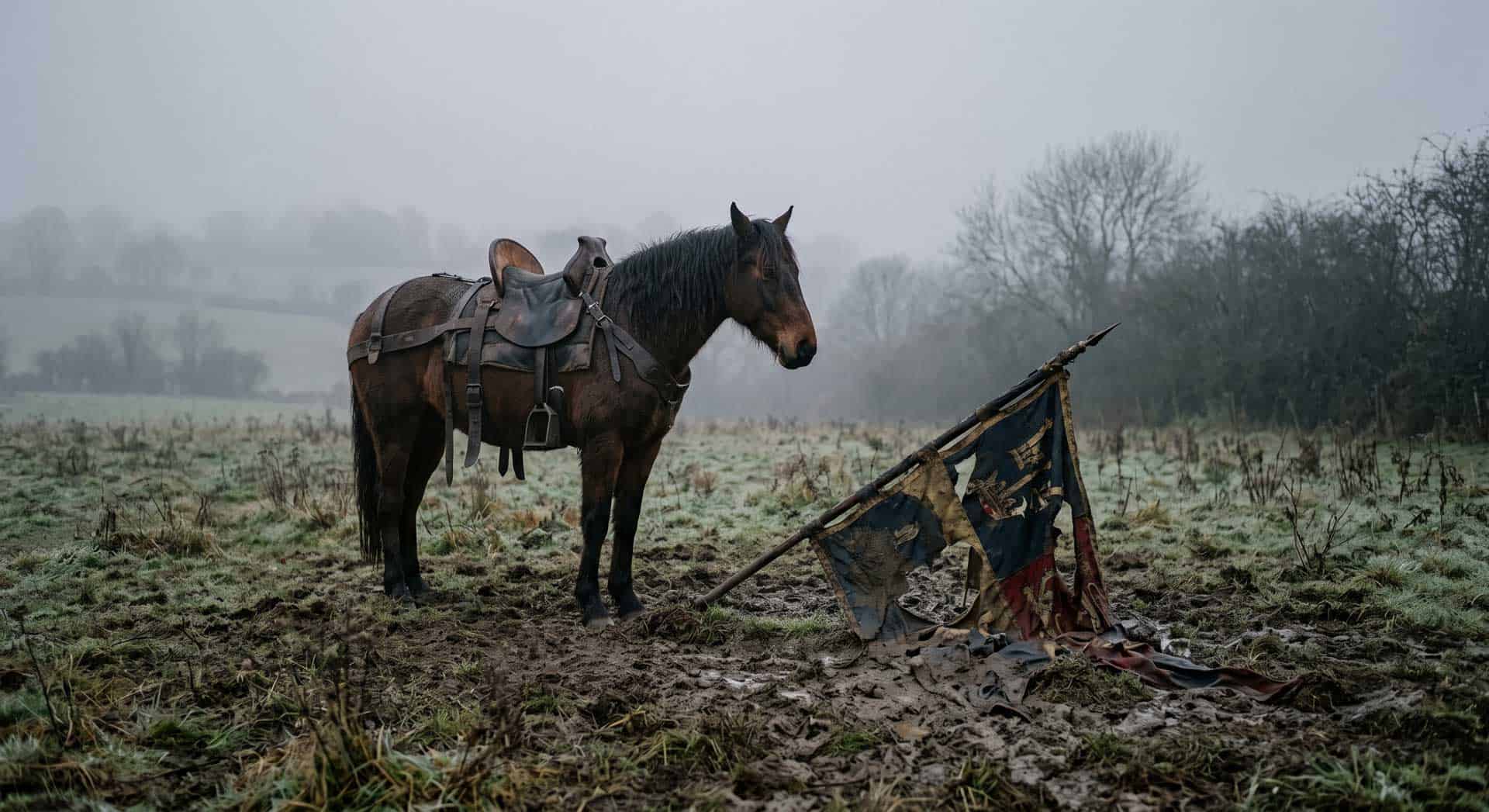
“My kingdom for a horse” is not a cry of despair. It is the moment when a structure reveals itself—a system that had been optimized until it failed because of a single missing animal. Richard had everything: the crown, the army, the loyalty of his men, who stood by him on the morning of the battle. What he didn’t have was a way out after the horse fell. That is the point of the Wars of the Roses: none of the parties involved lost because of a mistake. Everyone followed the logic of their own position to the bitter end. The statement is not an exaggeration. It is a summary—thirty years of war, reduced to a single animal that just happened to be missing.
Two Truths, One Family Tree
In 1399, Henry IV dethroned Richard II, invoking the male line of succession—he was a descendant of John of Gaunt, the third son of Edward III. Fifty years later, Richard, Duke of York, asserted his claim through a different line: that of Lionel of Antwerp, the second son of Edward III, passed down genealogically through his great-granddaughter Anne Mortimer. Both claims were complete, internally consistent, and historically documented. Neither was false. They were simply based on different premises: Did the proximity of the male line matter, or did the principle of seniority prevail, even if it ran through a woman? England had no answer to this question because it had never needed one before, as long as the various lines did not assert their claims simultaneously. Richard Neville, Earl of Warwick, switched sides in this dispute—from York to Lancaster. Historians call him “the Kingmaker,” not as an insult, but as a description of his role: If you cannot change the premise, you switch alliances. That is not treason. It was the rational response within a structure that provided no reliable answers.
Why No One Could Stop
Between 1461 and 1485, the English crown changed hands six times. Everyone who assumed the throne eliminated the immediate threat and thereby became the primary target himself. Edward IV ousted Henry VI. In 1483, Richard III eliminated his own brother’s sons—he had the princes disappear in the Tower; the case was never officially solved. Henry Tudor killed Richard at Bosworth. In the PI theory of the Priests of Nemi, this mechanism is called: “Whoever survives the structure becomes the structure.” None of these men was any less rational than his predecessor. Each acted exactly as his position demanded of him, thereby producing the next pretender. There was no point at which “more rational” behavior would have ended the war. Rationality was the problem, not the lack thereof.
The Kingmaker’s Paradox: Two claims to legitimacy, both perfect in themselves, both incompatible—every rational response to them prolongs the conflict; none resolves it.
Everyone acts rationally:
Lancaster—defends male primogeniture (the only premise under which Henry IV was legitimate)
York — invokes the senior line (the only premise under which Richard, Duke of York, was legitimate)
Warwick, the Kingmaker — switched sides as soon as the current alliance no longer guaranteed a stable crown
Richard III — eliminated the princes in the Tower to avoid becoming the next target himself
Outcome — thirty years of war, s
Navigation, Not Solution
What does this mean in practice? It does not mean, “If only they had agreed on a diplomatic solution.” An agreement was structurally impossible as long as both premises held true at the same time. What this shows is that when both sides act entirely rationally and both believe they are in the right, the conflict is not a communication problem. It is a structural problem, and structural problems are not solved by better arguments. Warwick, who switched sides, is neither a role model nor a cautionary tale—he is an illustration of how loyalty behaves when its prerequisite is no longer met. Those who seek to assign blame are looking in the wrong place. What remains is the question that England could not answer in 1485, but merely shifted elsewhere.
The Question of Marriage
In 1486, Henry VII married Elizabeth of York. The Tudor Rose, half white, half red, is not a synthesis. It is the resolution of the conflict. Neither of the two dominant premises had prevailed; both were superseded by a new structure that no longer needed to pose the question. Shakespeare, writing during the Tudor era, turned Richard III into the hunchbacked monster—propaganda that nonetheless reveals the underlying structure, despite his own intentions. Villains are fundamental to drama. Five hundred years later, “The White Queen” portrays the same man as someone who had no other choice. Both perspectives are correct. No one stands outside the events. Von Foerster would have nodded in agreement here: There is no external observer who can recount the Wars of the Roses from the outside—only parties who both construct and narrate the structure in which they are embedded.
Related Posts
Win the position. Guarantee your death. Repeat the Pattern forever.
How Every Solution Becomes the Next Problem
Why truth-tellers get ignored until it's too late
Why the dead are right more often than the living — and why the structure that silenced them is unchanged.
Auf piinteract.org:
- ["Warum Kriege nicht früher enden"] — Die Rosenkriege dauern dreißig Jahre, weil jede rationale Reaktion die Prämisse verlängert, nicht klärt.
- ["Loyalität vor Kompetenz"] — Warwick wechselt die Seiten. Nicht aus Verrat — weil Loyalität keine stabile Grundlage hat, wenn die Legitimität selbst umstritten ist.
- ["Interpretationshoheit erkennen"] — Shakespeare schreibt unter den Tudors, „The White Queen" unter anderen Vorzeichen. Wer erzählt, bestimmt, wer das Monster ist.
- ["Der Friedensstifter als Verräter"] — Jeder Vermittlungsversuch zwischen Lancaster und York wurde von der eigenen Seite als Schwäche gelesen.
Siehe auch (externe Quellen):
Richard III: Discovery and Identification — University of Leicester, Primärquelle zur Ausgrabung und Identifizierung des Skeletts 2012/2013, die die im Text beschriebenen Verletzungen und die verkrümmte Wirbelsäule dokumentiert.
Perimortem trauma in King Richard III: a skeletal analysis — Peer-reviewte Studie in The Lancet (2014): elf Verletzungen, neun am Schädel — die forensische Grundlage für die Todesumstände bei Bosworth.
Henry VI, Part 3, Act 3, Scene 2 — Folger Shakespeare Library, Primärtext des im Post zitierten Monologs.
The Lancastrians — Offizielle Seite des britischen Königshauses zur Abstammungslinie, die den Legitimitätsanspruch Lancasters gegenüber York einordnet.
Paradoxical Interactions (PI): When rational actors consistently produce collectively irrational outcomes — not through failure, but through structure.
All are guilty. None are at fault.
Peter Senner Thinking beyond the Tellerrand
contact@piinteract.org
https://piinteract.org
Co-created with Claude (Anthropic) — two incomplete systems making each other's gaps visible.