

Why a second regulatory intervention — still only under discussion — already produces structurally escalating consequences that the first one alone could never have generated.
"For every complex problem there is an answer that is clear, simple, and wrong."
— H.L. Mencken
4. April 2026
The Setup
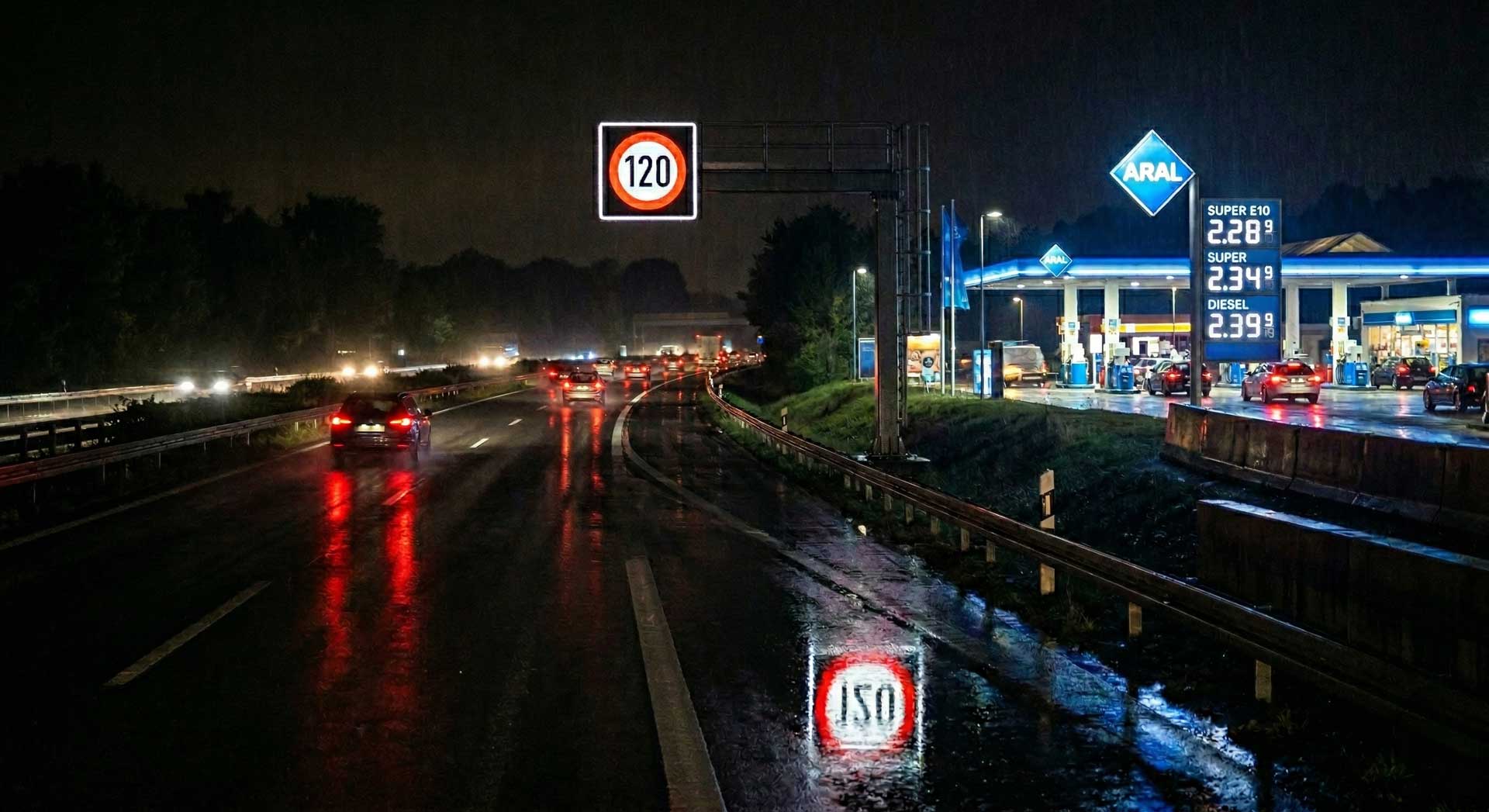
The ink on the fuel price law was barely dry. One price increase per day, at noon, no exceptions. The logic was clear: limit the chaos of hourly price swings, force transparency, protect consumers.
Now a second measure is being debated: a speed limit. 120 km/h on motorways. The logic is equally clear: lower speeds mean lower fuel consumption, lower demand, less pressure on an oil market already strained by a war in the Persian Gulf.
Both are defensible. The first was passed with a parliamentary majority. The second is presented as the logical next step — pragmatic, evidence-based, a natural complement to the first.
Together, they are something else.
The First Law
The April 1 regulation synchronized the market without coordinating it. Every petrol station raises prices once a day, at noon. Not because they agreed. Because the structure now gives them one permitted window and a shared incentive to maximize it.
The clock did the cartel's work. Without a meeting. Without liability.
What the first law left untouched: the oligopoly structure of the fuel market. The shared interest of refiners and distributors in margin preservation. The fundamental pricing logic of a market with inelastic demand — where fewer buyers don't automatically mean lower prices; they mean higher prices per transaction.
The Second Law
A speed limit would reduce fuel consumption. This is physics. At 120 km/h instead of 140, a car burns roughly 10–15% less fuel per kilometer. Aggregate demand falls.
In a competitive market with elastic supply, falling demand produces falling prices. That is the intended mechanism.
The German fuel market is not that market.
It is an oligopoly with high fixed costs, shared infrastructure, and a pricing structure already tuned — by the first law — to extract maximum margin from a single daily window. When volume falls, the incentive to protect margin per liter increases. Refiners do not absorb volume loss. They price through it.
A speed limit would remove buyers from the market. The fuel price law would ensure the remaining buyers pay the optimized price.
The PI doesn't wait for the law to pass. The market prices in expected volume reduction the moment the debate becomes serious. The synchronized clock is already running.
The Structural Turn
Each measure is designed to reduce the burden on consumers.
The first law: by making prices more predictable. The proposed second law: by making consumption cheaper.
The interaction: the first law created a synchronized daily price spike. A speed limit would reduce the volume over which that spike is distributed — concentrating the margin pressure into fewer transactions at the same optimized level.
The result would not be the sum of two interventions. It would be their structural product.
This is what Paradoxical Interactions look like at scale: not a single rational actor doing something irrational, but two rational policy decisions — one passed, one still being debated — already producing a combined dynamic that neither analysis predicted and neither institution owns.
The second law doesn't need to exist to have structural consequences. The debate is enough.
The PI Named
The Second Law PI: A regulatory intervention already in force and a second one merely under discussion interact structurally to produce an escalating outcome — because the market prices in anticipated volume reduction before any law is passed.
Everyone acts rationally:
- The legislature (law 1) — limits price volatility to protect consumers (rational: transparency, fairness)
- The legislature (law 2, proposed) — plans to reduce consumption to lower demand pressure (rational: conservation, affordability)
- Each petrol station — maximizes its single permitted daily increase against an already anticipated shrinking pool of transactions (rational: margin preservation under expected volume pressure)
- The refining industry — prices in expected volume loss with no structural incentive to absorb it (rational: shareholder return, cost recovery)
- The consumer — adjusts driving behavior in anticipation of the limit, tanks less, pays more per liter each time (rational: adaptation to policy signals and new price rhythm)
- The Bundeskartellamt — enforces the first law correctly and has no mandate over the structural interaction with a law that doesn't yet exist (rational: applies the rules as written)
All are guilty. None are at fault.
Navigation
The word for this is not "stupidity." Stupidity implies a failure of intelligence. What is happening here is a failure of structure — which is worse, because it is not correctable by smarter people.
The first law was analyzed independently. It passed its own cost-benefit review. It had a defensible theory of change. The second is being analyzed the same way — independently, on its own terms, against its own metrics.
The interaction between them is nobody's mandate to assess.
This is the standard operating mode of governance in complex systems: interventions are designed, evaluated, and implemented in isolation. The system they enter is not isolated. It is a network of interdependencies, each with its own structural logic, each capable of absorbing an intervention and redirecting its energy.
The fuel market has already absorbed the first law and produced synchronized daily margin spikes. It is already pricing in the debate about the second. If the speed limit passes, it will absorb that too — and produce higher per-liter margins on lower volume, delivered once daily at maximum coordination efficiency.
The debate itself is the second law. The vote is a formality.
Try and continue.
Related Posts
How Luhmann Refutes Himself. And Why It's Urgently Necessary.
The Phenomenon of Coupled Oscillators
How Every Solution Becomes the Next Problem
Why truth-tellers get ignored until it's too late
On piinteract.org
- Examples: Systems & Governance — The structural conditions under which regulatory interventions produce the outcomes they were designed to prevent.
- Anti-Practices — What not to do when the structure doesn't change.
- Framework — Why rational actors and collective irrationality are not contradictions.
Paradoxical Interactions (PI): When rational actors consistently produce collectively irrational outcomes — not through failure, but through structure.
All are guilty. None are at fault.
Peter Senner Thinking beyond the Tellerrand
contact@piinteract.org
https://piinteract.org
Co-created with Claude (Anthropic) — two incomplete systems making each other's gaps visible.