

The structure that predicts its own impossibility — and then exists anyway
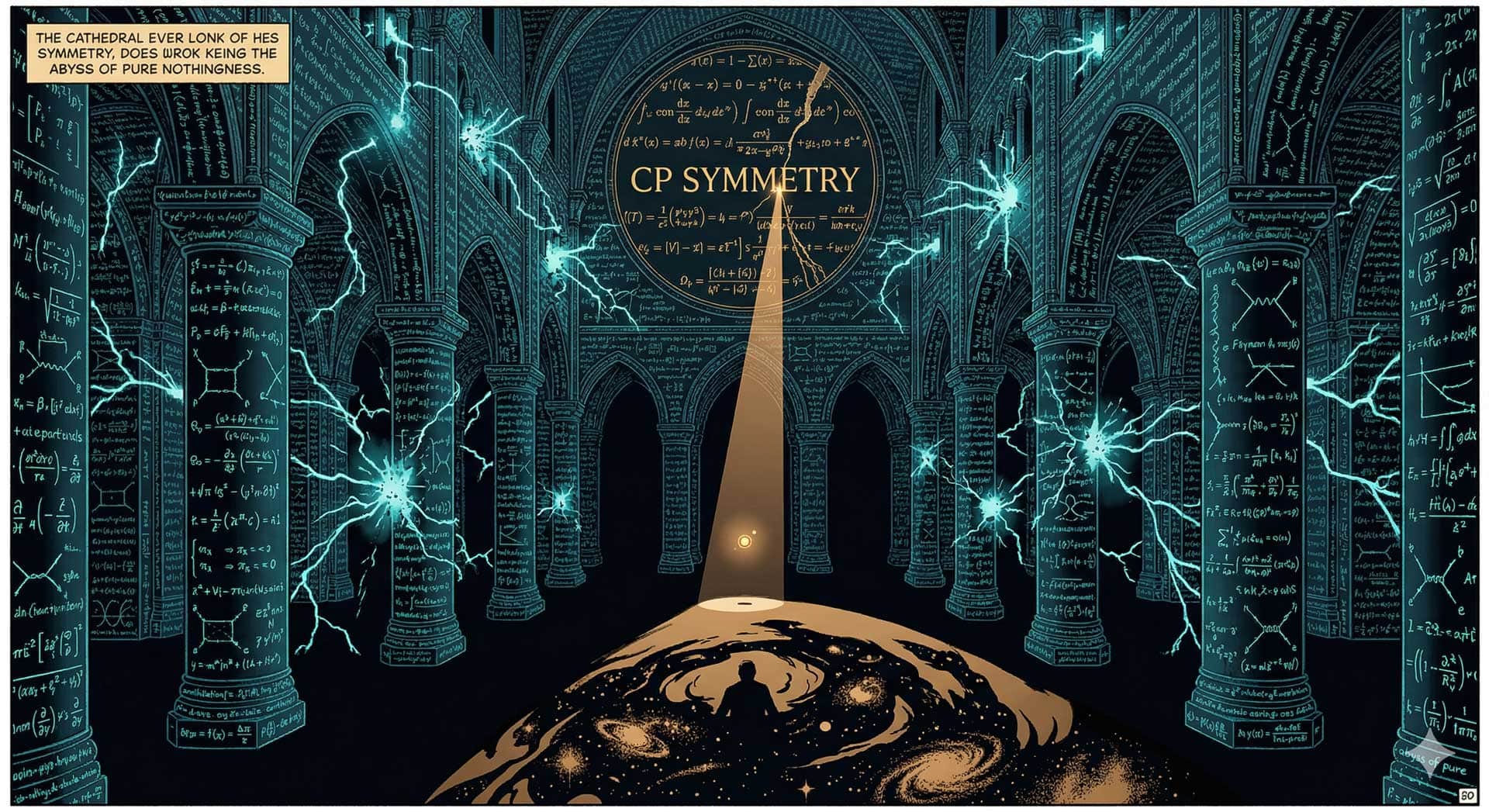
“Paradigms are not corrigible by normal science at all”
— Thomas S. Kuhn
23. February 2026
Peter Senner co-created with Claude
This one is different.
Dark Matter is a PI about searching for something that might not be there. The graviton is a PI about building theory around something that can't be tested. Both are structural traps within physics.
Antimatter is a PI about existence itself.
The problem no one can solve
The Big Bang should have produced equal amounts of matter and antimatter. This isn't speculation. It's what the physics says. Symmetry demands it. Every equation confirms it. The Standard Model — the most precisely tested theory in the history of science — predicts it.
Matter meets antimatter. They annihilate. Pure energy. Nothing left.
No protons. No atoms. No stars. No planets. No oceans. No life. No physicists. No Standard Model. Nothing.
And yet: here we are. Here is everything. Every galaxy, every atom in your body, every thought you've ever had exists because something broke the symmetry. Something gave matter a tiny edge over antimatter — roughly one part in a billion. For every billion antimatter particles that annihilated with their counterparts, one matter particle survived.
You are the rounding error of the universe.
The question is: what broke the symmetry?
The honest answer, after decades of research: we don't know. We have a name for it — baryogenesis. We have conditions for it — Sakharov's three conditions, proposed in 1967. We have candidates — CP violation, leptogenesis, electroweak baryogenesis.
None of them work well enough.
CP violation exists. It's been measured. It's real. But it's not enough. The amount of CP violation observed in particle physics is orders of magnitude too small to explain why the universe exists. It accounts for a tiny fraction of the asymmetry needed.
The Standard Model predicts its own non-existence. And then fails to explain why that prediction is wrong.
The structure of the paradox
Here's where it becomes a PI.
The Standard Model is, by every measurable standard, the most successful theory ever constructed. Its predictions match experiments to twelve decimal places. The Higgs boson — predicted in 1964, confirmed in 2012 — was a triumph of theoretical physics. The magnetic moment of the electron, calculated and measured, agrees to one part in a trillion.
This theory says the universe shouldn't exist.
And physics responds by saying: "The theory is correct. There must be something beyond it that we haven't found yet."
Not: "Maybe the theory is incomplete in a fundamental way." Not: "Maybe the framework itself is the problem." But: "The theory is right, and reality needs an extension."
This is structurally identical to Dark Matter. The model works too well in too many places to question the part that doesn't work. The failure isn't interpreted as a failure of the framework — it's interpreted as a gap within the framework. Something to be filled. Not something that questions the foundation.
Every actor is rational:
The experimentalist at CERN measures CP violation with increasing precision. Finds it's not enough. Publishes the result. Designs a more precise experiment. Rational.
The theorist proposes extensions — new sources of CP violation, new mechanisms, new particles. Each proposal generates predictions. Each prediction requires experiments. Rational.
The institution funds the search. The question "why does anything exist?" is both profound and fundable. It justifies accelerators, detectors, entire research programs. Rational.
The field treats the problem as solvable. "We just need to find the mechanism." Not "maybe our framework can't contain this." Because a solvable problem sustains a field. An unsolvable one dissolves it. Rational.
Collectively: a structure that treats its own deepest failure as a research opportunity rather than a foundational crisis.
Gödel in the Big Bang
This is where it gets uncomfortable.
Gödel's incompleteness theorem says: no sufficiently powerful formal system can prove all truths about itself from within. There will always be true statements that the system cannot derive.
The Standard Model is a formal system. An extraordinarily powerful one. And it has encountered a true statement it cannot derive: why anything exists.
This isn't a gap to be filled with a better experiment. This might be a Gödelian limit — a point where the framework encounters its own incompleteness and cannot, by its own rules, overcome it.
But acknowledging this would mean acknowledging that physics has structural limits. Not technical limits. Not funding limits. Not "we need a bigger accelerator" limits. Limits in principle. Limits in what a mathematical framework of this type can and cannot explain.
The structure cannot process this. Not because physicists are intellectually incapable of understanding Gödel — they understand it perfectly well in mathematics. But applying it to their own framework would mean accepting that the question "why does the universe exist?" might not have an answer within physics.
And a question without a possible answer doesn't generate experiments, doesn't justify funding, doesn't sustain careers, and doesn't get published.
So the question stays open. Classified as "unsolved" rather than "possibly unanswerable." The distinction is structural, not intellectual. "Unsolved" keeps the lights on. "Unanswerable" turns them off.
The deepest anti-practice
This is "The Right Tool Will Fix This" at cosmic scale.
The assumption: the Standard Model is the right framework. It just needs extension. More particles, more symmetry breaking, more mechanisms. The framework isn't wrong — it's incomplete. And incompleteness is temporary.
But what if it isn't? What if the Standard Model's inability to explain its own existence isn't a bug to be patched but a structural property of the framework itself?
Gödel didn't show that mathematics has unsolved problems. He showed that mathematics has unsolvable ones — from within. The difference is everything.
Physics has spent decades treating the matter-antimatter asymmetry as an unsolved problem. The structural question is whether it might be an unsolvable one — unsolvable not because we're not smart enough, but because the framework that poses the question cannot contain the answer.
Every extension proposed — supersymmetry, leptogenesis, new physics beyond the Standard Model — operates within the same structural logic. More particles. More symmetry. More mathematics of the same type. If the limit is Gödelian, then more of the same doesn't help. It can't. That's what Gödelian means.
But "more of the same" is all a structure can produce. Because producing something fundamentally different would require becoming a different structure. And structures don't do that voluntarily.
The hierarchy of denial
Across the three posts, a pattern emerges:
Gluons: Physics encounters unobservability and accepts it. Builds it into the theory. Moves on. Honest structure, honest science.
Dark Matter: Physics encounters non-detection and denies it. Treats forty years of null results as motivation rather than information. The structure sustains itself on the promise of future discovery.
Graviton: Physics encounters untestability and transcends it. Declares mathematical beauty sufficient. The structure no longer requires empirical contact.
Antimatter asymmetry: Physics encounters its own impossibility and reframes it. The theory that predicts non-existence is treated as correct, and existence becomes the anomaly requiring explanation. The structure has inverted the burden of proof: reality must justify itself to the model.
Each step is further from what science claims to be. Each step is a deeper PI.
And the deepest one — the antimatter asymmetry — is the most revealing. Because it shows a structure that has become so successful, so precisely confirmed, so institutionally entrenched, that when it predicts the non-existence of everything, the response isn't to question the structure. It's to question existence.
The question behind the question
Why does the universe exist?
Physics asks this as a technical question: what mechanism broke the matter-antimatter symmetry?
PI asks it as a structural question: can a framework that predicts its own non-existence ever explain its own existence?
The first question might have an answer. Someday. Maybe.
The second question is the one the structure cannot ask. Because asking it means confronting the possibility that the most successful theory in history has a boundary that isn't technical but logical. A boundary that more funding, more accelerators, more brilliant physicists cannot cross — because it's built into the type of framework being used.
And you can't fund that. You can't build a detector for it. You can't write a grant proposal that says: "We request $2 billion to investigate whether our framework is structurally incapable of answering this question."
So the question stays technical. The funding continues. The experiments get more precise. The asymmetry remains unexplained. And the structure — the beautiful, powerful, extraordinarily successful structure — keeps predicting that none of this should be here.
Including itself.
You are the PI
Here's the part that hits different.
Dark Matter is abstract. You can't feel the rotation curves of galaxies. The graviton is theoretical. You've never missed it.
But you? You are the antimatter asymmetry. Every atom in your body is the unexplained residue of a process that the best theory in physics says shouldn't have happened. You exist in the margin of error of the universe. Your morning coffee is a cosmological anomaly.
And the structure that's supposed to explain you... explains everything else. With extraordinary precision. Just not you. Not your existence. Not existence itself.
The universe shouldn't be here. You shouldn't be here. The theory says so.
The theory is correct.
You're here anyway.
All are guilty. None are at fault. Everything exists. Nothing should.
Related Posts:
À propos de l'amplification structurelle :
Why the universe's biggest mystery might be a structural trap
One is honest. Two are not. Physics knows the difference — and pretends it doesn't.
How Sam Altman accidentally delivered the perfect PI — and proved it by delivering it.
The Phenomenon of Coupled Oscillators
How Luhmann Refutes Himself. And Why It's Urgently Necessary.
Why the sharpest structural thinker of his generation proved his own framework — on himself. And why it took a bounty hunter from 1968 to see it coming.
Why every structural analysis of National Socialism performs the exact pathology it analyzes — and why this cannot be fixed from within the analysis.
Why the unresolved tension between relativity and quantum theory is not a gap in physics — but proof that physics works.
Why the solar system is an accident of mutual displacement — and why that is the only kind of stability that lasts.
Why the most famous thought experiment in physics was designed to kill a theory — and became its most enduring proof.
Why String Theory didn't fail physics — and why the structure made sure it couldn't.
Why a structure can make itself permanent without anyone intending it — and why insight changes nothing about the glass.
On piinteract.org:
- ["More of the Same"] — The detector found nothing. Build a more sensitive one. The absence of result becomes proof of method.
- ["Never Change a Winning Team"] — The standard model works. Until the anomalies accumulate faster than the explanations.
- ["This Time Will Be Different"] — New instruments. Same structure. The search continues because the framework cannot accommodate the alternative.
- ["See the Pattern, Not the Symptom"] — The anomaly keeps recurring because the pattern is never named. The symptom is treated. The structure persists.
Per Erratum ad Astra — through error to the stars.
But only if you're allowed to call the error what it is.
Peter Senner
Thinking beyond the Tellerrand
contact@piinteract.org
www.piinteract.org